The noise of the station seemed to disappear.
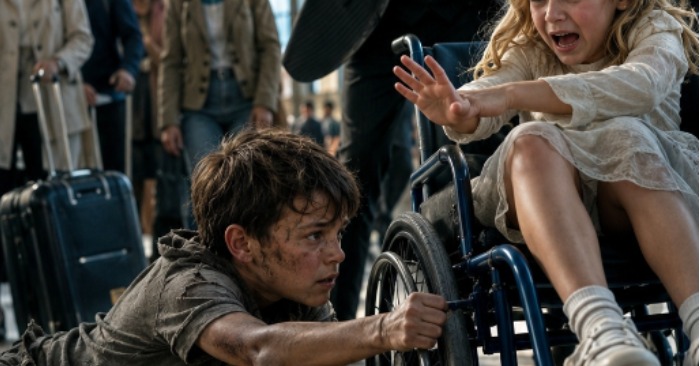
The wheelchair had stopped just inches from the boy.
The girl was breathing heavily, her hands digging into the armrests.
Her father still stood behind her, stiff, furious, his face red with shame and anger.
“Are you crazy?” he shouted.
The boy didn’t answer.
He tried to stand up, but his legs trembled.
One of his hands was scraped from hitting the ground.
Even so, he pointed at the right wheel.
“Don’t push it anymore.”
The father clenched his teeth.
“Don’t tell me what to do with my daughter.”
The girl, who hadn’t spoken until then, whispered:
“Dad…”
He leaned toward her.
“I’m here, sweetheart.”
But she wasn’t looking at him.
She was staring at the wheel.
“I felt something strange.”
Her father froze.
“You got scared.”
The girl shook her head.
“No. The chair was pulling to one side.”
The boy nodded quickly.
“Because the support is loose.”
A station worker approached.
“What’s going on?”
The father pointed at the boy.
“This kid threw himself at my daughter.”
“To stop her,” the boy replied.
His voice trembled.
But it didn’t break.
A man from the crowd crouched beside the wheel.
He looked underneath.
And his expression changed.
“There’s a loose piece.”
The father turned toward him.
“What?”
The man picked up a small metal nut from the floor.
“This shouldn’t be here.”
The girl covered her mouth.
The boy let out a deep breath, as if someone had finally seen what he had been trying to say.
“If she had gone all the way down the ramp like that, the wheel could’ve bent.”
The station worker crouched down too.
Checked the support.
Then looked up.
“He’s right.”
The silence became heavy.
The father slowly released the wheelchair handles.
His face began to change.
Not completely.
There was still pride.
Still anger.
But underneath appeared something worse.
Fear.
The girl looked at the boy.
“How did you notice?”
He lowered his eyes.
“By the sound.”
“The sound?”
The boy nodded.
“My brother used a wheelchair. When a wheel was damaged, it sounded different.”
The sentence changed the atmosphere.
The crowd stopped whispering.
The father blinked.
“Your brother?”
The boy swallowed hard.
“Yes.”
Pause.
“One time nobody checked his.”
The girl stopped breathing for a second.
“What happened?”
The boy looked down.
He took too long to answer.
And that pause said almost everything.
“He fell.”
Silence.
Brutal silence.
The girl gripped the armrests tightly.
The father lowered his eyes.
For the first time, he didn’t see a dirty boy blocking the way.
He saw someone who had run straight toward the greatest fear of his life just to stop it from happening again.
“I’m sorry,” the girl whispered.
The boy shook his head.
“It wasn’t your fault.”
Then he looked at her father.
“But you were going too fast.”
The man stiffened.
“There were too many people. We had to catch the train.”
“She told you something was wrong.”
The blow landed directly.
The girl looked at her father.
Her eyes filled with tears.
“I told you twice.”
The father closed his eyes.
He remembered.
Of course he remembered.
She had said, “Dad, wait.”
He had answered, “It’s fine.”
She had said, “The chair feels strange.”
He had answered, “Trust me.”
Trust me.
Those words burned now.
The boy continued:
“Sometimes people think helping means pushing harder.”
Pause.
“But sometimes helping means stopping.”
Nobody spoke.
Not the crowd.
Not the worker.
Not the father.
The girl looked down at her legs.
“My dad always pushes.”
The sentence came out softly.
Almost unintentionally.
But everyone heard it.
The father opened his eyes.
“Sofía…”
She didn’t look at him.
“Always.”
The silence became more intimate.
More painful.
The boy, still on the ground, moved aside a little to give her space.
“I didn’t mean to scare you.”
Sofía looked at him.
“You weren’t the one who scared me.”
The sentence hung in the air.
The father covered his face with one hand.
The worker spoke carefully:
“The wheelchair needs to be inspected before it moves again.”
The father nodded.
“Of course. We’ll take it to be repaired.”
Sofía raised her hand.
“No.”
He looked at her.
“What?”
“I want to see what’s broken.”
“Sofía, that’s not necessary.”
“Yes, it is.”
The boy watched her carefully.
Sofía took a deep breath.
“They always tell me I don’t need to see. I don’t need to know. That someone else will handle it.”
Pause.
“And then everyone decides for me.”
Her father froze.
The crowd no longer felt like a crowd.
It felt like a group of witnesses.
Sofía turned toward the worker.
“Can you show me?”
The worker hesitated, then nodded.
He crouched down and carefully explained where the loose support was, how the wheel had started vibrating, and why the ramp could have been dangerous.
Sofía listened to every word.
As if she were receiving something nobody had given her in years.
Information.
Control.
Respect.
The boy watched silently.
Behind her, her father seemed smaller and smaller.
When the worker finished, Sofía looked at the boy.
“What’s your name?”
“Iván.”
“Thank you, Iván.”
He lowered his eyes.
“I didn’t do anything.”
“You stood in front of it.”
The sentence silenced him.
Sofía continued:
“That’s not nothing.”
Iván pressed his lips together.
His eyes filled, but he didn’t cry.
“My brother used to say people look at the wheelchair, not the person.”
Sofía nodded slowly.
“He was right.”
The father knelt beside the wheelchair.
Not in front of Iván.
In front of his daughter.
“I’m sorry.”
Sofía looked at him.
Not with anger.
With exhaustion.
“You always apologize after deciding too quickly.”
He lowered his head.
“I know.”
“I don’t want you pushing me like I’m luggage.”
The father closed his eyes.
That sentence hurt worse than a scream.
“You’re not luggage.”
“Then ask me before moving me.”
The man nodded.
“I will.”
Sofía looked at the ramp.
Then her wheels.
Then her hands.
“And I want to learn how to inspect my chair.”
The father was about to answer immediately.
But he stopped.
Looked at her.
Really looked at her.
“Okay.”
Sofía turned toward Iván.
“Do you know how?”
He hesitated.
“A little.”
“Would you teach me?”
The father looked up, surprised.
So did Iván.
“Me?”
Sofía nodded.
“You saw what nobody else saw.”
The boy swallowed hard.
“Yes.”
Pause.
“I can teach you.”
The train departure echoed through the loudspeakers.
The father glanced toward the platform.
Then at his daughter.
“We’ll miss the train.”
Sofía looked at him.
For the first time, with a small sad smile.
“Then we miss it.”
The father didn’t argue.
It was a small moment.
But for her, it was enormous.
Not arriving.
Not rushing.
Not pushing.
Stopping.
Choosing.
Minutes later, a station technician arrived with tools.
Iván helped point out the damaged piece.
Sofía watched everything.
Asked questions.
Touched the wheel rim.
Learned where to inspect.
Learned what sound to listen for.
Her father stood off to the side.
He didn’t interrupt.
Didn’t correct anyone.
Didn’t give orders.
He simply watched his daughter recover something he hadn’t even realized he had taken away from her.
In the end, once the wheelchair was safe, Sofía rolled herself forward a few feet.
Slowly.
Iván walked beside her.
“If it vibrates, stop,” he said.
“If it sounds strange, I check it,” she answered.
He smiled faintly.
“Exactly.”
Her father followed a few steps behind.
Sofía stopped and turned toward him.
“You can walk with me.”
Pause.
“But don’t push me without asking.”
The man took a deep breath.
“Okay.”
Iván picked up his broken backpack from the floor.
He was about to leave quietly, just as he had arrived.
But the father called out to him.
“Iván.”
The boy stopped.
The man approached.
Pulled money from his wallet.
Iván stepped back.
“I didn’t do it for that.”
The father immediately put the money away.
And for the first time, he understood something.
Not all help can be paid for.
Sometimes it has to be honored.
“Then tell me how I can thank you.”
Iván looked at Sofía.
Then at the man.
“Listen to her when she says something is wrong.”
The father didn’t answer right away.
Then he nodded.
“I will.”
Iván lowered his eyes.
“That’s enough.”
But Sofía disagreed.
“No.”
Iván looked at her.
“You’re also coming tomorrow.”
“To where?”
“To teach me about the wheels.”
Iván blinked.
“Really?”
Sofía smiled a little more.
“Really.”
And that was the first time in a long while that Iván felt what he knew, what he had learned from the pain of losing his brother, could serve for something more than remembering a tragedy.
It could protect someone.
It could help.
It could turn a wound into a tool.
Weeks later, Sofía no longer let anyone move her wheelchair without asking.
She learned to inspect the brakes.
The wheels.
The supports.
She learned to listen to the sounds.
Iván began going to the station in the afternoons, where a mechanic allowed him to help with small repairs.
Not because he was perfect.
Because he paid attention.
Because he knew that one ignored detail could change a life.
And Sofía’s father, little by little, stopped pushing first.
He learned to ask:
“Do you want help?”
Sometimes she said yes.
Sometimes she said no.
And both answers slowly began to hold the same value.
Because that day, in a station full of rushing people, a poor boy didn’t just prevent a fall.
He stopped a harmful way of loving.
He taught that helping is not taking control.
Helping is seeing danger.
Speaking the truth.
And staying long enough for the other person to regain their own control.