The train doors let out a sharp warning beep.
The blind man stood still at the edge of the carriage, one hand resting on his white cane and the other held by the assistant who, just seconds earlier, had seemed completely in control.
But not anymore.
The entire station was watching.
The boy still held onto the man’s sleeve.
He wasn’t pulling him.
He wasn’t pushing him.
He was simply refusing to let him move forward.
“That’s not your train,” he repeated.
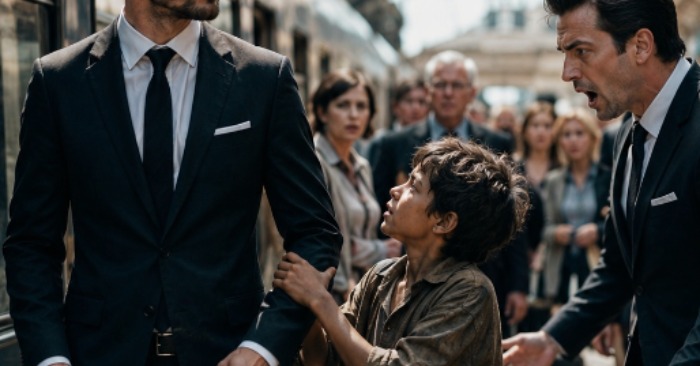
The assistant grabbed him by the shoulder.
“I told you to let go.”
The boy grimaced in pain, but he didn’t back away.
“Not until you look at the ticket.”
The blind man lifted his head.
His voice was deep, tired, but firm.
“Daniel, let him go.”
The assistant froze.
“Mr. Ortega, this boy is trying to take advantage of you.”
“I said let him go.”
The order landed with a strange weight.
The assistant removed his hand.
The boy breathed heavily.
He was twelve years old, carrying an old backpack over one shoulder, his shoes covered in dust. He looked completely out of place among the suits, expensive luggage, and shining watches.
But his eyes stayed fixed on the ticket.
“What’s your name?” the blind man asked.
“Nico.”
“Nico, tell me what you saw.”
The assistant tried to speak.
“Sir, we’re going to miss the train.”
Nico answered before he could.
“That’s the problem.”
Silence.
The nearest passengers stopped moving.
A security guard came running over.
“Do you need help?”
The assistant raised his hand.
“Yes. Remove this boy.”
But the blind man spoke calmly.
“No one removes him yet.”
The guard stopped.
Nico lifted the wrinkled ticket.
“This fell when the man took out his phone.”
“That proves nothing,” the assistant said.
“No,” Nico replied. “But it proves you gave him another one.”
The assistant’s expression changed.
Barely.
But it changed.
And the blind man noticed.
Not with his eyes.
With the silence.
“Daniel,” he said. “What ticket do I have in my hand?”
The assistant swallowed hard.
“Yours, sir.”
“Read it.”
“There’s no time.”
“Read it.”
The man’s voice became harder.
Daniel opened the ticket he was holding.
“Platform seven. Regional train to San Marcos.”
Nico shook his head immediately.
“You weren’t going to San Marcos.”
The blind man turned toward him.
“And where was I going?”
Nico looked down at the wrinkled ticket.
“To Puerto Norte. The twelve o’clock conference. Main hall.”
A murmur spread through the platform.
The blind man tightened his grip on the cane.
“That’s my meeting.”
Daniel closed his eyes.
Only for a second.
But it was enough.
The blind man inhaled slowly.
“Why do I have a ticket to San Marcos?”
Daniel tried to smile.
“It must have been a mistake from the agency.”
Nico raised his voice.
“It wasn’t a mistake.”
Everyone looked at him.
The boy opened his backpack and pulled out an old station ID hanging from a blue ribbon.
“My mom cleans the train cars. I wait for her here after school.”
The guard frowned.
“That doesn’t authorize you to interfere.”
“I didn’t interfere because I was authorized,” Nico said. “I interfered because I saw it.”
The blind man tilted his head.
“What did you see?”
Nico pointed at the floor.
“Mr. Daniel threw away the real ticket after you asked about the platform. Then he put another one in your hand.”
The station seemed suspended in time.
The train beeped again.
The doors began to close.
The assistant spoke quickly.
“He’s making it up. He’s just a kid looking for attention.”
Nico opened his hand.
In his palm, besides the correct ticket, was a small black earpiece.
Daniel went pale.
“That fell too.”
The blind man slowly turned his face toward his assistant.
“Daniel.”
The name came out low.
Dangerous.
Nico swallowed nervously.
“I heard something too.”
The assistant took a step toward him.
The guard blocked him.
“Back up.”
The blind man asked:
“What did you hear?”
Nico looked at Daniel fearfully.
Then back at the man.
“That if you didn’t make it to the meeting, they would sign without you.”
The blind man froze.
Everything in his face changed.
“Sign what?”
Nico lowered his voice.
“I don’t know. But he said, ‘The buildings will be sold before the old man gets there.’”
The platform turned ice cold.
Daniel let out a dry breath.
“Mr. Ortega, he doesn’t know what he’s talking about.”
“No,” the blind man said. “But I do.”
He pulled out his phone.
“Call Clara.”
Daniel tensed.
“I can do it.”
“No.”
The man extended the phone toward the guard.
“Please call the contact named Clara Méndez.”
The guard took the phone and dialed.
A few seconds later, a woman’s voice answered urgently.
“Mr. Ortega, where are you? The meeting already started. They’re saying you authorized the sale of the complex.”
The blind man closed his eyes.
“I authorized nothing.”
Daniel stepped backward.
Nico didn’t fully understand what was happening.
But he understood one thing: he had stopped the right man before he boarded the wrong train.
The blind man spoke into the phone.
“Clara, stop the signing. I’m at Central Station. Someone tried to misdirect me.”
The voice on the other end cracked.
“Sir… if they sign the sale, more than two hundred families will lose their protected housing.”
Nico looked up.
“Families?”
The blind man slowly lowered the phone.
His face had hardened.
“Yes.”
Pause.
“Families like yours, maybe.”
Nico said nothing.
But something in his expression confirmed too much.
The man sensed it.
“Do you live in the San Gabriel complex?”
Nico clutched his backpack tightly against his chest.
“My mom and I do.”
The silence deepened.
Daniel glanced toward the exit.
The guard noticed.
“Don’t move.”
The blind man spoke with icy calm.
“For six months, they told me the complex was empty.”
Nico frowned.
“It’s not empty.”
“They told me the families had already been relocated.”
Nico shook his head.
“My neighbor sleeps with three kids in one room because she doesn’t know if they’re going to throw her out. My mom keeps boxes packed in case letters come.”
The blind man gripped his cane until his knuckles turned white.
“Daniel…”
The assistant said nothing.
“How much did they pay you?”
Daniel lowered his eyes.
He didn’t answer.
He didn’t need to.
The blind man took a deep breath.
For years, he had trusted him.
Daniel read documents to him.
Guided him through airports.
Accompanied him to meetings.
Told him where to sign.
Which door to take.
Which elevator to use.
Which people to expect.
And at some point, that help had become control.
False help.
The kind that decided for him because he could not see.
But this boy, who no one had invited into the situation, had done the opposite.
He hadn’t controlled him.
He hadn’t used him.
He hadn’t decided for him.
He stopped him to give him information.
That was real help.
“Nico,” the man said.
“Yes.”
“Can you take me to the correct platform?”
Daniel lifted his head.
“Sir, you can’t trust him.”
The blind man turned toward his assistant.
“I just trusted you and nearly lost hundreds of homes.”
Daniel fell silent.
Nico looked up at the station clock.
“The train to Puerto Norte leaves in six minutes from platform two.”
The guard spoke.
“I’ll escort you.”
The blind man nodded.
“And him too.”
He pointed toward Daniel.
“But not in front of me.”
Security took hold of the assistant.
Not violently.
Firmly.
Nico walked beside the blind man.
He didn’t grab him.
He didn’t pull him.
He simply said:
“Three steps to the left. Then the floor changes. There’s a tactile line.”
The man stopped.
“You know this place well.”
“My mom says a station speaks if you learn how to listen to it.”
The blind man smiled faintly.
“Your mother is right.”
They walked quickly.
The guard cleared the way.
The noise of the station rose around them again, but to the man, everything suddenly felt different.
For years, he had depended on voices telling him what to do.
But this voice was different.
Nico didn’t command.
He described.
“Small step.”
“Turn right.”
“People ahead.”
“The train is arriving.”
When they reached platform two, the Puerto Norte train was waiting with its doors open.
The station chief, alerted by radio, was already there.
“Mr. Ortega, we’ll take you directly to the meeting hall once you arrive.”
The blind man placed a hand on Nico’s shoulder.
“He’s coming with me.”
Nico’s eyes widened.
“Me?”
“You’re the one who listened when everyone else was in a hurry.”
“But my mom—”
“We’ll call her.”
Nico hesitated.
Not because he feared the trip.
But because he feared stepping outside the place the world had assigned him.
The boy who waits.
The boy who stays quiet.
The boy who watches from the corner.
The blind man seemed to feel it.
“You’re not coming as a favor.”
Pause.
“You’re coming as a witness.”
In Puerto Norte, the meeting was moments away from ending when the doors opened.
The blind man entered with his white cane.
Beside him stood a boy with an old backpack.
Behind them, a station guard carrying the real ticket, the fake ticket, and the earpiece.
The room fell silent.
At a long table, several executives stood up.
One of them attempted a smile.
“Mr. Ortega, we thought you weren’t going to make it.”
“That’s what you hoped.”
No one spoke.
Clara Méndez, his trusted lawyer, approached with tears in her eyes.
“You arrived in time.”
The blind man extended his hand.
“The documents.”
Clara handed them over.
He didn’t sign them.
Not yet.
“Before we talk about buildings, I want to hear from someone who actually lives in them.”
Everyone looked at Nico.
The boy froze.
“I don’t know how to speak in meetings.”
The blind man leaned toward him.
“Then speak like you did at the station.”
Pause.
“Tell them what you saw.”
Nico took a deep breath.
He looked at the executives.
Men in expensive suits.
Perfect folders.
Impatient faces.
And for a second, he thought about his mother silently folding clothes.
About his neighbor packing boxes.
About the children in the building playing without knowing whether their home would still belong to them tomorrow.
Then he spoke.
“The complex isn’t empty.”
Silence.
“Families live there. Elderly people. Children. People who work and come home late. Mothers who can’t sleep because they think they’re about to be thrown out.”
One executive tried to interrupt.
“This is emotional, not legal.”
The blind man raised his hand.
“Let him continue, Nico.”
The boy tightened his grip on his backpack.
“I don’t know about laws. I just know that if you hadn’t arrived today, they were going to sell our home without letting anyone hear us.”
The room went silent again.
The blind man turned toward the table.
“Cancel the sale.”
A wave of murmurs exploded through the room.
“Mr. Ortega, the contracts are already advanced—”
“Cancel the sale.”
“The losses will be enormous—”
“The human losses would be greater.”
Clara smiled through tears.
Nico lowered his head, almost unable to believe it.
The blind man continued:
“And I want a complete audit. Starting with my personal team.”
No one dared answer.
That afternoon, the sale was never signed.
The eviction was stopped.
An investigation was opened.
Daniel lost his position, but more importantly, he lost the quiet control he had built over a man everyone underestimated because he could not see.
Weeks later, Mr. Ortega visited the San Gabriel complex.
Not with cameras.
Not with a prepared speech.
He went with Nico and his mother.
He listened to the families.
Asked their names.
Touched cracked walls.
Climbed slow staircases.
Learned the sound of the courtyard where the children played.
And in the end, he said something no one forgot:
“They told me this was property. But it’s a home multiplied by two hundred lives.”
The complex was renovated without forcing out its residents.
Nico received a railway scholarship and later another one to study accessible urban planning.
His mother kept working for a while, but no longer as an invisible woman in a station nobody noticed.
Mr. Ortega hired her to direct a station guidance program for elderly people, blind passengers, and lost children.
Because she had taught Nico the most important thing of all:
seeing does not always depend on the eyes.
Sometimes it depends on attention.
And that day, in a station full of people rushing everywhere, a poor boy did not stop a blind man to bother him.
He stopped him to return his right to decide with the truth in his hands.
Because helping someone is not leading them where you want them to go.
Helping is making sure they arrive where their voice, their heart, and their choices still matter.