The silence in front of the theater was absolute.
The girl was still holding the locket in her hand.
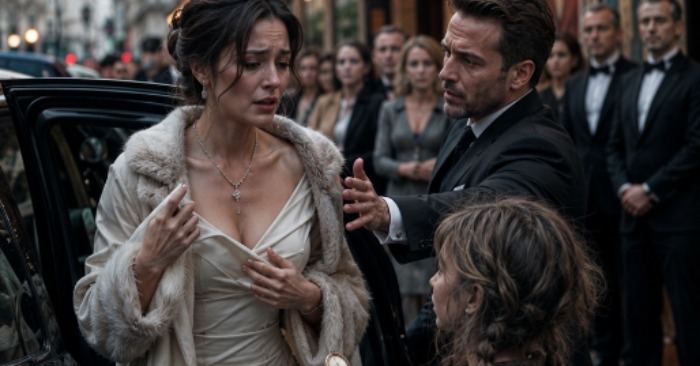
The actress was halfway out of the black car, one foot on the red carpet and one trembling hand against the door.
For five years, no one had heard her voice.
Not journalists.
Not directors.
Not admirers.
Not even the employees in her own home.
The great Isabel Vega, the actress who had once filled entire theaters simply by appearing beneath a white light, lived trapped in a silence everyone called trauma.
But now she had spoken.
A single word.
A name.
“Marina…”
The girl swallowed.
“She was my mother.”
Isabel’s representative immediately stepped forward.
“This is absurd. Mrs. Vega, let’s get back in the car.”
Isabel did not move.
Her eyes remained fixed on the locket.
It was small.
Golden.
Worn at the edges.
With a thin crack down the center.
But to her, it was not an object.
It was a door.
A door someone had kept closed for years.
The girl took a step toward her.
“My mom said that if you didn’t speak, I had to sing this to you.”
The representative stretched out a hand to stop her.
“Don’t come any closer.”
Isabel slowly turned toward him.
And she spoke again.
With a broken voice.
Low.
But clear.
“Let her.”
The crowd reacted with a muffled murmur.
Some covered their mouths with their hands.
Others began to cry without fully understanding why.
The representative went rigid.
“Isabel, please…”
She looked at him.
“I said let her.”
The man lowered his hand.
The girl approached slowly.
She was about nine years old.
Her hair tied back carelessly.
Her cheeks marked by the cold.
Her shoes too big for her feet.
But in her eyes there was a determination that did not belong to an ordinary child.
It belonged to someone who had come there with a promise.
“What’s your name?” Isabel asked.
The girl clutched the locket.
“Luna.”
Isabel closed her eyes.
“Marina wanted to name you that.”
Luna stopped breathing.
“You really knew my mom?”
Isabel let out a small sob.
“She was my sister.”
The word fell over the theater entrance like a blow.
Sister.
The photographers lowered their cameras.
The representative turned pale.
Luna frowned.
“My mom said you didn’t want to see her.”
Isabel opened her eyes.
That sentence hurt more than any memory.
“That isn’t true.”
The representative interrupted:
“Mrs. Vega is not in any condition to talk about this.”
Isabel looked at him with a new hardness.
“And you are not in any condition to keep speaking for me.”
The silence grew deeper.
For years, that man had been her public voice.
Her shield.
Her filter.
Her elegant jailer.
He answered for her.
Canceled meetings.
Filtered letters.
Decided who could come close.
And everyone called it care.
Luna lifted the locket.
“My mom kept it until the end.”
Isabel extended her hand.
Her fingers touched the metal.
And in that instant, a memory returned in full.
Two girls hidden behind the stage of an old theater.
Marina singing softly.
Isabel promising that one day they would perform together.
The same locket passing from one hand to the other.
A promise:
“If one loses her voice, the other will sing until she finds it.”
Isabel covered her mouth.
“No…”
Luna opened the locket.
Inside was a tiny photo.
Two girls.
One in a blue dress.
The other with a white ribbon in her hair.
Both smiling in front of a red curtain.
“My mom said you would remember this photo.”
Isabel began to cry.
Not like a celebrity.
Not like a woman used to an audience.
She cried like a sister who had just discovered that the past was not dead.
Only hidden.
“They told me Marina left because she hated me,” she whispered.
Luna shook her head firmly.
“No.”
Pause.
“She came looking for you many times.”
The representative lowered his gaze.
Isabel saw him.
And everything inside her tightened.
“What did you do?”
He tried to hold her gaze.
He couldn’t.
“I only wanted to protect you.”
Isabel let out a broken laugh.
The first in years.
A laugh without joy.
“That word again.”
Luna reached into her bag and pulled out an old envelope.
“My mom wrote this before she died.”
Isabel extended her hand, but the representative reacted.
“No.”
Too quickly.
Too clearly.
The actress froze.
“Why not?”
He did not answer.
Luna took a step back, protecting the envelope against her chest.
“My mom said you would try to take it from me if he was still nearby.”
The crowd held its breath.
Isabel slowly turned toward her representative.
“What does that mean?”
The man tried to smile.
“A confused child repeating things she doesn’t understand.”
Luna raised her voice.
“I do understand.”
Her voice trembled.
But it did not break.
“I understand that my mom died believing her sister had abandoned her.”
Isabel closed her eyes as if the sentence had pierced through her body.
“No…”
Luna continued:
“I understand that she sent letters and never received an answer.”
Pause.
“And I understand that someone returned them without delivering them.”
Isabel opened her eyes.
Her gaze locked onto the representative.
He stepped back half a pace.
It was enough.
“You returned them,” she said.
It was not a question.
The man breathed with difficulty.
“Marina was unstable. Every time she appeared, you got worse.”
“I got worse because you told me she didn’t want to see me.”
“I was trying to spare you pain.”
“You took my sister from me.”
The sentence made everyone freeze.
Even the noise of the street seemed to fade away.
Luna began to cry.
“My mom sang that song every night.”
Pause.
“She said that if you heard it, you would know she never stopped looking for you.”
Isabel took the envelope.
This time no one stopped her.
She opened it with trembling hands.
Marina’s handwriting filled the page.
“Isa, if this letter ever reaches you, I don’t want it to break you. I want it to bring you back. I don’t know what they told you about me, but I never completely left. Every song I sang in the street, every small stage where I performed, every night Luna fell asleep in my arms, I thought of you.”
Isabel could barely breathe.
The letter continued:
“If you no longer speak, don’t believe you lost your voice. Maybe you only hid it somewhere no one could use it against you. But if my daughter sings our song, listen to her. Not for me. For you. Because a voice does not die when it falls silent. It dies when everyone decides to speak in its place.”
Isabel lowered the letter.
The crowd was still there.
But it no longer mattered.
Only Luna mattered.
Only Marina mattered.
Only the voice that had just returned through pain mattered.
The representative murmured:
“Isabel, go into the theater. Don’t do this here.”
She looked at him with a new calm.
“Everyone here saw me stay silent for years.”
Pause.
“Now they’re going to see me speak.”
The man froze.
Isabel turned to Luna.
“Sing again.”
Luna wiped her tears with her sleeve.
“Here?”
“Here.”
The girl took a deep breath.
And sang.
The same melody.
But this time it did not sound like a plea.
It sounded like a key turning inside an ancient lock.
Isabel closed her eyes.
At first, she only listened.
Then her lips began to move.
The crowd stopped breathing.
The representative murmured:
“No…”
But Isabel sang.
Her voice came out weak.
Broken.
Almost unrecognizable.
But it came out.
And when the second line found Luna’s voice, something in front of the theater broke in a beautiful way.
The famous actress and the homeless girl were singing together a song that belonged to two sisters separated by lies.
A woman in the audience began to cry.
A guard lowered his head.
A journalist turned off his camera.
Because for one second, everyone understood that this was not news.
It was grief.
It was help.
It was a girl fulfilling her mother’s final wish.
When the song ended, Isabel knelt in front of Luna.
The expensive dress touched the wet ground.
She didn’t care.
“Forgive me.”
Luna shook her head.
“My mom said you were a victim too.”
Isabel broke down sobbing.
“I should have searched harder.”
“She said the same thing about you.”
The sentence destroyed them both.
Isabel hugged Luna.
At first, the girl went stiff.
Then she clung to her tightly.
As if she were embracing not only an unknown aunt, but the part of her mother that still remained in the world.
The representative tried to leave quietly.
But Isabel raised her head.
“No.”
The man stopped.
“I want my letters.”
He did not answer.
“All of them.”
Isabel’s voice trembled, but it was no longer broken.
“And I want to know how many times Marina came to see me.”
The man lowered his gaze.
The truth had nowhere left to hide.
Days later, entire boxes of undelivered letters were discovered.
Returned messages.
Stored photographs.
Invitations rejected by someone who had no right to answer.
Isabel did not return to the theater that night to receive an award.
She went up on stage only to say one sentence:
“For years, I believed I had lost my voice. Today I discovered it had been managed for me.”
The audience remained silent.
Then she looked at Luna, sitting in the front row with the locket in her hands.
“And it was a little girl who came to give it back to me.”
The applause came afterward.
But Isabel no longer needed it in the same way.
In the months that followed, she left her representative.
Reopened her home.
Read every letter from Marina.
Some made her smile.
Others brought her to her knees.
All of them arrived late.
But not uselessly.
Luna began living with a foster family she had chosen herself, supported by Isabel, without turning love into a new prison.
Isabel did not try to replace Marina.
That would have been another way of erasing her.
Instead, she did something more honest.
She stayed.
She listened.
She learned Luna’s life little by little.
And every evening, before sleeping, Luna sang a fragment of the song.
Sometimes Isabel answered.
Sometimes she only cried.
But she no longer stayed silent because someone else decided for her.
Because that day in front of the theater, a homeless girl did not sing to ask for coins.
She sang to fulfill a promise.
And with an old song, a broken locket, and a trembling voice…
she helped a famous woman recover the one thing no one should ever have taken from her:
her own voice.