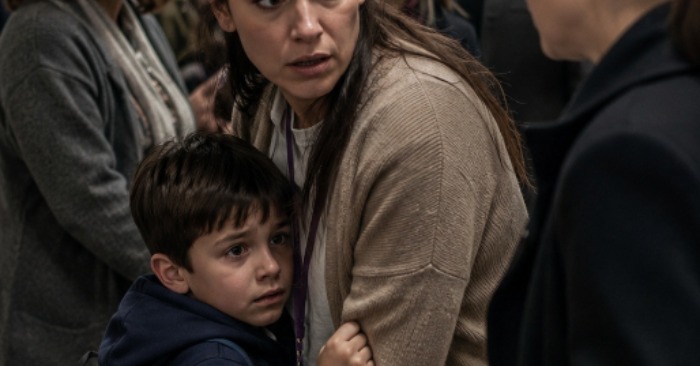
The school hallway froze.
The children stopped talking.
The parents stopped checking their phones.
The principal still held the form in her hand, looking first at the papers and then at the boy.
Everything seemed correct.
The name.
The signature.
The document number.
The authorization.
Even the copy of the ID.
But the boy would not let go of his teacher’s sleeve.
His name was Mateo.
He was seven years old.
Normally, he ran out when the bell rang.
Normally, he talked nonstop.
Normally, he showed his drawings, his stickers, his baby teeth, and every little story that had happened in class.
But that afternoon, he said nothing.
He only trembled.
And that was what Teacher Clara could not ignore.
The elegant woman smiled, although her eyes no longer smiled.
—I understand that you want to protect him, Miss, but I’m authorized. His father asked me to pick him up.
Clara felt the boy grip her sleeve even tighter.
—Mateo, do you know this lady?
The woman answered before him.
—Of course he knows me. He’s nervous because his mother couldn’t come.
Clara didn’t take her eyes off the boy.
—Mateo.
He swallowed.
The principal spoke carefully:
—Clara, the document is complete.
—I know.
—Then we can’t hold the minor without a reason.
Clara looked at the boy’s face.
White.
Closed off.
Trapped.
—We do have a reason.
The woman raised an eyebrow.
—What?
Clara lowered her voice.
—He is afraid.
The sentence fell over the hallway with uncomfortable simplicity.
Some parents looked at one another.
One murmured:
—But if she has papers…
Clara heard him.
And that frightened her more.
Because too often people look at papers when they should look at the person standing in front of them.
The woman took a step toward Mateo.
—Come on, sweetheart. Don’t make a scene.
The boy stepped back.
That movement changed everything.
Clara placed herself in front of him.
—Don’t touch him.
The woman lost a little patience.
—You are making a serious mistake.
—Maybe.
Clara took a deep breath.
—But if I hand him over and I’m wrong, the mistake will be worse.
The principal tensed.
—Let’s call his mother.
The woman answered quickly:
—She isn’t answering. She’s working.
—Then we wait.
—We can’t wait. I’m in a hurry.
Clara looked at her.
—That’s what worries me.
Silence returned.
Mateo was still behind the teacher.
His backpack was open on one side.
When Clara crouched down to calm him, she saw a small keychain hanging from the inner zipper.
It was a little blue plastic house.
Inside, it had a tiny photo.
A woman.
The same one standing in front of them.
But behind the photo, written in childish handwriting, was a phrase:
“The lady in the gray car.”
Clara felt cold.
She didn’t shout.
She didn’t move suddenly.
She only took the keychain carefully and looked at Mateo.
—What is this?
The boy began crying silently.
The woman held out her hand.
—That’s mine.
Clara closed her fist around the keychain.
—I don’t think so.
The principal came closer.
—Let me see it.
Clara showed it to her.
The principal read the phrase.
Her face changed.
The woman clutched her purse.
—That child makes things up. His mother fills his head with nonsense.
Mateo raised his voice for the first time.
—No.
Everyone turned toward him.
The word came out small.
But firm.
Clara crouched beside him.
—Mateo, tell me who she is.
The boy looked at the woman.
Then at Clara.
—She’s the woman who waited outside my house.
The principal stopped breathing.
The woman let out a cold laugh.
—Absurd.
Mateo began speaking faster, as if he were afraid of being interrupted.
—My mom saw her from the window. She was inside a gray car. Then she appeared at the store. Then at the bus stop.
Clara felt her heart pounding.
—Does your mom know she came for you?
Mateo shook his head hard.
—My mom said that if she ever came, I shouldn’t go with her.
The principal immediately took out her phone.
—Close the front door —she ordered the secretary.
The woman took a step back.
—This is illegal.
Clara stood up.
—So is trying to take a frightened child with papers that may not be real.
The woman changed.
There was no sweetness anymore.
No smile.
Only haste.
—The father has a right.
Clara answered:
—Then he can come personally.
The woman looked toward the exit.
The secretary had already closed the inner door.
The school guard was approaching from the courtyard.
The principal called Mateo’s mother’s main number.
Once.
Twice.
Nothing.
Then she called the secondary emergency number.
A breathless female voice answered.
—Mateo? Is Mateo there?
The principal turned on the speaker.
Mateo let go of Clara and ran toward the phone.
—Mom!
The voice on the other end broke.
—My love, are you okay?
—The lady in the gray car came.
The mother was silent for a second.
Then her voice changed completely.
—Do not hand him over. Please, do not hand him over.
The principal went pale.
—Ma’am, we are with him. He is safe.
The woman in the dark coat tried to speak:
—This is a family dispute. I have authorization.
The mother shouted from the phone:
—That woman is not family!
The entire hallway shuddered.
Mateo started crying hard.
Clara hugged him.
—I’m here.
The mother spoke through tears:
—Two weeks ago, he reported a man who was following me. She was with him. I don’t know how she got those papers.
The principal looked at the form as if it now weighed twice as much.
—We’re calling the police.
The woman stepped back again.
—You have no proof.
Mateo raised his head.
—Yes.
Everyone looked at him.
He moved a little away from Clara and opened his backpack with trembling hands.
He took out a drawing.
On the sheet was a house, a gray car, and a woman in a dark coat.
In the corner, there was a date.
The date was ten days earlier.
Clara felt a lump in her throat.
—Why did you draw this?
Mateo wiped his face with his sleeve.
—Because my mom said that if I was afraid, I should draw what I saw.
The woman stopped moving.
The principal took the drawing.
Then looked at the woman.
—You are staying here until the police arrive.
—I’m not staying anywhere.
She tried to walk toward the door.
The guard blocked the way.
—Wait, ma’am.
She tried to push past him.
At that moment, several parents moved away from the exit.
Not to make a spectacle.
To stop her from disappearing.
The same crowd that at first had murmured that “the papers were in order” began to understand that something about that scene had never been right.
The police arrived ten minutes later.
To Mateo, it felt like hours.
During that time, Clara did not let go of his hand.
His mother arrived almost at the same time, running, with her hair messy, her jacket thrown on badly, and her eyes full of terror.
When she saw her son, she dropped to her knees in the middle of the hallway.
—Mateo.
The boy ran to her.
The hug was so strong that no one spoke.
Not the parents.
Not the principal.
Not the officers.
Clara slowly moved away, but Mateo reached a hand toward her.
He didn’t want to let go completely.
His mother noticed.
She looked at Clara.
—Thank you.
Clara shook her head.
—He warned me without words.
His mother cried harder.
—Sometimes no one believes a mother when she says something isn’t right.
The principal lowered her eyes.
The weight of that sentence fell over everyone.
The officers checked the form.
The copy of the ID.
The signature.
The supposed permission.
Everything had been made to look perfect.
But the verification phone number did not match the father.
The signature had differences.
And the woman could not explain why she appeared in the boy’s drawings before that afternoon.
When they took her away to give a statement, the woman looked at Clara.
—You ruined a matter you don’t understand.
Clara held her gaze.
—No.
Pause.
—I listened to a child you expected no one to hear.
The woman did not answer.
Mateo’s mother held her son tightly against her.
Later, in the principal’s office, everything became a little clearer.
Not everything.
But enough.
Mateo’s father had debts.
There were people trying to pressure him.
Someone had obtained information from the school.
Someone had forged an authorization.
Someone had thought that a well-dressed woman, with proper documents and a calm voice, would pass without a problem.
And she almost did.
Almost.
If not for a teacher who decided to look at the child before the paper.
The principal closed the folder with trembling hands.
—We failed by not verifying earlier.
Mateo’s mother didn’t shout.
That was worse.
—My son had to be afraid for you to verify it.
The principal lowered her head.
—You’re right.
Clara looked at Mateo.
He was sitting beside his mother, still hugging his backpack.
—It wasn’t your fault —she told him.
Mateo looked at her.
—I didn’t speak at first.
—But your body did.
He frowned.
Clara smiled sadly.
—Your hands. Your eyes. The way you grabbed me. All of that speaks too.
Mateo lowered his gaze.
—I thought that if I said something, no one would believe me.
His mother closed her eyes.
Clara moved a little closer.
—I believed you.
The boy slowly nodded.
—That’s why I didn’t go.
The next day, the school changed its rules.
A form would not be enough.
A signature would not be enough.
An ID would not be enough.
When someone new came to pick up a child, there would be a direct call to the parents, a family code word, and above all, a question to the child in a safe space:
“Do you want to go with this person?”
The principal gathered all the teachers.
Clara spoke at the end.
She didn’t give a long speech.
She only said:
—A document can lie better than a frightened child. Look at the child.
No one dared to argue.
Weeks later, Mateo began coming into school more calmly.
He still looked toward the door some afternoons.
He still clutched his backpack when he saw dark coats.
But he also searched for Clara with his eyes.
And when he found her, he breathed.
One day he brought her a new drawing.
On the sheet was the school.
The door.
His mother.
Him.
And Clara.
This time there was no gray car.
Clara looked at the drawing and smiled.
—What’s the title?
Mateo thought for a second.
Then wrote in pencil:
“The Door That Didn’t Open.”
Clara had to look away so she wouldn’t cry.
Because that day, in an ordinary school hallway, she didn’t do something great in the eyes of the world.
She didn’t appear on television.
She didn’t chase anyone.
She didn’t solve everything.
She only closed a door at the right moment.
And sometimes the greatest help is exactly that:
not letting someone take a child just because they brought perfect papers…
when his eyes are asking for help.