The garden hung suspended in silence.
The water in the basin kept moving in small circles.
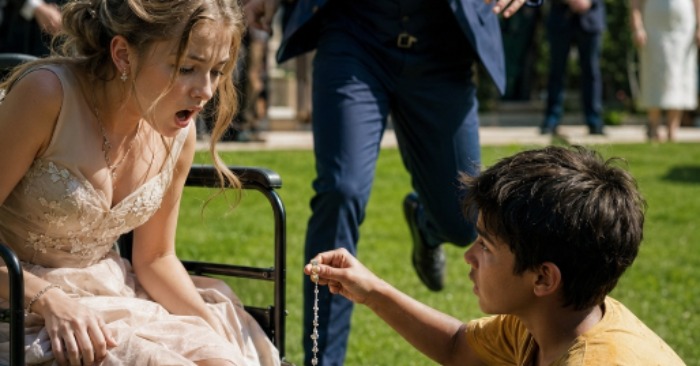
The girl stared at the silver bracelet as if someone had pulled a lost part of her life from the bottom of the water.
The boy held it in his wet palm.
He did not look proud.
He did not look surprised.
He looked sad.
As if he had been waiting for that moment for a very long time.
“That belonged to my mother,” the girl whispered.
Her father came running and stopped a few steps away.
His face was pale.
His breathing broken.
“Give it to me,” he ordered.
The boy closed his hand around the bracelet.
“It isn’t yours.”
The blow was small.
But the entire garden felt it.
The girl slowly turned toward her father.
“Dad… why does he have it?”
The man did not answer.
And that silence was the first crack.
The girl’s name was Valeria.
For two years, she had lived in that chair as if the whole house had learned to speak to her more softly.
No one mentioned certain things.
No one spoke about her mother.
No one touched the old music room.
No one opened the greenhouse door where she had fallen the last time she tried to walk alone.
Everything had become soft.
Too soft.
Too careful.
Too silent.
And in that silence, Valeria had begun to feel less like a daughter and more like a fragile memory.
But now she was there.
Under the sun.
With her feet in the water.
With her toes still trembling.
And a bracelet belonging to her mother in the hand of an unknown boy.
“Who are you?” she asked.
The boy swallowed.
“My name is Mateo.”
“How do you have that?”
Mateo looked at her father.
“My grandmother gave it to me.”
The father closed his eyes.
Valeria saw it.
“Who is your grandmother?”
Mateo answered:
“Rosa.”
Valeria’s face changed.
Rosa.
She remembered that name.
Rosa had worked in the mansion when her mother was alive.
Not like just another employee.
Like someone who entered rooms without making noise, arranged flowers, sewed dresses, listened to secrets, and knew when a little girl needed bread with honey before sleeping.
Rosa disappeared shortly after her mother’s death.
Valeria was told she had gone to the countryside.
That she was already old.
That she no longer wanted to work.
But her father’s expression said something else.
“Rosa left years ago,” Valeria said.
Mateo shook his head.
“She was thrown out.”
The father took a step toward him.
“Enough.”
Mateo did not step back.
He was still barefoot.
His knees were still stained with grass.
But in that moment, he seemed steadier than all the adults in the mansion.
“My grandmother said that if one day you couldn’t stand up, I had to bring you warm water and this bracelet.”
Valeria lowered her gaze to her feet.
“Why?”
Mateo opened his hand.
The bracelet shone beneath the sun.
It had tiny engravings.
So small they could barely be seen.
Valeria stretched out her fingers.
“Let me see it.”
Mateo handed it to her carefully.
Her father spoke immediately:
“Valeria, no.”
She looked up.
“Why?”
He did not answer.
Valeria held the bracelet close to her face.
Then she saw the inscription.
It was not her name.
It was a phrase.
A brief phrase, engraved in delicate letters:
“When you are afraid, follow the water.”
Valeria stopped breathing.
The garden disappeared for an instant.
A memory returned.
Her mother sitting on the edge of a fountain.
Valeria’s feet dipped in cool water.
A laugh.
A warm hand holding her ankle.
The same bracelet closing around her skin.
“Mom used to say that,” she whispered.
Mateo nodded.
“My grandmother said your mother repeated it to you when you were little.”
Her father pressed his lips together.
“That proves nothing.”
Valeria looked at him.
“It proves you knew.”
The silence returned.
Colder.
Harder.
Mateo took a deep breath.
“There’s more.”
Her father spoke in a low voice:
“Not another word.”
But Valeria raised her hand.
“No.”
Pause.
“I want to hear it.”
It was the first time in a long time that her voice did not sound like a question.
Mateo reached into the pocket of his old pants and pulled out a folded piece of paper.
It was protected inside a transparent bag.
“My grandmother said your mother left this for you.”
Valeria reached out her hand.
Her father tried to take the paper first.
But this time Valeria was faster.
“Don’t touch it.”
Her father froze.
Mateo lowered his gaze.
He did not want to enjoy this.
He had not come to destroy a family.
He had come because an old woman had made him promise something before she died.
Valeria opened the paper.
The handwriting was her mother’s.
She recognized it instantly.
Her heart began pounding so hard that the sound seemed to fill the garden.
She read aloud, her voice broken:
“My little Valeria, if you ever spend too long sitting and believing the world ended in your legs, look for the water.”
The girl covered her mouth.
Her father brought a hand to his face.
Mateo remained still.
Valeria continued reading.
“Water remembers what fear erases. When you were little and became frightened, your feet always responded first to warmth, rhythm, and play. Do not let anyone turn your fear into a locked room.”
The letter trembled in her hands.
Her feet did too.
The water in the basin moved.
Valeria felt it.
A small tremor.
Real.
“Again…” she whispered.
Mateo leaned in a little.
“Don’t look at their faces.”
“What?”
“Look at the water.”
Valeria lowered her gaze.
The toes of her right foot made the slightest movement.
Almost nothing.
But it was hers.
Her father took a step back as if he had seen a miracle and an accusation at the same time.
“It can’t be…”
Valeria looked up.
“How long did you have this letter?”
He closed his eyes.
“Valeria…”
“How long?”
The question cut through the air.
The man swallowed.
“Since the day your mother died.”
Valeria let the letter fall onto her lap.
She did not cry at first.
The wound was too large to come out as tears.
“You hid it from me.”
“I wanted to protect you.”
She let out a broken laugh.
“From my mother?”
“From hope.”
The sentence was honest.
And that was why it hurt more.
Her father continued, his voice breaking:
“After the accident, every time you tried to move and couldn’t, you broke. Every time someone said there was a possibility, you went days without speaking. I thought that if I stopped talking to you about moving forward, about trying, about remembering… you would suffer less.”
Valeria looked at him as if she no longer knew who he was.
“And you decided I would live better without knowing what Mom left me.”
He lowered his head.
“Yes.”
The word remained naked.
Without excuse.
Without decoration.
Mateo clenched his hands.
“My grandmother said he would do it out of fear.”
Valeria turned toward him.
“Your grandmother knew everything?”
“Yes.”
“Why didn’t she come earlier?”
Mateo swallowed.
“Because they wouldn’t let her in.”
Her father closed his eyes again.
Valeria turned back to him.
“You forbade her from coming too?”
He did not answer.
But there was no need anymore.
Mateo spoke more softly:
“My grandmother came to the gate every month. She brought flowers. She brought letters. The guards took her away.”
Valeria felt something inside her break with a silent sound.
Rosa had not left.
She had been erased.
Like the letter.
Like the bracelet.
Like her mother.
Like everything that could remind her that before the chair, she had been a girl who loved running toward the water.
“And you?” Valeria asked. “Why did you come?”
Mateo looked at the basin.
“Because my grandmother died three weeks ago.”
Valeria closed her eyes.
“I’m sorry.”
“Before she died, she told me not to let another person be buried alive inside a beautiful house.”
Her father looked up.
The sentence struck him like a verdict.
Valeria looked at the mansion.
The perfect grass.
The clean windows.
The white curtains.
The terrace where everyone spoke softly.
Suddenly, all of it seemed less like a home and more like a display case.
“Buried alive,” she repeated.
Mateo lowered his head.
“I didn’t mean to say it like that.”
“But it’s true.”
Her father approached carefully.
“Daughter…”
Valeria raised her hand.
“No.”
Pause.
“Don’t call me that right now if you’re going to keep deciding for me.”
He stopped.
The gesture cost him.
But he did it.
Mateo picked up the towel from the grass.
“The water is getting cold.”
Valeria looked at her feet.
The right one was still barely responding.
The left was not.
But for the first time in two years, she did not feel that this was a complete defeat.
She felt a door.
Small.
Narrow.
But open.
“What do I do?” she asked.
Mateo shrugged.
“I don’t know everything.”
Pause.
“My grandmother only said that the first step doesn’t start in the leg. It starts when someone stops obeying fear.”
Valeria took a deep breath.
“Then I want to try.”
Her father took an automatic step.
“Valeria, wait.”
She looked at him.
“That is the only thing you’ve asked me to do for two years.”
Pause.
“Wait.”
He fell silent.
“Now I want you to wait.”
Mateo positioned himself in front of the chair.
“You don’t have to stand up.”
Valeria looked at him.
“Then why did you come?”
“So you would know you’re allowed to want to.”
The sentence was simple.
And true.
Valeria cried then.
Not only from sadness.
From anger.
From relief.
From everything they had taken from her with an intention they called love, but that felt far too much like a cage.
“I want to put on the bracelet,” she said.
Her father closed his eyes.
Mateo took the silver bracelet.
“May I?”
Valeria nodded.
The boy knelt again.
Carefully, he fastened the thin chain around Valeria’s right ankle.
The metal was cold.
The water warm.
Her skin trembling.
Valeria breathed as if she had just returned to a room from her childhood.
“Mom used to put it on me before dancing in the garden.”
Mateo smiled faintly.
“My grandmother said you danced terribly.”
Valeria let out a laugh through her tears.
The first real laugh in a very long time.
“That’s true too.”
Her father covered his mouth.
That laugh destroyed him more than any scream.
Because he had not heard it like that in years.
Not like a daughter trying to be strong.
But like Valeria.
Just Valeria.
Mateo stood up.
“Now move your foot as if you were ringing a bell.”
Valeria frowned.
“A bell?”
“The bracelet used to have a little bell. My grandmother said it rang every time you ran.”
Valeria closed her eyes.
The memory returned whole.
The little bell.
The grass.
Her mother laughing.
“Faster, Valeria.”
Her ankle moving.
The small sound.
The open world.
And then her right foot moved again.
More clearly.
More strongly.
Not a step.
Not a cure.
Not an ending.
But yes, an answer.
Her father fell to his knees on the grass.
“Forgive me.”
Valeria did not look at him immediately.
She kept looking at the water.
Her feet.
The bracelet.
The letter on her lap.
Mateo, who seemed too small to have brought so much truth.
“I can’t forgive you today,” she said.
Her father nodded, crying.
“I know.”
“But you can begin.”
“Tell me how.”
Valeria lifted the letter.
“Open the music room.”
Her father stopped breathing.
“Valeria…”
“Today.”
He closed his eyes.
Then he nodded.
“Yes.”
“And call everyone you pushed out of my life.”
“Yes.”
“And never use the word protect again if what you’re doing is hiding the truth from me.”
The man lowered his head.
“Yes.”
Mateo began gathering the basin.
Valeria stopped him.
“Don’t go.”
He looked at her.
“I already brought what I had to.”
“No.”
She touched the bracelet.
“You brought my mother.”
Mateo quickly lowered his gaze.
His eyes filled with tears.
“My grandmother used to say that mothers find strange paths when someone remembers them well.”
Valeria smiled sadly.
“Then your grandmother came too.”
Later, the music room was opened.
The air smelled of closed-up wood and soft dust.
The piano was covered.
The curtains were still.
On one wall there was a photograph of Valeria’s mother dancing in the garden, with a little girl standing on her feet.
Valeria entered in her wheelchair.
But she entered wearing the bracelet.
Her father walked behind her, without pushing her.
He asked first.
“Do you want help?”
Valeria took a moment to answer.
“Not yet.”
And he accepted it.
That was his first real act of repair.
Not doing.
Not ordering.
Not controlling.
Waiting.
Mateo stayed in the doorway.
Valeria looked at the piano.
“Do you know how to play?”
He shook his head.
“No.”
“I don’t anymore either.”
Pause.
“But I can learn again.”
That day she did not walk.
She did not dance.
There was no perfect ending.
But there was something far more important:
the truth returned to the house.
The letter was placed in a frame.
The bracelet stayed on her ankle.
Rosa’s name was spoken aloud again.
And Valeria’s father began calling the people he had pushed away out of fear.
One by one.
With shame.
With apologies.
With few excuses.
Weeks later, Valeria returned to the garden.
The same white basin.
The same grass.
Mateo sitting nearby, this time with new shoes he did not want to wear.
“They’re uncomfortable,” he said.
Valeria laughed.
“Then take them off.”
He smiled and obeyed.
Valeria looked at her feet in the water.
The silver bracelet shone.
She moved her toes.
First one.
Then another.
Not every day did they respond the same.
Not every day was good.
But she no longer lived waiting for permission to try.
And that changed everything.
Because that day, a barefoot boy did not come to the garden to perform a miracle.
He came with a basin, a bracelet, and a promise.
And he reminded a girl trapped inside a perfect mansion that sometimes the cruelest thing is not losing movement.
It is someone hiding the things that could help you believe again.
The water did not save her.
Neither did the bracelet.
The truth saved her.
And when Valeria moved her foot beneath the sun, it was not only her body that responded.
It was the part of her that everyone had tried to keep still…
out of fear of seeing her fall.