“THE ANIMALS CAN’T BREATHE!” the young worker gasped.
George pulled him into the fresh air.
Inside the exhibition tent, dozens of cattle, sheep, and goats were packed into narrow pens beneath a low canvas roof.
The ventilation fans had stopped working.
With the afternoon sun heating the enclosed space, the temperature had climbed dangerously high.
Several animals were panting heavily. Others pressed against the barriers, struggling to find room.
The thumping came from a frightened calf kicking against its pen.
“Open the sides!” George shouted.
The fair’s livestock supervisor immediately halted judging and called the veterinary team.
Workers opened the tent’s ventilation panels while others began moving animals toward shaded outdoor pens.
Charles tried to intervene.
“Those are championship animals! You can’t move them before judging!”
A veterinarian stepped between him and the entrance.
“Your competition is over until these animals are safe.”
The millionaire fell silent.
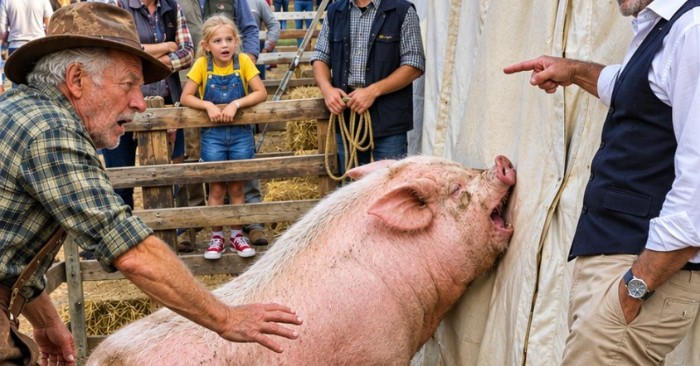
George helped guide a trembling calf into the shade. Roscoe stood nearby, snorting at the unfamiliar animals.
Then a farm assistant discovered that the ventilation system had been switched off earlier that morning.
Its electrical circuit had repeatedly overloaded because the tent contained nearly twice the number of animals approved for the space.
Charles had squeezed in extra livestock from his breeding operation, hoping to dominate every category.
Rather than reduce the numbers, his team had continued operating the overcrowded tent.
The fair organizers suspended his entries and began reviewing the welfare violations.
Fortunately, the veterinary team treated the affected animals promptly. None died, although several required further care.
When the emergency ended, George found Roscoe drinking from a water trough.
The old farmer sat beside him.
“You stubborn old fool,” he whispered. “What would I do without you?”
A veterinarian approached.
“Your pig probably noticed the sounds and smells before we understood something was wrong. We can’t know exactly what alerted him.”
George smiled.
“Whatever it was, I’m glad he made a fuss.”
News of the incident spread through the county.
At the next agricultural committee meeting, farmers demanded stricter inspections, minimum space requirements, functioning ventilation, and emergency plans for every livestock exhibition.
The changes were approved before the following year’s fair.
Charles lost his judging privileges pending the outcome of the welfare investigation.
But George declined the special trophy organizers offered Roscoe.
“He doesn’t need another ribbon,” he said. “Give the money to the local animal shelter.”
One year later, George returned to the county fair.
This time, the livestock tents were spacious, airy, and carefully inspected.
Roscoe, older and slower, stood in a comfortable shaded pen with plenty of fresh water.
A little girl approached and gently scratched his ears.
“Is this the pig who saved the fair?”
George laughed.
“He’s the pig who refused to be quiet.”
The child smiled.
“Then I’m glad somebody listened.”
Roscoe never won a championship ribbon. But his stubborn escape helped change how hundreds of animals would be treated—and that was worth more than any prize.