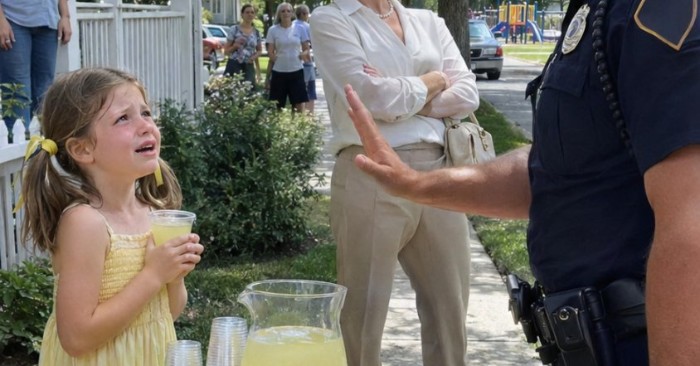
“What did you find?” the officer asked gently.
Emily glanced toward the playground fence.
“Promise you won’t be angry.”
He crouched beside her stand.
“I’m listening.”
Three weeks earlier, the neighborhood playground had been closed after someone stole the new swings, climbing ropes, and several expensive play panels.
The children were heartbroken.
Emily’s little brother cried every afternoon because he couldn’t use his favorite swing.
The neighborhood association announced that replacing the equipment would take months.
So Emily began selling lemonade.
Her notebook contained the names of children who’d offered their allowance money, along with drawings of the equipment they wanted back.
But that wasn’t what frightened her.
“Yesterday, I was looking for my brother’s ball,” she whispered. “It rolled behind the playground.”
She’d squeezed through a gap in the hedge and discovered several large boxes beneath a tarpaulin beside a locked maintenance shed.
One box had fallen open.
Inside was a bright blue swing seat.
The same color as her brother’s missing swing.
“I didn’t touch anything,” Emily said. “I just ran home.”
The officer became serious.
“Did you tell anyone?”
Emily shook her head.
“The man who lives across the street told us the equipment was stolen. I saw his truck near those boxes.”
The officer asked Emily to remain with her mother, who had just come outside, while he contacted his supervisor.
Other officers checked the property and spoke with the neighborhood association.
The truth emerged that afternoon.
The equipment hadn’t been stolen by strangers.
The association’s maintenance contractor had removed it without authorization, intending to sell the valuable pieces and charge the neighborhood for replacements.
The angry neighbor who complained about Emily’s stand was a committee member who had approved the contractor’s work without checking where the equipment went. Investigators found no evidence that the neighbor knew about the attempted sale.
The contractor was investigated, and the equipment was recovered.
When Emily learned that the swings would return, she began jumping with excitement.
“Does that mean I can stop selling lemonade?”
The officer smiled.
“You can. But I have a better idea.”
With her mother’s permission, he brought Emily’s fundraising notebook to the next neighborhood meeting.
The residents were astonished.
While adults had argued over contracts and complaints, one little girl had quietly raised money because she wanted other children to have somewhere to play.
The association refunded the money Emily had collected and worked with the community to create a properly supervised playground fund.
Local volunteers repaired the fence, planted shade trees, and helped restore the play area.
The following month, the playground reopened.
Emily cut the ribbon with a pair of oversized scissors, assisted by her mother.
Then she ran straight toward the bright blue swing.
Her little brother was already waiting.
“Push me!” he shouted.
Emily laughed and gave him a gentle push.
Across the playground, the officer watched with a smile.
Later, Emily asked him whether she’d been wrong to sell lemonade without permission.
He explained that local rules still mattered, but adults could help children find safe, lawful ways to raise money.
Emily nodded thoughtfully.
“Next time, I’ll ask first.”
The officer laughed.
“And next time, I’ll buy two cups.”
That summer, Emily opened another lemonade stand—this time with her mother’s help and the necessary approval.
The proceeds went toward new playground benches.
And on opening day, the same officer arrived as her very first customer.
Emily had only wanted to buy back a swing for her little brother. Instead, her courage helped an entire neighborhood discover what had happened—and reminded the adults that even the smallest voice deserves to be heard.