The dining room became completely still.
Not out of fear.
Because of something worse.
Because of that strange feeling that appears when everyone knows they have just witnessed something impossible.
The old woman had spoken.
A single word.
A name.
Tomás.
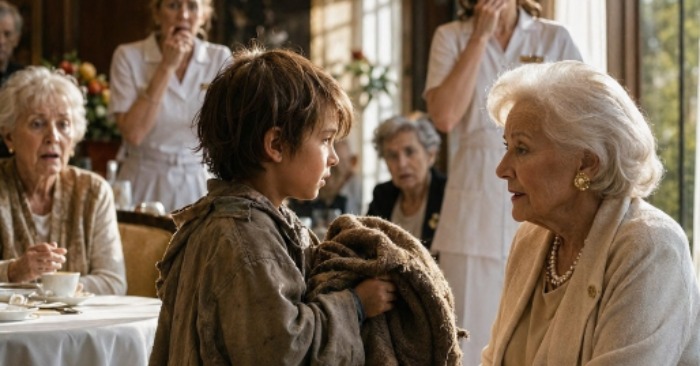
The director, who only seconds earlier had been about to call security, froze with her hand suspended in the air.
The head nurse brought her fingers to her mouth.
“Mrs. Isabel…”
The old woman did not look at her.
Her eyes were fixed on the blanket.
That old, worn piece of faded blue fabric seemed worthless.
But to her, it was like seeing a ghost return.
The boy took another step.
“My mom said you would know what to do with this.”
The director reacted.
“Don’t come any closer.”
But this time, the voice that answered was not the boy’s.
It was the old woman’s.
Weak.
Trembling.
But clear.
“Let him.”
No one moved.
For three years, Isabel Márquez had not spoken a single complete sentence.
Her family paid for the best room.
The best doctors.
The best nurses.
But she spent her days staring out the window, as if waiting for something everyone else had already forgotten.
The boy walked forward slowly.
His shoes were torn.
His small hands were red from the cold, and his eyes were filled with a sadness far too big for his age.
When he reached her, he held out the blanket.
The old woman lifted her hand with effort.
Her fingers touched the fabric.
And then she began to cry.
It was not a loud cry.
It was worse.
It was a silent, ancient cry, as if it had been locked away for decades.
“Where did you get it?” she asked.
The boy swallowed.
“From my mom.”
Isabel closed her eyes.
“What is your mother’s name?”
The boy lowered his gaze.
“Her name was Clara.”
The old woman stopped breathing.
The nurse held her by the shoulder.
“Mrs. Isabel…”
But she did not take her eyes off the boy.
“No…” she whispered. “It can’t be.”
The boy opened a small cloth bag he wore across his chest.
He took out a photograph folded into four.
He handed it to her.
Isabel took it with trembling hands.
The photo was old.
Almost torn at the corners.
In it, a young woman appeared holding a baby wrapped in that same blue blanket.
On the back, written in faded ink, was a sentence:
“So that one day you know I never stopped looking for you.”
Isabel pressed the photo against her chest.
“My son…”
The director frowned.
“Your son?”
Isabel struggled to breathe.
“Tomás.”
The entire dining room listened.
No one dared to interrupt.
“They told me he died when he was a baby,” the old woman whispered. “They told me he hadn’t survived.”
The boy looked at her with a sad calm.
“My mom said that was a lie.”
The sentence landed like a blow.
Isabel opened her eyes.
“What?”
“She said his father never knew who he really was.”
The old woman began to tremble.
“Your grandfather…”
The boy nodded.
“His name was Tomás.”
Silence.
The old woman let out a broken sound.
It was not a word.
It was pain.
It was love.
It was an entire life collapsing in a single second.
“He lived…” she murmured. “My son lived.”
The boy wiped a tear with his sleeve.
“Yes.”
A pause.
“But he died last year.”
Isabel squeezed her eyes shut.
As if the news had pierced straight through her body.
The nurse tried to move closer, but Isabel raised her hand.
She wanted to listen.
Even if it hurt.
Even if it was late.
“My mom cared for him until the end,” the boy continued. “He didn’t know you existed. But before he died, he found a box.”
He took another object from the bag.
A small silver locket.
Old.
Worn.
Isabel recognized it instantly.
She covered her mouth with her hand.
“I put that in the blanket…”
The boy nodded.
“My mom investigated. She searched for months. She found your name. She found this place.”
A pause.
His voice broke.
“But she got sick before she could come.”
The silence grew heavy.
Painful.
The boy held the blanket tightly.
“Before she died, she asked me to come instead.”
Isabel looked at him as if she were no longer seeing a stranger.
She saw a pair of eyes.
A way of pressing the lips together.
A way of staying still when the pain was too much.
Small features.
Fragments of someone lost.
“What is your name?” she asked.
The boy swallowed.
“Mateo.”
Isabel repeated the name quietly.
“Mateo…”
And then she stretched out her arms.
Not much.
She could not.
But enough.
The boy hesitated.
The director seemed about to intervene.
The nurse slowly shook her head.
No.
That moment was not to be touched.
Mateo came closer.
Slowly.
And when the old woman embraced him, the blanket remained between them, as if it were finally closing a circle that had taken an entire lifetime to complete.
Isabel cried against his hair.
“You came late…” she whispered.
Mateo closed his eyes.
“My mom said you would say that.”
The old woman pulled back slightly.
“And what else did she say?”
Mateo looked at her.
With tears.
But also with a small, beautiful strength.
“That it wasn’t too late if you could still hug me.”
Isabel completely broke down.
The nurse was crying too.
Several residents wiped their eyes.
The director, who minutes earlier had wanted to throw the boy out, lowered her gaze in shame.
Isabel took Mateo’s hand.
“Are you alone?”
The boy did not answer right away.
And that pause was enough.
The old woman understood.
Her face changed.
Not only with sadness.
With decision.
For the first time in three years, Isabel Márquez no longer looked like a woman waiting for the end.
She looked like someone who had just found a reason to keep going.
“Prepare my office,” she said.
The director blinked.
“Your office?”
Isabel raised her gaze.
Firm.
“And call my lawyer.”
Everyone froze.
“Mrs. Isabel, perhaps you should rest—”
“I have rested too much.”
The sentence filled the dining room.
The old woman squeezed the boy’s hand.
“This child is my family.”
Mateo opened his eyes.
“I didn’t come for money.”
Isabel looked at him with immense tenderness.
“I know.”
A pause.
“That is why you deserve something much more important.”
The boy frowned.
“What?”
Isabel smiled through her tears.
“A home.”
The entire dining room fell silent.
But it was no longer a silence of shock.
It was a silence of witnesses.
Of people watching how an old blanket, almost without value, had given a woman back her voice, her memory, and her blood.
That afternoon, for the first time in years, Isabel did not ask them to close the curtains.
She asked them to open them.
She wanted light.
She wanted air.
She wanted to see Mateo’s face clearly while he told her everything he knew about his father.
And he told her.
He spoke to her about Tomás.
About how he fixed old radios.
About how he sang off-key.
About how he kept the blue blanket like a treasure without knowing why.
Isabel listened to every word as if she were recovering pieces of a son who had been stolen from her.
She could not watch him grow up.
She could not embrace him.
She could not tell him the truth.
But in Mateo’s eyes, she found a continuation.
A small miracle.
Human.
Imperfect.
Real.
From that day on, the chair by the window was no longer alone.
Mateo came every afternoon.
Sometimes he read.
Sometimes he listened.
Sometimes he simply sat beside her, with the blue blanket folded across both their legs.
And every time someone asked how a woman who had not spoken for years had come back to life, the nurse always answered the same thing:
“It wasn’t medicine.
It wasn’t treatment.
It was a boy.
A blanket.
And a truth that arrived late…
but not too late.”