The arena fell silent.
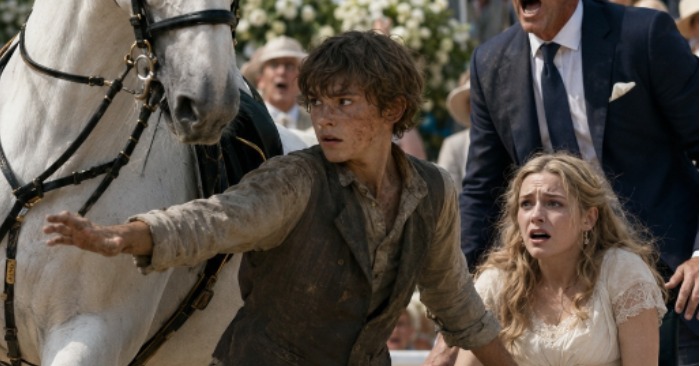
The white horse breathed heavily, its ears tense and its hooves restless against the pale sand.
The guests, dressed in expensive suits and elegant hats, watched from the stands, unsure whether they had just witnessed an accident being prevented… or a scene nobody had planned.
In the center of the arena, a small boy stood between the horse and the wheelchair.
He wasn’t wearing a fancy uniform.
Just a worn shirt, dusty pants, and old boots far too big for his feet.
But he wasn’t shaking.
At least not because he feared the horse.
He was shaking from the anger of seeing something everyone else refused to look at.
“Move,” the girl’s father ordered.
The boy didn’t move.
“Listen to her first.”
The father stepped toward him.
“Don’t tell me how to care for my daughter.”
The girl looked up.
She was twelve years old, with a light dress over her legs and a thin blanket covering her knees.
Her face was pale.
But her eyes weren’t on the horse.
They were on her own foot.
“Dad…” she whispered.
He leaned toward her.
“It’s okay, sweetheart. It was just the animal. It scared you.”
She slowly shook her head.
“It wasn’t the horse.”
The boy turned to her.
“Say it.”
The girl swallowed.
“I felt my leg.”
The air seemed to vanish from the arena.
The father closed his eyes for a moment.
“No.”
A quick word.
Automatic.
Too quick.
The girl looked at him.
“Why do you always say ‘no’ before listening to me?”
The audience became completely still.
The horse took a small step, but the boy lifted his hand and spoke to it calmly.
“Easy, Atlas. Easy.”
The head trainer approached from the side.
“How do you know his name?”
The boy didn’t take his eyes off the horse.
“I clean his stable.”
The father let out a bitter laugh.
“Then go back to cleaning it and leave this moment to the adults.”
The girl lowered her gaze.
The boy didn’t.
“The adults almost made her fall.”
The blow landed hard.
Several guests murmured.
The trainer looked at the wheelchair wheel.
It was too close to an uneven patch of sand, where the ground dipped by just a few inches.
For someone walking, it was nothing.
For a wheelchair, it could be enough.
“The arena isn’t level here,” the trainer said, surprised.
The boy nodded.
“And the horse felt it before you did.”
The father looked at the ground.
Then at the horse.
Then at his daughter.
But he was still trapped inside his pride.
“This was a charity presentation. Just a photo.”
The girl looked at him through tears.
“I am not a photo.”
The sentence cut through the arena.
It wasn’t a shout.
It didn’t need to be.
The father froze.
The boy took a deep breath.
“The horse got restless because she tensed.”
The trainer frowned.
“How do you know that?”
“Because my mother worked in equine therapy.”
The girl lifted her head.
“Equine therapy?”
The boy nodded.
“She helped children who couldn’t walk well. She said horses feel things before people do.”
The father stiffened.
“That has nothing to do with her.”
The girl looked at him.
“Are you sure?”
Silence.
The boy took a step toward the chair.
He stopped before touching it.
“May I check the wheel?”
The girl nodded.
“Yes.”
The father opened his mouth, but she raised her hand.
“I said yes.”
That small act seemed to move more than the wheel.
The boy crouched down.
He checked the ground.
The slope.
The gathered sand.
Then he looked at the girl’s right foot.
“When the horse came closer, you curled your toes.”
The girl stopped breathing.
“How…?”
“I saw it under the blanket.”
The father shook his head.
“It was a reflex.”
The boy looked at him.
“Maybe.”
Pause.
“But a reflex is still a response.”
The trainer lowered his gaze.
He couldn’t argue with that.
The girl started to cry.
“They told me there were no responses.”
The father lowered his eyes.
And that gesture gave him away.
The girl saw it.
“Dad…”
He struggled to breathe.
“It wasn’t that simple.”
“What wasn’t simple?”
The audience remained silent.
No one dared to move.
Even the horse seemed to be waiting.
“After the accident, there were specialists,” the father said. “Some said that maybe, with long therapy, you could recover partial sensation.”
The girl went completely still.
“Maybe?”
“They didn’t want to give you false hope.”
“They didn’t, or you didn’t?”
The father didn’t answer.
The boy lowered his gaze.
He knew that kind of silence.
The silence of adults who believe hiding pain is protection.
The girl gripped the arms of her chair.
“You brought me here so everyone could clap for me for being strong.”
Pause.
“But you hid the only reason I could have tried to be strong for real.”
The father covered his face with one hand.
“I was afraid of watching you suffer again.”
She cried with anger.
“I was already suffering.”
The boy slowly stood up.
“My mother used to say helping isn’t taking away the fear.”
Everyone looked at him.
“It’s staying when someone decides to go through it.”
The girl breathed through her tears.
“Is your mother here?”
The boy’s face changed.
He didn’t need to answer.
The girl lowered her voice.
“I’m sorry.”
He gave a small nod.
“Before she died, she taught me something.”
He turned toward the horse.
“Atlas helped in therapy. Not at galas.”
The trainer’s eyes widened.
“This horse was at a rehabilitation center before he was bought.”
The father turned toward him.
“What?”
The trainer nodded slowly.
“Yes. He was very good with nervous patients.”
The boy looked at the girl.
“That’s why he reacted when you felt something.”
The girl looked at the horse.
No longer with fear.
With an emotion too big for her body.
“Can I touch him?”
The father stepped forward.
“I don’t think—”
She interrupted him.
“I wasn’t asking you.”
The entire arena felt that sentence.
The father went still.
The boy looked at the girl.
“You can. But slowly.”
He gently took the reins and brought the horse a little closer.
Atlas lowered his head.
The girl reached out.
Her fingers touched the animal’s warm muzzle.
And then her foot moved again.
This time, everyone saw it.
A tiny movement.
But real.
A woman in the stands covered her mouth.
The trainer murmured:
“I saw it.”
The father couldn’t speak.
The girl began to cry.
“I felt it again.”
The boy knelt in front of her.
“You don’t have to stand today.”
She looked at him, crying.
“Then what do I do?”
“Believe your body when it says something.”
The girl looked at her leg.
Then at the horse.
Then at her father.
“I want to do therapy.”
The father nodded immediately.
“Yes.”
She shook her head.
“Not just because you feel guilty now.”
He lowered his head.
“No.”
“I want to see all my reports.”
“Yes.”
“And I want to decide for myself.”
The father struggled to breathe.
“Yes.”
The boy stepped aside.
He thought he had done enough.
But the girl called him.
“Wait.”
He stopped.
“What’s your name?”
“Nicolás.”
“Nicolás, can you walk beside me to the exit?”
The boy looked at her father.
For the first time, the father said nothing.
He only nodded.
Nicolás moved beside the chair.
He didn’t push it.
He didn’t touch it.
He simply walked next to her while Atlas moved slowly on the other side.
The girl moved the wheels herself.
Slowly.
Afraid.
But by her own choice.
At first, the audience didn’t clap.
Maybe because they understood this wasn’t a performance.
It was too intimate a moment to turn into noise.
Then someone stood.
Then another.
And another.
But the girl wasn’t looking at the audience.
She was looking at the path.
The ground.
The wheel.
Her hand.
Her foot.
The things that belonged to her.
Weeks later, she began equine therapy.
It wasn’t easy.
There were days of frustration.
Days with no movement.
Days of tears.
But there were also responses.
Small ones.
Real ones.
Nicolás attended some afternoons with permission from the center.
Not as an expert.
As someone who knew how to listen to horses and respect silences.
The father learned to stay to the side.
To ask before pushing.
To stop turning every step forward into a photograph.
And Atlas, the white horse everyone had wanted to use as gala decoration, returned to doing what he knew best:
accompanying someone who was learning to trust again.
Because that day, a poor boy didn’t ruin a presentation.
He saved it from becoming a lie.
And he reminded everyone that helping is not placing someone beneath perfect lights.
Helping is seeing the tremble, stopping the spectacle, and saying:
“Now, yes. We’ll go slowly. But we’ll go with you.”