The bus stop fell silent.
Not completely.
The bus engine was still running.
One door remained open.
An orange slowly rolled until it hit the shoe of a woman standing there with her mouth hanging open.
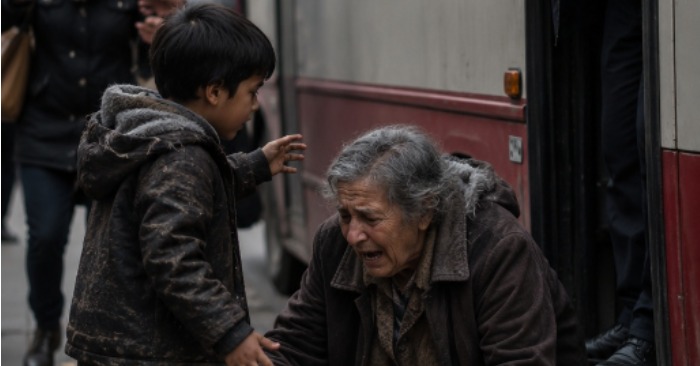
The elderly woman was sitting on the sidewalk, trembling.
The boy stood in front of her with his hands raised.
He didn’t look proud.
He didn’t look defiant.
He looked scared.
Like someone who had done the only thing he could do… and still knew everyone was going to misunderstand it.
—He pushed her! —a man repeated from the line.
The driver stepped off the bus, his face red.
—Kid, are you crazy?
The boy opened his mouth.
But nothing came out.
The elderly woman tried to speak, but she was still breathing heavily.
A torn bag lay beside her knee, crushed bread, oranges scattered across the ground, and one hand pressed against her chest.
—I… —she whispered.
Nobody heard her.
Everyone was looking at the boy.
Like always happens in a crowd: first they look for someone to blame, then they ask questions.
The boy lowered his gaze.
—I didn’t want to hurt her.
—Then why did you pull her? —the driver asked.
The boy pointed at the bus step.
—Because she was about to step there.
Everyone looked.
At first they saw nothing.
Just the black step, worn down by thousands of shoes.
But then the driver leaned closer.
His expression changed.
A small metal piece was sticking out from the edge, raised like a trap.
Right where the elderly woman would have placed her foot.
The driver touched the metal piece.
It moved.
Then he looked at the elderly woman.
Then at the boy.
—My God…
A woman covered her mouth with her hand.
The man who had shouted first lowered his eyes.
The elderly woman started crying.
Not loudly.
Not dramatically.
Her eyes simply filled with tears, and they rolled down her wrinkled face.
—I didn’t see it —she said.
The boy remained still.
—I did.
The driver closed the bus door and turned off the engine.
—Nobody gets on until this is checked.
The atmosphere changed instantly.
One second earlier the boy had been the aggressor.
Now everyone was beginning to understand that maybe, just maybe, they had just yelled at the only person who had prevented a tragedy.
The elderly woman stretched out her hand toward him.
—Come here, son.
The boy hesitated.
He looked at the passengers.
He looked at the driver.
He looked at the elderly woman’s hand.
As if he wasn’t sure anyone could call him that after accusing him.
Finally, he stepped closer.
—What’s your name? —she asked.
—Nico.
—Nico… thank you.
He lowered his eyes.
—I didn’t do anything.
The elderly woman slowly shook her head.
—You held me before I fell.
The boy pressed his lips together.
Those words hurt him.
Not because they were bad.
But because they came from a memory that was still too alive.
—My grandmother didn’t have that —he said.
The elderly woman looked at him gently.
—What happened to her?
Nico took a deep breath.
The crowd was still listening.
But this time nobody interrupted.
—One time she was getting onto a bus. There was a broken step. She said something moved, but the driver was in a hurry.
The current driver lowered his gaze.
Nico continued:
—She stepped wrong. Fell backward. Hit herself hard.
The elderly woman closed her eyes.
—I’m so sorry.
—Since then, I watch the steps.
Pause.
—All of them.
The silence was heavy.
But different.
It was no longer suspicion.
It was shame.
One woman crouched down and started gathering the elderly woman’s oranges.
Another picked up the bread.
A young man offered water.
The scene slowly changed: the same people who had shouted were now helping.
But Nico remained stiff.
As if he didn’t know how to trust such a sudden change.
The driver approached him.
—I’m sorry.
Nico didn’t answer.
—I yelled at you without looking.
The boy raised his eyes.
—Everyone did that.
The sentence hurt because it was true.
The elderly woman took his hand.
—Then all of us need to learn something today.
The driver inspected the step more carefully.
—This could have happened to anyone.
Nico looked at the elderly woman.
—But it almost happened to her.
The elderly woman smiled sadly.
—And you saw it.
An ambulance wasn’t necessary, but a nurse riding on the bus checked the woman. She only had a minor bruise on her knee and a terrible fright.
The next bus arrived fifteen minutes later.
People started moving again.
The elderly woman tried to lift her bags, but Nico stepped forward first.
—I’ll help you.
She looked at him.
—Are you taking this bus?
Nico shook his head.
—No.
—Then?
—I don’t want you getting on alone.
The elderly woman said nothing for a second.
Then she nodded.
—Alright.
Nico picked up her bags.
Before getting on, he stopped at the first step.
He looked at it.
Touched it.
Tested it with his foot.
Then looked up at her.
—Now it’s okay.
The elderly woman started crying again.
—My husband used to do that for me.
Nico looked at her.
—Is he gone?
She nodded.
—He died two years ago.
The boy lowered his gaze.
—My grandmother too.
The elderly woman struggled to breathe for a moment.
—Then today they both sent someone to us.
Nico didn’t know what to say.
He helped her get on.
This time nobody was in a hurry.
Nobody pushed.
Nobody complained.
The driver waited.
The passengers waited.
And when the elderly woman sat down, she placed one of her bags on the seat beside her.
—Sit with me until the next stop.
Nico hesitated.
—I don’t have a ticket.
The driver, from the front, spoke without turning around:
—Today you do.
Nico slowly got on.
He sat beside the elderly woman.
His hands rested on his knees, uncomfortable, as if he didn’t want to take up too much space.
The elderly woman opened her bag and pulled out a mandarin.
—Here.
Nico shook his head.
—You don’t have to.
—It’s not payment.
Pause.
—It’s company.
That word touched him.
Company.
Not charity.
Not a reward.
Not pity.
Company.
Nico accepted the mandarin.
The bus moved slowly forward.
For several minutes they didn’t speak.
Then the elderly woman asked:
—Where are you going?
—To the store where my mom works.
—Is it far?
—Three stops.
The elderly woman smiled.
—Then you’re almost accompanying me home.
Nico carefully peeled the mandarin.
—Do you live alone?
—Yes.
He looked at her.
—Then who helps you with the bags?
The elderly woman let out a small laugh.
—I used to say I could do it myself.
—And now?
She looked out the window.
—Now I think maybe you also have to let someone help sometimes.
Nico nodded.
—My grandmother used to say that.
—What did she say?
—That helping isn’t interfering where you weren’t asked.
Pause.
—It’s showing up when someone still doesn’t know how to ask for it.
The elderly woman fell silent.
Those words hit her deeply.
At the next stop, a woman got on and recognized Nico.
—Out in the streets watching buses again?
Her voice was harsh.
Nico lowered his eyes.
The elderly woman turned toward her.
—This boy just stopped me from falling.
The woman froze.
—What?
—He noticed a broken step when nobody else did.
The woman looked at Nico.
Her expression softened slightly.
—Oh.
She didn’t apologize.
Not everyone knows how.
But at least she stopped looking at him like he was a problem.
When they reached the elderly woman’s stop, Nico stood up immediately.
He got off first.
Checked the step.
Then extended his hand to her.
The elderly woman took it.
—Thank you, Nico.
He carried down her bags.
She searched inside her purse.
—I don’t have much, but—
Nico quickly shook his head.
—I don’t want money.
The elderly woman studied him.
—Then come tomorrow for tea.
He blinked.
—What?
—I live in the building on the corner. Third floor. My name is Teresa.
Nico didn’t know what to say.
Teresa smiled.
—You can come with your mother. So it doesn’t seem strange.
The boy almost smiled.
—My mom likes tea.
—Then it’s settled.
Days later, Nico and his mother went.
Teresa’s home was small, clean, and full of old photographs.
There was a photo of her husband standing beside a bus.
Another showed her as a young woman laughing with a red scarf.
And on the table there were mandarins.
Nico’s mother listened to the whole story.
When Teresa described how everyone had shouted, the mother closed her eyes painfully.
—It’s always the same —she said.
Teresa took her hand.
—That day it changed.
And it was true.
Not for everyone.
Not forever.
But for that bus stop, yes.
The driver reported the broken step.
The transportation company inspected several old buses.
They added a small new rule: if a passenger reports damage, the bus must stop until it is checked.
The driver, ashamed, asked for Nico to be invited to a safety talk at the station.
Nico didn’t want to go.
—I’m not an expert.
Teresa answered him:
—No. You’re a witness.
And he went.
He stood in front of adult drivers with a quiet voice and said:
—My grandmother said something was wrong, but nobody wanted to lose time.
Pause.
—Losing one minute isn’t as serious as losing someone.
Nobody spoke for several seconds.
Then an older driver lowered his head and said:
—You’re right.
From then on, Nico kept watching the steps.
But no longer only out of fear.
Also because he now knew that paying attention could help.
Teresa started waiting for the bus more calmly.
Sometimes Nico accompanied her.
Sometimes he just stopped by for tea.
Sometimes they didn’t talk much.
They only shared mandarins.
And that was help too.
Because that day, a boy didn’t push an elderly woman to hurt her.
He pulled her away from danger while everyone else was too busy rushing to notice it.
And at an ordinary bus stop, on an ordinary morning, among torn bags and oranges rolling across the sidewalk, a crowd learned something that should have been simple:
before accusing someone who acts quickly…
look at what they were trying to prevent.