The yard fell silent.
No one moved.
The black motorcycles remained lined up beside the fence like silent witnesses.
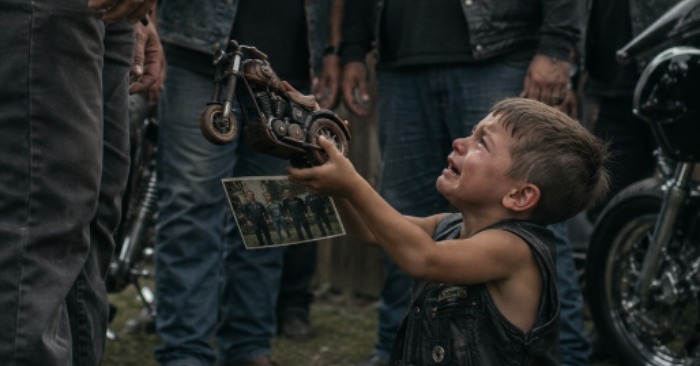
The boy was kneeling on the grass, his cheeks wet and his hands trembling.
In front of him, the huge biker held the little toy motorcycle as if it weighed more than a real machine.
His name was Bruno.
Everyone in the club knew him as a hard man.
Few words.
A heavy stare.
Hands marked by years of road, grease, and fights he preferred not to talk about.
But in that instant, Bruno didn’t look hard.
He looked like a man who had just been handed back a ghost.
—What did you say? —he asked, his voice almost gone.
The boy swallowed.
He slipped his hand into the inner lining of his tiny vest and took out a folded photo.
He had kept it so close to his chest that the paper was warm and wrinkled.
Bruno took it slowly.
He opened it.
And the world stopped.
In the photo was a young woman.
Dark hair.
Light eyes.
A smile he had tried to forget for twenty years and never could.
Isabel.
And beside her, a newborn baby wrapped in a gray blanket.
But it was not just any blanket.
An old patch was sewn onto the fabric.
A club patch.
The same patch Bruno had torn from his vest the night they told him Isabel had disappeared forever.
The biker stopped breathing.
One of the men behind him whispered:
—Bruno…
He didn’t answer.
His eyes were fixed on the photo.
The toy motorcycle was still in his other hand.
The curved handlebars.
The carved tank.
The black stripe along the side.
It was all his.
Every detail.
Years earlier, before becoming the man everyone feared, Bruno used to make little wooden motorcycles in secret.
He made them at night.
Sanded them patiently.
Painted them with a black stripe.
Isabel used to say they were too beautiful to hide.
He would answer that the world didn’t need to know he still had tenderness left in him.
Only she knew.
Only she received those toys.
—What’s your name? —Bruno asked.
The boy wiped his nose with his sleeve.
—Nico.
—Who gave you this, Nico?
—My dad.
The word struck him again.
Bruno closed his eyes.
—What was his name?
—Tomás.
A murmur ran through the bikers.
Bruno didn’t know that name.
That relieved him for half a second.
Then it sank him deeper.
Because if Tomás was not him, then he was the man who had raised the boy.
The man who had been where Bruno had not.
The boy looked at the toy motorcycle.
—My dad said that if something happened to him, I had to come here.
Bruno crouched in front of him.
Not too close.
He didn’t want to scare him.
—What happened to him?
Nico pressed his lips together.
He tried to be strong.
But he was too small to carry such a big story.
—He died.
The entire yard lowered its gaze.
No one asked how.
Not yet.
The pain was too fresh in the boy’s voice.
Bruno took a deep breath.
—And your mom?
Nico slowly shook his head.
—I never knew her.
Bruno looked at the photo again.
Isabel with the baby.
Isabel alive.
Isabel holding a son.
His son.
His throat tightened.
—They told me she died before having the baby.
One of the older bikers, César, lifted his head.
—Bruno…
The tone was strange.
Too quick.
Too loaded.
Bruno turned toward him.
—What?
César didn’t answer.
And that silence was a crack.
Nico opened his little vest and took out another object.
An old key tied with a cord.
—My dad said this key was for you.
Bruno took it.
He recognized it instantly.
It was the key to the club’s old cabinet.
A cabinet that had not been opened in years.
One where they kept old jackets, route photos, and things no one wanted to touch again.
But that key was not supposed to be in a child’s hands.
—Where did Tomás get it?
Nico lowered his gaze.
—He said he found it among my mom’s things.
Bruno slowly stood up.
The yard was no longer just a yard.
It was an open grave.
All the men in the club seemed to feel it.
—Let’s go inside —Bruno said.
Nico stepped back a little.
—I don’t want trouble.
Bruno lowered his gaze toward him.
—They brought it before you arrived.
Pause.
—But you didn’t bring it.
Nico nodded faintly.
They entered the old club hall.
It smelled of leather, wood, cold coffee, and gasoline.
On the walls were photos of old routes, rusty plates, hanging helmets, and worn flags.
Nico looked at everything with enormous eyes.
As if he were entering a place that belonged to a story someone had whispered to him all his life.
Bruno walked to the cabinet at the back.
The metal was scratched.
The lock old.
The key went in with difficulty.
Turned.
The door opened with a dry sound.
Inside were jackets.
Boxes.
Papers.
And a small gray cloth bag.
Bruno took it.
His name was written on it in handwriting that split his chest open.
For Bruno. If he ever stops hating me.
It was Isabel’s handwriting.
The huge man had to brace one hand against the cabinet.
For the first time in years, his legs seemed to fail him.
Nico looked at him with fear.
—Are you okay?
Bruno let out a broken laugh.
—No.
Pause.
—But keep going.
He opened the bag.
Inside were three things.
A letter.
A lock of a child’s hair tied with blue thread.
And another toy.
A wooden motorcycle.
Smaller.
Unfinished.
On the bottom, a phrase was carved:
For our son.
Bruno closed his eyes.
The entire room stayed suspended.
César took a step back.
Bruno heard him.
Without looking, he said:
—Don’t move.
César stood still.
Bruno opened the letter.
His voice trembled as he read.
“Bruno, if this reaches you, it means the lie lasted longer than my strength.”
No one breathed.
“I left because they told me you had chosen the club over us. They told me that if I came back, I would put you in danger. They told me you didn’t want to know about the child.”
Bruno lifted his gaze.
—Who told her that?
No one answered.
But César closed his eyes.
Bruno returned to the letter.
“I didn’t want to believe it. I went to the workshop twice. I asked for you. The second time, César found me outside and told me not to come back. He said you had already moved on with your life.”
The silence was brutal.
Everyone looked at César.
Bruno didn’t move.
The letter kept trembling in his hands.
“When I gave birth to the baby, César came again. He handed me the patch you had torn off and said that was your answer.”
Bruno squeezed the letter until he almost tore it.
Nico looked at the men without understanding everything, but sensing the danger.
—Who is César? —he asked.
No one answered.
Bruno slowly turned toward the older man.
—You.
César lifted his hands.
—Bruno, it wasn’t like that.
—It wasn’t like that?
Bruno’s voice came out low.
More dangerous than a shout.
—She wrote your name.
César took a deep breath.
—I was trying to protect you.
Bruno let out an empty laugh.
—That word always appears when someone destroys a life.
César lowered his gaze.
—The club was in trouble. There were people looking for you. If they knew you had a woman and a son…
—It wasn’t your decision.
The sentence fell like a broken chain.
César didn’t answer.
Bruno looked back at Nico.
The boy was still holding the toy motorcycle against his chest.
A boy who had crossed who knows how many streets to sell the last memory of his adoptive father.
A boy who had not come looking for revenge.
He had come looking for an answer.
—Tomás raised you —Bruno said.
Nico nodded.
—Yes.
—Was he good to you?
The boy hugged the toy tighter.
—He was my dad.
Bruno lowered his gaze.
That answer hurt him and saved him at the same time.
Tomás was not his enemy.
Tomás was the man who had not left the boy alone when everyone else failed.
—Before he died —Nico said—, he told me he wasn’t my blood father.
Pause.
—But he said that didn’t change the fact that he loved me.
Bruno closed his eyes.
—He was right.
Nico took one last thing from his pocket.
A small paper.
—He also said you shouldn’t hate him.
Bruno took it.
It was a note written in different handwriting.
Tomás’s.
“Bruno, if you are reading this, I am gone. Isabel never stopped saying your name. I loved her, but I never tried to erase you. I raised Nico because someone had to stay. If you are his father, don’t arrive late twice.”
Bruno broke.
He didn’t fall.
He didn’t shout.
He only sat slowly in a wooden chair and covered his face with his hands.
The bikers remained silent.
No one had ever seen Bruno cry.
No one.
Nico took a timid step toward him.
—Are you my father?
The question was small.
But it filled the whole room.
Bruno lifted his face.
His eyes were red.
He looked at the photo.
The letter.
The unfinished motorcycle.
The patch.
Then he looked at the boy.
His son.
A son who had reached him years late, mud on his shoes, and an inheritance made of wood, lies, and someone else’s love.
—I don’t know if I deserve to say yes —he whispered.
Nico lowered his gaze.
Bruno leaned toward him.
—But if you let me, I’ll start by not disappearing again.
The boy didn’t answer right away.
He squeezed the toy motorcycle.
—My dad Tomás said I didn’t have to go with you if I was afraid.
Bruno nodded.
—Your dad Tomás was a wise man.
Nico swallowed.
—He also said that if you cried when you saw the photo, maybe you weren’t bad.
Bruno let out a broken laugh through his tears.
—Then I suppose I passed that part.
Nico moved a little closer.
—I don’t want to sell the motorcycle.
Bruno looked at the toy.
—I’m not going to buy it.
The boy tensed.
Bruno continued:
—I’m going to help you keep it safe.
Pause.
—And if you want, someday we’ll make another one together.
Nico looked at him for the first time with less fear.
—Do you know how to make them?
Bruno took the unfinished motorcycle from the gray bag.
—I learned for your mother.
Pause.
—I can learn again for you.
César tried to speak.
—Bruno…
The man raised a hand without looking at him.
—No.
The word was final.
—Today you are not going to explain your lie in front of my son as if it were sacrifice.
César lowered his head.
One of the bikers opened the door.
Nothing more was needed.
César walked out slowly.
The club that had once protected him now left him alone with what he had done.
Bruno turned back to Nico.
—Do you have somewhere to sleep tonight?
The boy nodded.
—At Mrs. Marta’s house. She was my dad’s neighbor.
—Does she take good care of you?
—Yes.
Bruno took a deep breath.
He wanted to say “come with me.”
He wanted to hug him.
He wanted to recover twenty years in one sentence.
But Tomás’s letter was still in his hand.
Don’t arrive late twice.
And he understood that arriving on time now did not mean tearing the boy away from the only safety he had left.
It meant staying close.
With patience.
With truth.
Without demanding immediate love.
—Then we’ll go talk to Marta together —he said—. If you want.
Nico nodded.
—I want to take the motorcycle.
Bruno smiled sadly.
—Of course.
Before leaving, Nico stopped in front of the wall of photos.
He pointed to an old image.
A young Bruno.
Isabel beside him.
Both of them next to a red motorcycle.
—She’s my mom.
Bruno stood beside him.
—Yes.
—She was pretty.
—Very.
—Would she have loved me?
Bruno closed his eyes.
The question almost split him in two.
—She loved you before she saw you.
Nico looked at the photo for a long time.
Then he reached out and touched Isabel’s face.
—Then I didn’t come alone.
Bruno couldn’t speak.
He only shook his head.
No.
He had not come alone.
He had come with Isabel.
With Tomás.
With a key.
With a toy motorcycle.
With the truth that had taken far too long to find its way to the club.
That afternoon, when they went out into the yard, the bikers stepped aside to let the boy pass.
No longer as a stranger.
But as someone who brought blood, memory, and a wound they would all have to learn to care for.
Nico looked at the big motorcycles.
Then at his own, small and wooden.
—My dad used to say motorcycles aren’t only for leaving.
Bruno looked at him.
—What did he say?
Nico held the toy against his chest.
—That they’re also for coming back.
Bruno felt his heart break again.
But this time it was not only pain.
It was also a promise.
Because that day, a boy did not come to the bikers’ yard to sell a toy motorcycle.
He came to collect a truth no one had dared to deliver.
And the hardest man in the club discovered that the loudest roar did not come from any machine.
It came from a small voice saying:
“My dad said you were my real father.”
And from that moment on, Bruno understood that the hardest road of his life would not be searching for the past.
It would be earning, step by step, the right to be in his son’s future.