The rain beat against the restaurant windows.
Inside, the glasses sparkled.
The white tablecloths were perfectly pressed.
Waiters moved silently between tables where a single dinner cost more than a week of groceries for many families.
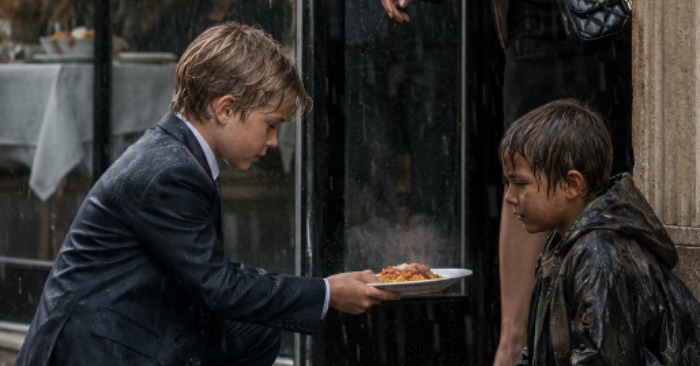
But outside, beside the entrance, a poor boy sat on the ground.
Soaked.
Still.
With an old backpack in his arms.
He wasn’t asking for anything.
He wasn’t holding out his hand.
He wasn’t looking at the customers.
He was only watching the door as if he were waiting for someone who might never come out.
The first to see him was Tomás.
He was ten years old, wearing a dark blue suit, new shoes, and had an almost untouched dinner in front of him.
His mother was talking on the phone.
His father was checking messages.
No one was looking outside.
Tomás was.
He saw the boy in the rain.
He saw his lips trembling.
He saw how tightly he held the backpack against his chest.
And without saying anything, he took his plate.
Meat.
Potatoes.
Warm bread.
He crossed the entire restaurant.
The customers began to turn.
His mother put down the phone.
—Tomás, where are you going?
He didn’t answer.
He pushed open the glass door and stepped out into the rain.
The poor boy looked up.
Tomás knelt in front of him.
—You’re hungry, aren’t you?
The boy didn’t take the plate.
He only looked at it as if he didn’t understand why someone elegant was kneeling in front of him.
Then Tomás’s mother came out furious.
—Put that plate down right now!
Her voice was so loud that even the customers inside froze.
Tomás didn’t move.
—Mom, he’s cold.
—You don’t know who he is.
—He’s a child.
The sentence stopped her for a second.
But shame was stronger.
The shame of seeing her son kneeling at the entrance of an expensive restaurant.
The shame of everyone watching.
The shame of a simple act making visible something she preferred not to see.
—Come back inside —she ordered.
The poor boy lowered his gaze.
—I don’t want to cause trouble.
Tomás held the plate closer.
—It’s not trouble.
His mother took a step toward him.
—Tomás.
The tone was a warning.
But before the rich boy could stand up, the poor boy spoke.
—I didn’t come to ask for food.
The mother froze.
—Then what are you doing here?
The poor boy struggled to breathe.
He put his hand into his backpack.
Tomás saw his fingers trembling.
Not from the rain.
From fear.
He took out an old wallet.
Dark leather.
Worn at the corners.
Tomás’s mother frowned.
—What is that?
The boy opened it.
Inside was a photo.
Tomás’s father was in it.
Younger.
Without a suit.
Smiling beside a dark-haired woman at a bus station.
The mother stopped breathing.
Inside the restaurant, Tomás’s father slowly stood up from the table.
He had seen the wallet from the other side of the glass.
All the color drained from his face.
—Where did you get that? —the woman asked.
The poor boy looked toward the man inside the restaurant.
—It belonged to my mom.
Tomás turned toward his father.
—Dad…
The man came out slowly.
The rain hit his white shirt, but he didn’t even seem to notice.
His eyes were fixed on the wallet.
—It can’t be.
The poor boy took a step back.
As if that voice confirmed something he had feared for a long time.
—My mom said that if I ever found you, I should give this back to you.
Tomás’s father swallowed.
—What was your mother’s name?
The boy clutched the wallet.
—Clara.
The word fell over the restaurant entrance like thunder.
Tomás’s mother looked at her husband.
—Who is Clara?
He didn’t answer.
Tomás slowly stood up, still holding the plate in his hands.
The food was getting cold in the rain.
—Dad, do you know her?
The man closed his eyes.
—Yes.
The poor boy spoke in a low voice:
—She said you would know why you left us at the station.
The customers inside the restaurant were no longer pretending not to look.
Some were standing.
Others were moving closer to the glass.
A waiter placed a tray on a table without realizing it.
Tomás’s mother clenched her jaw.
—Explain yourself.
His father took a deep breath.
—Years ago… before I met you…
—No —the poor boy interrupted him.
Everyone looked at him.
His voice was still trembling, but his eyes were no longer lowered.
—My mom said not to let you start that way.
The father froze.
—What?
The boy opened the wallet again.
He took out a folded note.
—She said you always started stories by leaving out the part that hurt the most.
Tomás’s mother felt the ground disappear beneath her feet.
Tomás looked at his father as if he no longer fully recognized him.
The poor boy held out the note.
—She told me to give it to you in front of someone who could listen.
The father didn’t take it.
He couldn’t.
So Tomás took it for him.
—Can I read it?
The poor boy nodded.
Tomás opened the paper.
The handwriting was simple, uneven, written by tired hands.
He began to read quietly, but everyone could hear him.
“If this letter has reached your hands, it means my son was braver than I was and found you.”
The father lowered his gaze.
Tomás continued:
“I don’t want money. I never did. I wanted an answer. That night at the station, you said you would come back with tickets, food, and help. We waited until the doors closed. We waited until they turned off the lights. We waited even when it started raining.”
Tomás’s mother brought a hand to her mouth.
The poor boy wasn’t crying.
He was looking at the ground.
As if he had already heard that story too many times.
Tomás continued:
“My son was born months later. I never spoke badly of you to him. I only told him that sometimes people leave because they are cowards, not because those who wait are worth little.”
The father lifted his head.
His eyes were full of tears.
—I came back.
The poor boy looked at him.
—No.
—Yes, I came back.
—My mom said you didn’t.
The father struggled to breathe.
—When I returned, you were already gone.
Tomás’s mother looked at him.
—When did you return?
The man didn’t answer right away.
And that silence was another crack.
The poor boy took something else out of the wallet.
An old ticket.
Wrinkled.
Stained.
—She kept this.
The father took it with trembling hands.
It was a bus ticket.
Date.
Time.
Destination.
And on the back, a handwritten sentence:
“If I’m not back before seven, take the last bus.”
Tomás looked up at his father.
—Why didn’t you come back before seven?
The man closed his eyes.
The rain kept falling.
The entire restaurant waited.
—Because I was afraid.
No one spoke.
The confession was simple.
Cowardly.
Human.
Terrible.
—Clara was pregnant —he said—. I had no money. No steady job. My family was pressuring me. They told me that if I left with her, I would be left with nothing.
Tomás’s mother let out a dry, broken laugh.
—And you chose not to be left with nothing.
The man looked at the poor boy.
—I came back the next day.
The boy shook his head.
—My mom slept at the station that night.
The blow was devastating.
—I came back —the father repeated, now crying—. But she had already gone.
—Because you told her to take the last bus if you didn’t come back.
The father lost his voice.
Tomás’s mother took a step back.
—Is this boy…?
The silence answered before anyone did.
Tomás looked at the poor boy.
Then at his father.
Then back at the boy again.
—Are you my brother?
The poor boy lowered his gaze.
—I don’t know.
His voice broke for the first time.
—My mom said not to come looking for a father. She said maybe it was already too late for that.
Pause.
—But before she died, she asked me to bring the wallet.
Tomás dropped the note.
—Your mom died?
The boy nodded.
Tomás’s mother closed her eyes.
The father covered his face with his hands.
But Tomás didn’t look at the adults.
He looked at the boy.
At his wet clothes.
At his broken shoes.
At the old backpack.
At the plate still in his own hands.
And suddenly he understood something no adult had said:
his possible brother had come to a luxury restaurant not to ask for food, but to return a truth.
Tomás knelt again.
This time he didn’t offer the plate as charity.
He placed it on the ground between them.
—Eat with me.
The poor boy looked at him, confused.
—What?
—Whether you’re my brother or not, I don’t want you to be alone in the rain.
Tomás’s mother broke down crying.
Not elegantly.
Not discreetly.
She cried like someone who had just seen her son do what the adults had failed to do.
The father tried to approach the poor boy.
—Son…
The boy stepped back.
—Don’t call me that yet.
The man stopped.
That sentence was fair.
And it hurt because it was fair.
—What’s your name? —Tomás asked.
—Nico.
Tomás nodded.
—I’m Tomás.
—I know.
—How?
Nico pointed to the wallet.
—My mom had clippings. Photos. Once she said you looked like a good person.
Tomás swallowed.
—Me?
Nico nodded.
—She said that if I ever came, I shouldn’t come for him.
He looked at the father.
—That I should come for you.
Tomás felt his eyes fill.
—Why?
Nico clutched his backpack.
—Because she said you weren’t to blame for what he left behind.
Tomás’s mother looked at her husband.
Not only with hatred.
With something deeper.
With the understanding that the decisions a person hides do not disappear.
They wait.
They grow.
They walk through the rain.
And one day they enter everyone’s life with an old wallet.
The manager came out of the restaurant with an umbrella.
—You can come inside. Please.
Nico quickly shook his head.
—I can’t.
—Yes, you can —Tomás said.
Nico looked at his shoes.
—I’ll make it dirty.
Tomás looked at the shiny restaurant floor.
Then he looked at his brother.
Or at the boy who might be.
—Then let it get dirty.
The sentence made Tomás’s mother cry again.
They went inside.
The customers stepped aside in silence.
No one complained about the water on the floor.
No one talked about rules.
No one asked for him to be taken out.
Nico sat at a table near the window.
Not at the back.
Not hidden.
In front of everyone.
Tomás sat beside him.
His mother sat across from them.
His father remained standing.
Nico looked at him.
—You don’t sit down yet.
The man nodded.
—Alright.
—First you have to answer something.
—Anything you want.
Nico took one last thing out of the wallet.
A small key.
—My mom said this opens a box at the station.
The father stopped breathing.
—What box?
—I don’t know.
Nico looked at Tomás.
—She said that inside is what you never dared to look for.
The tension returned.
Stronger.
Deeper.
Tomás looked at his father.
—What’s in that box?
The man was pale.
—I don’t know.
But his voice didn’t sound convincing.
Tomás’s mother heard it.
Nico did too.
And the story, which had seemed to reach its ending at the restaurant door, had just opened another door.
A station.
A box.
A key.
And a truth Clara had kept until the final moment.
Tomás took the plate and gently pushed it toward Nico.
—First you eat.
Nico hesitated.
Then he took a piece of bread.
His hands were still trembling.
The father remained standing.
Outside, the rain beat against the glass.
Inside, no one touched their glasses.
Because everyone understood that that afternoon, they were not watching a poor boy receive food.
They were watching a family discover that the past doesn’t disappear just because someone can pay for expensive dinners.
And when Nico took the first bite, Tomás said quietly:
—Afterward, we’re going to the station.
Nico looked at him.
—You’re coming with me?
Tomás nodded.
—Yes.
Pause.
—This time, no one waits for you alone.
The father closed his eyes.
The mother lowered her head.
And Nico, with the bread in his hand, finally cried.
Because he had not come looking for food.
He had come looking for someone who wouldn’t leave before the doors closed.
And maybe, for the first time, someone had just stayed.