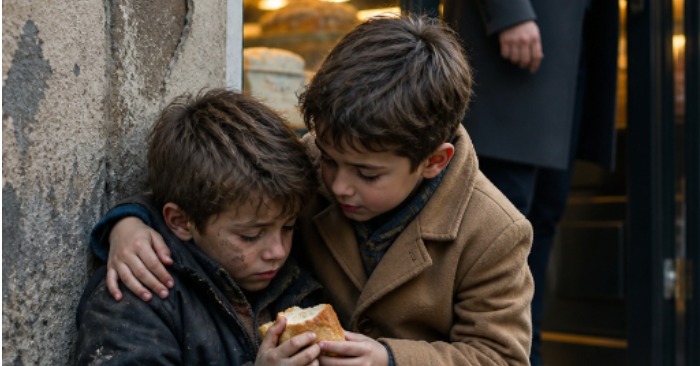
When the boy shared his bread… the man realized what he had forgotten
The door burst open so forcefully that both boys flinched apart in surprise.
The man who stepped out wore a dark coat, spotless shoes, and an expression of anger that seemed more used to giving orders than asking questions.
His gaze locked immediately onto the boy in the camel coat.
“Tomás!” he snapped again. “What are you doing out here?”
Tomás didn’t answer right away.
He was still half-kneeling in front of the other boy, as if he didn’t want to leave him alone for even a second.
The child against the wall lowered his eyes instantly.
He reacted like someone who already knew what was coming.
Shame.
Rejection.
The order to leave.
The same scene as always.
The man took two more steps.
Then he saw the bread in the dirty boy’s hands.
He also noticed how his own son stood between him and that small stranger, almost shielding him with his body.
“Go inside right now,” he said sharply.
Tomás stood up.
But he didn’t move.
“He’s hungry.”
The sentence was simple.
So simple it hurt.
The man frowned.
“That’s none of your business.”
Tomás pressed his lips together.
“Yes, it is.”
The man looked at him, surprised.
Not because the boy had raised his voice.
He hadn’t.
It was worse.
He had answered with a steady calm—one that didn’t seem to belong to an eight-year-old.
Behind them, some people kept walking.
Others began to slow down and watch.
A bakery waiter leaned out the door.
The woman at the counter stopped sorting bags.
No one spoke.
But everyone was waiting.
The hungry boy tried to stand.
Maybe to leave before being thrown out.
Maybe out of habit.
Tomás saw him and gently held his arm.
“No,” he said softly. “Stay.”
The man noticed that gesture.
And for some reason, something in his expression shifted slightly.
Not much.
Just enough that his anger no longer looked so clean.
“What’s your name?” he asked, this time looking at the boy by the wall.
The child hesitated.
He clutched the bread tightly with both hands, as if someone might take it away at any moment.
“Leo.”
“Where is your family, Leo?”
The boy lowered his head.
“My mom is in the hospital.”
Suddenly, the street felt colder.
Tomás looked at his father.
The man didn’t react immediately.
“And your dad?”
Leo shook his head.
He didn’t need to explain further.
Sometimes absence is understood even when no one names it.
Tomás turned fully toward his father.
“I told you he was hungry.”
The man’s hardness began to crack—quietly.
Not because the poor boy had said anything extraordinary.
But because his own son was looking at him as if expecting something greater than an order.
Something human.
“How long have you been here?” the man asked.
Leo shrugged.
“Since this morning.”
“Alone?”
Leo nodded.
“My mom got dizzy last night. They took her to the hospital. A lady told me to wait, but then she asked me to leave because they were cleaning.”
He paused.
“I didn’t want to steal. I just wanted to sit near the warmth for a while.”
Tomás looked down at the piece of bread still in his hand.
Then he took off his scarf.
Without asking.
Without hesitation.
And wrapped it around Leo’s neck.
Leo froze.
As if he didn’t know what to do with something so small—and so enormous at the same time.
The man watched the scene.
On any other day, he might have said no—that the clothes would get dirty, that they should go inside, that this wasn’t their problem.
But something stopped him.
Maybe the image of his son.
Maybe the tremor in Leo’s hands.
Maybe the memory that hit him without warning when he heard the word “hospital.”
His wife had also been in a hospital the last time.
And since she died, Tomás had stopped smiling the way he used to.
He had grown quieter.
More attentive to others.
As if he had inherited all her tenderness—while his father had slowly lost his.
“Dad,” Tomás said softly, “Mom wouldn’t leave him here.”
The sentence fell between them with brutal force.
The man closed his eyes for a second.
Just one.
But it was enough.
Because it was true.
His wife would never have left a child trembling in the street while warm bread sat behind a door.
Never.
And Tomás knew it.
He had seen it in her.
He remembered it better than his father did.
The man took a deep breath.
Then looked at Leo again.
This time, not as a problem at the entrance of his business.
But as a child.
Just that.
A child who was hungry, cold, and afraid.
“Have you eaten anything else today?”
Leo shook his head.
Tomás tightened his lips.
“I only gave him half because I thought maybe he wanted to save the other half for someone else.”
Leo looked down at the bread.
“It was for my mom.”
No one spoke for a moment.
Not the father.
Not Tomás.
Not the waiter at the door.
Not the woman behind the counter.
Because that sentence changed everything.
He wasn’t a child begging for the sake of begging.
He wasn’t lying.
He was a hungry boy saving his share for his sick mother.
The man swallowed.
For the first time, his voice came out different.
Lower.
“Come inside.”
Leo looked up as if he hadn’t heard correctly.
“What?”
“I said come in. It’s cold.”
Tomás didn’t move immediately.
He looked at him.
As if he needed to be sure he meant it.
The man opened the bakery door wider.
“Both of you.”
Leo stayed still.
Children who have been rejected too many times don’t believe in kindness the first time it appears.
Tomás understood that before anyone.
He reached out his hand again.
“Come.”
Leo hesitated.
Just for a second.
Then he took Tomás’s hand.
And that small gesture—the dirty hand gripping a warm one—softened something deep inside the man completely.
They went inside.
The smell of fresh bread wrapped around Leo instantly.
His body reacted before his mind.
He tensed.
As if afraid everything would disappear if he moved too much.
Tomás led him to a small table near the radiator.
The waiter brought hot soup.
The woman at the counter brought a cup of chocolate.
Leo looked at them as if he couldn’t understand why they were doing so much for him.
“Eat,” Tomás said.
Leo started slowly.
Then faster.
Then tried to stop, embarrassed.
But Tomás didn’t laugh.
He just broke another roll and slid it toward him.
“This one’s for your mom too.”
That’s what filled Leo’s eyes with tears again.
The father watched from a few steps away.
Saying nothing.
Not interfering.
Until finally, he stepped closer.
“Which hospital is she in?”
Leo looked up.
It was hard for him to answer, his mouth still trembling.
“San Gabriel.”
The man nodded.
He took out his phone.
Made a short call.
Very short.
Then put it away.
“When you’re done eating, I’ll take you there.”
Tomás smiled for the first time since stepping outside.
It was a small smile.
But real.
And his father saw it.
It had been a long time.
Leo set down the spoon.
“I don’t have anything to pay.”
The man shook his head slowly.
“You didn’t come here to pay today.”
Leo didn’t fully understand the sentence.
But Tomás did.
And he lowered his gaze to hide that his eyes had filled too.
The ride to the hospital was quiet.
Leo carried a small bag with bread for his mother.
Tomás’s scarf was still around his neck.
And Tomás didn’t ask for it back.
He sat beside him, as if afraid that if he moved away, Leo might disappear again.
When they arrived, Leo pressed the bag tightly to his chest.
They went up together.
The man walked ahead.
Tomás and Leo behind him.
They seemed like three very different people, suddenly bound by something both simple and immense.
They reached a small room.
Leo’s mother was there.
Pale.
Tired.
But awake.
When she saw her son, she tried to sit up quickly.
“Leo…”
Her voice broke.
Leo ran to her.
“I brought you bread.”
He handed her the bag like it was the most valuable treasure in the world.
The woman began to cry.
Not loudly.
Not dramatically.
Just that quiet kind of crying from someone who has been holding everything in for too long.
Tomás stood at the door.
His father beside him.
Both watching in silence.
“Who are they?” the woman asked through tears.
Leo looked at Tomás first.
“He gave me bread.”
Then he pointed to the man.
“And he brought us.”
The woman tried to wipe her tears quickly, embarrassed.
“I… thank you… I don’t know how…”
The man shook his head.
“You don’t have to explain anything.”
Then he paused.
A long one.
As if choosing his next words was harder than any deal he had ever made.
“You’re not going back to the street tonight.”
The woman looked at him, confused.
Leo too.
Tomás stepped forward.
“We have a room above the bakery. My grandmother used to use it. It’s empty.”
His father looked at him.
Not because the idea surprised him.
But because his son had found the answer before he did.
And again, he felt that unbearable mix of pride and guilt.
“Yes,” he said at last. “You can stay there until she recovers.”
The woman broke into real tears.
Leo clutched the now-empty bread bag tighter.
He didn’t know what to say.
Sometimes, when life has been too hard, help hurts before it heals.
Tomás approached the bed slowly.
He looked at Leo’s mother.
“He was saving half for you.”
The woman closed her eyes.
As if that sentence was too much.
As if her son’s love was holding her together from the inside just when she was weakest.
Tomás’s father turned for a moment toward the hospital window.
He took a deep breath.
Then looked back at his son.
At Leo.
At Leo’s mother.
And he understood something he had been forgetting for far too long:
the most important thing about a door wasn’t that it could be closed—
it was that it could be opened.
That night, when they left the hospital, Tomás walked beside Leo without letting him go.
It didn’t feel as cold anymore.
Or maybe the cold was still there—but finally, something stronger was too.
Leo looked up at Tomás.
“Why did you help me?”
Tomás thought for a few seconds.
Then answered with a simplicity that made everything more painful—and more beautiful at the same time.
“Because you were hungry.”
Leo lowered his gaze.
As if no one had ever given him such a clear reason to care about him.
And for the first time in a long while, he didn’t walk like a child expecting to be pushed away everywhere.
He walked like a child who had finally been seen.