The room fell silent.
Not a normal silence.
One of those silences that appears when everyone understands that something impossible has just happened.
The woman’s hand had moved.
Very little.
Barely one finger.
But in that room, that tiny movement was louder than any scream.
The doctor quickly approached the bed.
“Repeat the melody.”
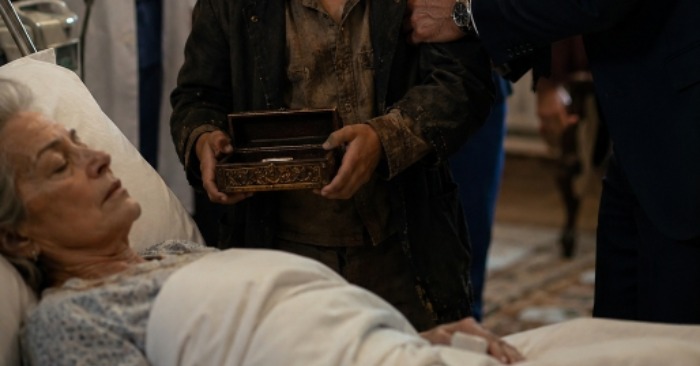
The boy looked at the music box.
Then he looked at the man who was still gripping his arm.
“You’re hurting me.”
The man let go of him immediately.
Not out of compassion.
Out of fear.
His mother had not responded to anything for months.
Not voices.
Not treatments.
Not pleading.
And now an unknown boy, with torn shoes and an old box, had done what no one else could.
“Who are you?” the man asked.
The boy swallowed.
“My name is Mateo.”
“How do you know my mother?”
Mateo looked at the woman in the bed.
His eyes filled with tears.
“She used to come to the park.”
The family exchanged glances.
“My mother didn’t go to parks,” the man said coldly.
Mateo slowly shook his head.
“Yes, she did.”
A pause.
“But without you.”
The sentence landed heavily.
The woman’s youngest daughter took a step forward.
“What do you mean?”
Mateo opened the music box again.
The melody played softly.
Old.
Sad.
The woman in the bed began breathing differently.
The monitor shifted slightly.
The nurse looked up.
“She’s reacting.”
The man turned pale.
“That proves nothing.”
Mateo looked at him.
For the first time, without fear.
“She said you only saw her when you needed a signature.”
The blow was brutal.
No one spoke.
The daughter lowered her gaze.
The son clenched his jaw.
The doctor stood still, understanding that this was no longer just a strange visit.
It was a truth entering without permission.
“She used to sit with me on the blue bench,” Mateo continued. “She brought me bread. She taught me words. She said that when she was a child, she also felt lonely in a huge house.”
The youngest daughter covered her mouth.
“Mom used to talk about a blue bench…”
The son turned toward her.
“What?”
“In her diaries,” she whispered. “She always wrote about a blue bench.”
Mateo lifted the music box.
“She gave it to me before she got sick.”
A pause.
“She told me that if one day she didn’t wake up, I had to play it near her.”
The man let out a dry, nervous laugh.
“That’s absurd.”
The doctor looked at him.
“Your mother just reacted.”
The man did not answer.
Mateo took one step closer to the bed.
“She also told me not to be afraid of you.”
The sentence cut through the room.
The youngest daughter began to cry.
“Why would you be afraid?”
Mateo lowered his gaze.
“Because she said you wouldn’t understand.”
“Understand what?” she asked.
Mateo took a deep breath.
“That she wanted to leave me something.”
The son went rigid.
“There it is.”
His voice became hard again.
“That’s what you came for. Money.”
Mateo stepped back as if he had been struck.
“No.”
“Of course it is.”
“I don’t want her money.”
The boy gripped the music box with both hands.
“I want her to wake up.”
The silence returned.
This time, more painful.
The woman in the bed moved her finger again.
The nurse saw it.
“Again.”
The doctor leaned closer.
“Mrs. Valeria… if you can hear me, try to move your hand.”
Nothing.
Only the sound of the music box.
Mateo closed his eyes.
And began to sing softly.
He did not sing well.
His voice trembled.
It was small.
Broken.
But the melody was the same.
The youngest daughter broke down crying.
“That song…”
Mateo looked at her.
“She said she used to sing it to her children when they were little.”
The son stood motionless.
Something changed in his face.
A memory reached him.
A dark room.
A young mother sitting on the edge of his bed.
That melody.
The same one.
The one he had forgotten.
The one she had never stopped remembering.
“No…” he whispered.
Mateo kept singing.
The woman’s hand slowly closed over the sheet.
Everyone saw it.
The doctor spoke urgently:
“Keep going.”
Mateo sang louder, even as tears ran down his face.
The son moved closer to the bed.
For the first time in months, he did not look like a busy or important man.
He looked like a lost child.
“Mom…”
The woman did not open her eyes.
But a tear appeared at the edge of her eyelid.
The whole room broke.
The youngest daughter fell to her knees beside the bed.
“Mom, we’re here.”
The son looked at Mateo.
No longer with anger.
With shame.
“What else did she tell you?”
Mateo slowly stopped singing.
The music box continued on its own for a few more seconds.
“She told me you weren’t bad.”
A pause.
“You were just far away.”
The man closed his eyes.
That hurt more than an accusation.
Because it was true.
For years, his mother had lived surrounded by luxury, assistants, doctors, and lawyers.
But not by company.
They visited her to talk about properties.
Signatures.
Decisions.
Accounts.
And she, in silence, had found in a boy from the park something her own family had stopped giving her:
time.
Presence.
Someone to listen.
“She taught me to read,” Mateo said. “She told me people can survive with little money, but not with little love.”
The youngest daughter cried even harder.
“That sounds like her.”
Mateo moved closer to the bed.
Carefully.
As if every step were asking permission.
He placed the music box on the table beside the woman.
“She also said that if she woke up… she didn’t want you to take me out of her life.”
The son looked at him.
Mateo lowered his head.
“But if you don’t want me here, I’ll go.”
No one spoke.
The doctor watched the monitor.
The nurse had tears in her eyes.
The youngest daughter stood and went to Mateo.
She knelt in front of him.
“You’re not leaving.”
The boy looked at her, surprised.
“I’m not?”
She shook her head, crying.
“If my mother wanted you here, then you stay here.”
The son took a deep breath.
He looked at his mother.
Then he looked at the boy.
And finally understood that this child had not come to take anything from them.
He had come to return someone to them.
“I’m sorry,” he said.
Mateo did not answer.
He only looked at him.
The man lowered his voice.
“I shouldn’t have grabbed you like that.”
Mateo gave a small nod.
“She said it was hard for you to apologize.”
The youngest daughter let out a broken laugh through her tears.
The son almost smiled too.
For the first time, the room did not feel so cold.
The doctor asked for silence.
The woman had moved her hand again.
More clearly.
More strongly.
Everyone came closer.
The son took her hand.
“Mom, if you can hear us… we’re here.”
Mateo looked at the music box.
Then he began to sing again.
The melody filled the room.
And then it happened.
The woman opened her eyes.
Not completely.
Barely.
But she opened them.
The youngest daughter cried out her name.
The doctor asked for calm.
The son began to cry in a way he had not cried in years.
The woman’s gaze moved slowly.
First toward her children.
Then toward Mateo.
And although she could not speak, her hand searched for the boy’s.
Mateo came closer.
Trembling.
She squeezed his fingers.
Weakly.
But with intention.
The son saw that gesture.
And in that instant, he understood something that no document, no inheritance, and no bank account could explain.
His mother had not been lost.
They had left her alone.
And a poor boy, with an old music box, had been the only one who remembered how to find her.
From that day on, the room was no longer filled with brief visits and unfinished conversations.
The youngest daughter came back every morning.
The son canceled meetings for the first time in years.
Mateo began reading aloud to the woman by the window.
And the music box always remained on the table, open, like a small wooden promise.
Because sometimes a person does not wake up simply because the body can.
Sometimes they wake up because, at last, someone brings back the only music the heart never forgot.