The entire restaurant became still.
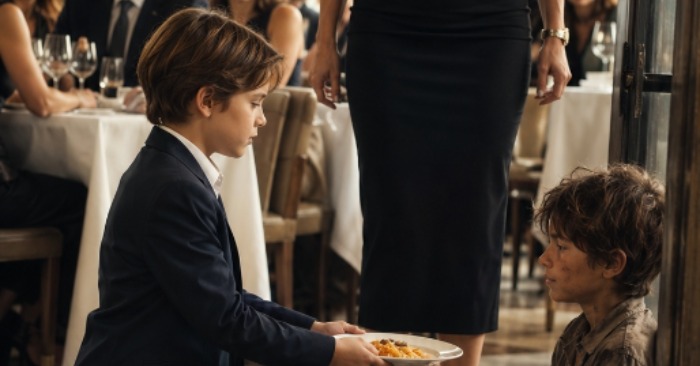
The plate was still in the boy’s hands.
His mother, standing between the perfect tables, did not know what to do first: snatch it away, apologize to the customers, or pretend that this moment was not happening.
Her son did not look away.
He was barely nine years old, but in that instant, he seemed steadier than every adult in the room.
In front of him, the homeless boy remained seated near the side door, his knees pulled to his chest and his dirty fingers pressed against his old clothes.
He was not crying.
He was not begging.
He was not speaking.
And perhaps that was what hurt the most.
The mother took a sharp breath.
“Lucas, get up.”
The boy did not get up.
“Now.”
Lucas held the plate with both hands.
“He’s going to eat first.”
A murmur passed through the restaurant.
A waiter stopped walking.
A couple at the table in the back slowly lowered their cutlery.
The mother smiled with embarrassment, as if trying to turn everything into a small scene, something easy to control.
“Forgive us,” she said to the others. “My son is confused.”
Lucas turned his head toward her.
“I’m not confused.”
The sentence was calm.
But it struck her.
“You don’t know what you’re doing,” the mother whispered, moving closer. “These people can take advantage.”
The poor boy lowered his head even more.
As if he wanted to disappear.
Lucas carefully placed the plate on his lap.
“He didn’t take advantage of me.”
The mother frowned.
“What does that mean?”
Lucas looked at the homeless boy.
“His name is Nico.”
Nico barely lifted his eyes, surprised to hear his name in that place.
The mother blinked.
“You know him?”
Lucas swallowed.
For the first time, his voice trembled.
“Yes.”
The mother felt something uncomfortable tighten in her chest.
“Since when?”
Lucas did not answer immediately.
He looked at the food.
He looked at Nico’s hands.
Then he looked at his mother.
“Since the day I got lost.”
The color began to drain from the woman’s face.
“Lucas…”
“You were on a call,” he said.
The silence grew heavier.
“We were leaving the shopping mall. There were so many people. I let go of your hand for one second.”
The mother parted her lips.
But nothing came out.
She remembered that day.
Of course she remembered it.
The worst half hour of her life.
Guards running.
Security cameras being checked.
Her son missing among hundreds of people.
Then he appeared, sitting with security, pale but safe.
She had always believed a guard had found him.
Lucas pointed at Nico.
“He found me.”
Everyone looked at the homeless boy.
Nico gripped the edge of the plate.
“I didn’t do anything.”
Lucas shook his head.
“Yes, you did.”
A pause.
“You saw me crying near the exit. You asked me my name. You gave me your bottle of water. And you walked with me to security.”
The mother took a step back.
“It was you?”
Nico did not answer.
He only lowered his gaze.
Lucas kept speaking.
“I was scared. Really scared. People were passing by, but no one stopped.”
The sentence landed across every table.
No one moved.
“He did.”
The mother truly looked at Nico for the first time.
Not as a stain in the restaurant.
Not as a problem.
As a child.
A small, thin, tired child, with broken shoes and eyes far too old.
“Why didn’t you say anything?” she asked Lucas.
He looked at her with pain.
“Because when I told you a boy had helped me, you said he probably wanted something.”
The mother closed her eyes.
That sentence came back to her like a slap.
She had said it.
Without thinking.
Without looking.
Without asking.
Nico gently pushed the plate back toward Lucas.
“I don’t want trouble.”
Lucas stopped him.
“You’re not trouble.”
“Yes, I am,” Nico whispered. “I always am when I go into places like this.”
The mother felt something inside her break.
The room remained silent.
Not out of respect.
Out of shame.
Because everyone had seen the homeless boy before Lucas approached him.
Everyone.
And no one had done anything.
The mother slowly crouched in front of Nico.
Her expensive dress brushed the floor.
For the first time, she did not care.
“Are you hungry?”
Nico looked at her with distrust.
“I don’t want them to throw me out.”
The woman took a deep breath.
“I’m not going to throw you out.”
Lucas watched her, waiting to know whether this was real.
The mother looked at the plate.
“Please eat.”
Nico hesitated.
His hands moved toward the food with painful slowness.
As if he were asking the entire world for permission.
He took a small piece of bread.
He bit into it.
And then his eyes filled with tears.
He said nothing.
He made no sound.
He just ate.
Slowly at first.
Then a little faster.
Lucas sat down beside him on the floor.
His mother was about to tell him to get up.
But she stopped.
She saw him.
She saw her son sitting beside Nico as if there were no difference between them except luck.
And that image left her defenseless.
The manager appeared from the back.
“Ma’am, if you need help removing the boy…”
She raised her hand.
“No.”
The manager froze.
“Excuse me?”
The woman stood.
Her voice changed.
It was no longer the voice of someone embarrassed.
It was the voice of someone who had just understood something too late.
“Bring another plate.”
The manager blinked.
“Another?”
“Yes. And soup. And water. And something warm to take away.”
Nico lifted his head.
“You don’t have to.”
The woman looked at him gently.
“Yes, we do.”
A pause.
“Not because you should have to ask. Because we should have offered before.”
The restaurant fell silent.
A woman at a nearby table wiped away a tear.
A man lowered his gaze toward his own untouched plate.
Lucas breathed as if he had been waiting for that moment for days.
“Thank you, Mom.”
His mother could not hold his gaze.
“Don’t thank me yet.”
She turned toward Nico.
“Where are your parents?”
Nico stopped eating.
The change was immediate.
His hands went still.
The question opened a door that was not ready to open.
“My mom works nights,” he finally said. “She cleans offices.”
“And now?”
Nico swallowed.
“She’s sick.”
Lucas looked at him.
“Is that why you were outside?”
Nico nodded.
“I wanted to get something for her.”
The mother felt her chest close.
“How old are you?”
“Ten.”
Ten.
Only one year older than Lucas.
And yet he seemed to carry an entire life on his shoulders.
The manager returned with food.
But this time, he did not leave it on the table from a distance.
He crouched slightly and placed it in front of Nico.
“Here you go.”
Nico looked at him, surprised.
“Thank you.”
The mother took a deep breath.
Then she looked at Lucas.
“Do you remember when you came back that day at the mall?”
Lucas nodded.
“I hugged you so tightly you could barely breathe.”
“Yes.”
She smiled with pain.
“I never asked who brought you back to me.”
A pause.
“Today I’m going to fix that.”
Nico looked up.
“What do you mean?”
The woman took out her phone.
“I want to meet your mother. Not to judge her. Not to take anything from you. To help.”
Nico tensed.
“We don’t want charity.”
“I’m not offering charity.”
The woman lowered the phone.
“I’m thanking you.”
The difference seemed to touch him.
Nico looked at Lucas.
Lucas smiled.
“My mom sometimes takes a while to understand. But when she understands, she understands hard.”
For the first time, Nico almost smiled.
The mother let out a small laugh mixed with tears.
Then she asked them to prepare several bags of food.
Not one.
Several.
The manager did not ask questions.
The waiters began to move.
And then something happened that no one expected.
An older woman rose from a table.
She walked over to Nico.
She placed money beside the bag.
“For medicine,” she said.
A young man approached next.
“I have a pharmacy nearby. I can help with that.”
A couple offered to drive them home.
A waitress said she knew a community clinic.
Within minutes, that corner that had begun in humiliation filled with outstretched hands.
Nico looked at everything with fear.
Too used to help coming with conditions.
Lucas touched his shoulder.
“You don’t have to answer now.”
Nico looked at him.
“Why are you doing this?”
Lucas thought for a few seconds.
Then he answered with the brutal honesty of a child:
“Because when I was scared, you didn’t ask if I was rich.”
Silence.
The mother covered her mouth.
That was the final blow.
Nico lowered his gaze.
His tears fell onto the plate.
“I just didn’t want you to be alone.”
Lucas nodded.
“Me neither.”
The mother knelt again.
This time in front of both of them.
“Nico, I promise you something.”
The boy looked at her cautiously.
“I’m not going to help you so I can feel like a good person.”
A pause.
“I’m going to help you because my son is alive and safe because of you.”
Nico did not know what to say.
Lucas gently pushed the plate toward him.
“Eat before it gets cold.”
And Nico ate.
In the middle of the most elegant restaurant on the avenue.
Surrounded by people who, at first, had looked at him as if he did not belong there.
But that day, the question changed.
It was no longer whether Nico belonged in the restaurant.
It was whether the restaurant deserved to stand before a child who, having so little, had offered help when no one else had wanted to stop.
Weeks later, Lucas and his mother visited Nico’s mother.
They helped with medicine.
With food.
With a better job.
It was not perfect.
It was not magical.
But it was real.
Lucas and Nico saw each other many times after that.
Sometimes at the restaurant.
Sometimes in the park.
Sometimes doing homework at the same table where everything had begun.
And every time Lucas’s mother saw the two boys together, she remembered the sentence that changed her life:
“When I was lost, he was the only one who didn’t leave me alone.”
Because sometimes the greatest help does not come from the one who has the most.
It comes from the one who knows exactly what it feels like to be invisible…
and still chooses to see someone else first.