The afternoon fell brightly over the restaurant.
Through the large windows came a warm, clean light that made the glasses, the white tables, and the marble floor shine as if everything had been designed to impress.
The old man was still standing beside the side alley.
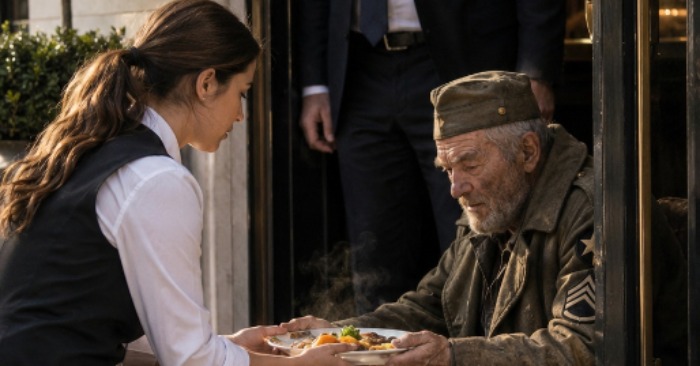
The waitress, still kneeling in front of him, held the plate with both hands, as if that small gesture were the only decent thing left amid so much cruelty.
“Sir… it’s hot,” she said softly. “Please, eat.”
The man looked at her for a few seconds.
His military coat was old.
His boots were worn.
His gray beard seemed to carry too much time and too many stories.
But there was no shame in his eyes.
Only exhaustion… and dignity.
“Thank you, daughter,” he finally said.
His voice was hoarse, but steady.
Behind them, the side door suddenly swung open.
The manager appeared again, furious, blinded by rage.
“What do you think you’re doing?”
The waitress immediately stood up, holding the plate.
“He was hungry.”
“He’s behind my restaurant, next to the trash, in broad daylight,” he spat. “Do you want everyone to see this?”
“They already saw how you threw him out,” she replied.
The manager took a threatening step toward her.
“Get back inside right now or I’ll fire you in front of everyone.”
The young woman swallowed.
She was afraid.
But she did not step back.
“If you fire me for feeding a veteran, then do it.”
The man froze for a second.
He had not expected someone to speak to him like that.
Not in front of the old man.
Not with the door open and several employees watching from inside.
“A veteran?” he mocked. “He’s nobody anymore.”
The sentence landed like a slap.
And then the old man slowly lifted his head.
He straightened his back.
Just that.
But it was enough for his entire presence to change.
Suddenly he no longer looked like a defeated man.
He looked like someone who had commanded troops, crossed through wars, and survived things the manager could not even imagine.
“Be careful with your words, young man,” the old man said.
His voice no longer sounded tired.
It sounded authoritative.
It sounded dangerous.
The manager let out a nervous laugh.
“And what are you going to do?”
He did not finish the sentence.
Because at that moment, the roar of several engines was heard in front of the restaurant.
Everyone turned.
Three black SUVs had just stopped at the main entrance.
Under the clear daylight, several doors opened at once.
Men in dark suits stepped out.
Serious.
Fast.
One of them, with a folder in his hand, walked straight toward the alley.
“Mr. Whitmore,” he said urgently. “We’ve been looking for you for an hour.”
The waitress blinked.
The manager turned pale.
The old man watched him calmly.
“I’m here, Daniel.”
The assistant lowered his head, relieved.
“The board is waiting for your decision.”
The manager took a step back.
“Mr… Whitmore?”
The old man did not answer right away.
He slowly removed the worn military coat.
Underneath, he wore an impeccable suit.
A medal gleamed on his lapel.
And in that instant, the entire scene changed.
No one saw a poor man anymore.
They saw General Adrian Whitmore.
Decorated hero.
Billionaire businessman.
Founder of one of the most powerful logistics companies in the country.
A figure too important to be ignored… and too human to forget a humiliation.
The manager stopped breathing for a second.
“I… I didn’t know…”
The general looked at him without a single trace of emotion.
“That is exactly the problem.”
The sentence destroyed him.
“Sir, please… if I had known who you were…”
“Would you have treated me better?” the general asked.
Silence.
Brutal.
The man did not answer.
Because they both knew the answer.
The general slowly turned toward the waitress.
His eyes, hard only a second earlier, softened.
“What is your name?”
“Elena,” she answered, almost in a whisper.
“Elena,” he repeated. “You did not see a torn coat. You did not see a nuisance. You did not see an obstacle.”
A pause.
“You saw a hungry man.”
The young woman’s eyes filled with tears.
“My grandfather was a veteran too,” she said. “He always said the worst part wasn’t serving… it was coming back and feeling that nobody saw you.”
The general watched her for a long moment.
And then he nodded.
“Your grandfather was right.”
The manager tried to approach.
“Mr. Whitmore, let me explain—”
“No.”
Just one word.
Dry.
Final.
The general turned toward the main entrance of the restaurant, where the customers had already stood up and were watching in absolute silence.
“Six weeks ago,” he said in a firm voice, “I bought this restaurant chain.”
The murmur was immediate.
The manager turned white.
“I wanted to see with my own eyes how they treated a person when they believed he had nothing.”
A pause.
Then he fixed his eyes on him.
“And now I know.”
The manager felt himself collapse.
“Sir, please…”
But it was already too late.
“You are fired. As of this moment.”
Two security agents stepped forward.
Not toward the old man.
Toward the manager.
The employees silently made way.
The customers did not look away.
The man who, only minutes earlier, had humiliated a veteran in front of everyone was now leaving defeated under those same stares.
No one defended him.
Because everyone knew why it was happening.
When he disappeared, the silence left behind was different.
Cleaner.
Fairer.
The general looked at Elena again.
She was still holding the hot plate in her hands.
“It seems your soup is no longer so hot,” he said.
The young woman let out a small nervous laugh, despite her tears.
“I can still bring another one.”
The general smiled faintly.
“Then you will have to join me for lunch.”
Her eyes widened.
“Me?”
“You.”
A pause.
“If you accept.”
The cooks smiled from the back.
An elegant woman at a nearby table discreetly wiped her eyes.
Elena looked at him.
Then she looked at the plate.
Then at the entire restaurant.
And nodded.
“I accept.”
That same afternoon, the best seat in the restaurant was not for a celebrity or an investor.
It was for a general who wanted to sit down to lunch with the only person who had treated him like a human being when he seemed to have nothing to offer.
They talked for hours.
Not only about what had happened.
They talked about Elena’s grandfather.
About her sick mother.
About the double shifts she worked.
About her dream of studying business administration someday.
The general listened to her with absolute attention.
Without interrupting.
Without looking at the clock.
The way men listen when they know how to recognize true greatness when it appears quietly.
Before leaving, he placed a folder on the table.
“I do not make decisions lightly,” he said.
Elena opened it, confused.
Inside were documents.
A contract.
A proposal.
Her hands trembled.
“I don’t understand…”
The general looked at her calmly.
“Starting tomorrow, you will be the new general manager of this restaurant.”
She looked up, in shock.
“What?”
“And you will have a stake in the business.”
The young woman felt the air disappear.
“I don’t know if I can…”
“You can.”
The answer was immediate.
“What you did today cannot be taught in an office. But the rest can.”
Elena’s eyes filled again.
“Thank you…”
The general smiled.
“Start by never allowing anyone to be judged by their appearance again.”
The next day, she gathered the entire staff.
The afternoon light came through the windows again.
But the place no longer seemed the same.
“From today on,” she said, “no one here will be treated according to their clothes, their money, or their appearance.”
A pause.
“If someone comes in hungry, they will be given food. If someone comes in tired, they will be offered a seat. And if anyone ever confuses luxury with cruelty again… they will leave.”
The employees listened to her in silence.
Some ashamed.
Others relieved.
As the weeks passed, the restaurant changed.
The reviews no longer spoke only about the food.
They spoke about the treatment.
The respect.
The warmth.
About how the most exclusive restaurant in the city had also become one of the most human.
And every Wednesday at noon, without publicity or cameras, free meals were served to veterans.
Paid for quietly.
With respect.
Without spectacle.
Once a month, the general returned.
Sometimes in a suit.
Sometimes in his old military coat.
And every time he walked through the door, Elena remembered that bright afternoon when everything changed.
Because in broad daylight, in front of everyone, a young waitress saw humanity where others saw only appearance.
And a veteran, who seemed forgotten by the world, discovered that there were still people capable of looking first at the heart…
and only then at the coat.