The alarm was still blaring.
Loud.
Sharp.
Relentless.
The hallway of the private school looked like a scene of controlled chaos that had stopped being controlled.
Students ran toward the exits.
Teachers shouted instructions.
Red lights flashed across the white walls.
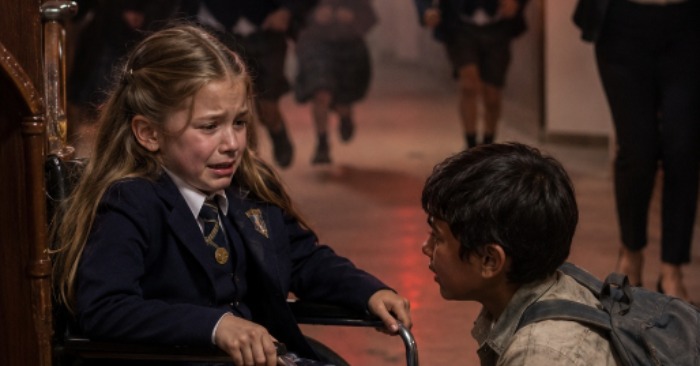
Artificial smoke from the drill spread across the floor like low fog, wrapping around expensive shoes, new backpacks, and frightened faces.
But at the end of the hallway, near the stairs, Sofia couldn’t move.
Her wheelchair was stuck.
One of the front wheels had jammed against a raised metal piece sticking out of the floor.
She pushed once.
Nothing.
She pushed again.
Nothing.
“Help!” she screamed.
Her voice disappeared beneath the alarm.
A group of students ran past.
One looked at her.
Another did too.
But they kept going.
Not because they were cruel.
Because they were afraid.
And fear makes the world small.
Then Mateo appeared.
He wasn’t wearing an expensive uniform.
His shirt was borrowed.
His backpack had a broken zipper.
Everyone knew who he was.
The janitor’s son.
The boy who studied there thanks to a scholarship.
The boy some people greeted when they needed something… and forgot when they didn’t.
Mateo was already near the exit when he heard Sofia.
He stopped.
Turned his head.
Saw her.
Alone.
Her eyes full of panic.
And he ran toward her.
A teacher saw him.
“Mateo, don’t go back there!”
But he didn’t stop.
He ran against everything.
Against the alarm.
Against the smoke.
Against that invisible rule that said boys like him should step aside, not intervene.
He reached the wheelchair and dropped to his knees.
“Are you hurt?”
Sofia was crying.
“I can’t move it.”
Mateo looked at the wheel.
Then the stairs.
Then her legs covered by a blue blanket.
“Easy. The wheel’s jammed.”
She was breathing too fast.
“I can’t get down. I can’t move. I can’t…”
Mateo lifted his gaze.
“Look at me.”
Sofia didn’t.
She kept staring at the stairs.
Mateo spoke louder:
“Sofia, look at me.”
She finally did.
They had been classmates for months.
They had never exchanged more than three sentences.
She was the daughter of an important businessman.
He was the son of the man who cleaned the hallways after everyone left.
But in that moment there were no last names.
Only fear.
“Breathe with me,” Mateo said.
“I can’t.”
“Yes, you can.”
He placed one hand on the edge of the chair.
He didn’t touch her without permission.
He didn’t shove her.
He didn’t decide for her.
He only pointed at the wheel.
“I’m going to free it. When I do, you push on the right side.”
She shook her head.
“I can’t.”
“Yes, you can.”
“I CAN’T FEEL ANYTHING!”
Mateo looked at her.
And then he saw something.
Small.
Almost invisible.
While she cried, her right foot had trembled beneath the blanket.
Not from falling.
Not from the chair moving.
A movement of its own.
Mateo lowered his voice.
“Your leg moved.”
Sofia froze.
“No.”
“Yes.”
“Don’t say that.”
Her voice cracked.
“Don’t say that if it isn’t true.”
Mateo swallowed hard.
He suddenly understood this wasn’t about a wheel.
He was touching a wound.
“I saw it.”
The alarm kept screaming.
The teacher reappeared at the end of the hallway.
“Mateo!”
He shoved his fingers beside the jammed axle.
There was dust, a bent metal piece, and a small rock wedged beneath the support.
He pulled hard.
His hand scraped open.
He didn’t let go.
Sofia watched him, lips trembling.
“Why did you come back?”
Mateo didn’t lift his head.
“Because you heard me.”
She frowned.
“What?”
“The first day of school. When everyone laughed at my broken backpack.”
Sofia looked down.
She remembered.
One student had said his backpack looked like it came from the trash.
Everyone laughed.
Sofia didn’t.
She had tapped her pencil against the desk and said:
“That’s enough.”
Nothing more.
Two words.
But to Mateo, they had been huge.
“You were the only one who said something,” he told her.
The wheel clicked free.
Mateo took a deep breath.
“Now push.”
Sofia placed her hands on the rims.
Her fingers trembled.
“I’m scared.”
“So am I.”
That surprised her.
“You?”
Mateo nodded.
“But my dad says helping doesn’t mean you’re not afraid.”
Pause.
“It means staying even when you are.”
Sofia pushed.
The chair moved slightly.
Just a few inches.
But it moved.
The teacher finally reached them.
“Thank God! Come on, come on.”
She tried to push the wheelchair.
Sofia raised a hand.
“No.”
The teacher stopped.
Mateo looked at her.
Sofia was breathing hard.
But something had changed in her face.
“I want to do it myself.”
“Sofia, there’s no time.”
Mateo glanced toward the exit.
Then at the artificial smoke.
“It’s a drill. There’s time.”
The teacher wanted to argue, but she saw Sofia’s face.
And stayed silent.
Sofia pushed again.
The chair moved forward.
Mateo walked beside her.
Not in front.
Not behind.
Beside her.
“Right,” he said.
She pushed.
“Left.”
She pushed.
The chair rolled farther.
Then it happened again.
Her right foot trembled beneath the blanket.
Sofia felt it.
This time she couldn’t deny it.
She lost her breath.
“Mateo…”
“I know.”
“I felt it.”
The teacher crouched beside her.
“What did you feel?”
Sofia started crying in a different way.
This wasn’t panic.
It was something much more dangerous.
Hope.
“My leg.”
The teacher froze.
“Are you sure?”
Sofia nodded through tears.
“I felt it.”
Mateo looked toward the end of the hallway.
Sofia’s father was there.
He had rushed into the school surrounded by security staff, his face pale with terror.
“Sofia!”
He ran toward her and reached for the wheelchair.
But Sofia removed her hands from the handles.
“No.”
The man froze.
“Sweetheart, we need to get you out.”
“I’m getting myself out.”
The sentence left him speechless.
Mateo took a step back.
He didn’t want trouble.
Sofia’s father noticed him.
“What happened here?”
The teacher answered:
“Your daughter was trapped. Mateo came back for her.”
The man looked at the boy.
For one second, he seemed ready to thank him.
But then he saw Mateo’s dirty hands on the chair, the worn clothes, the small streaks of blood on his fingers.
His expression changed.
“You touched her wheelchair?”
Sofia raised her voice.
“He helped me.”
“He could’ve hurt you.”
Mateo lowered his eyes.
He was used to that tone.
The tone of people who are less grateful when the person helping looks poor.
But Sofia didn’t look away.
“Dad, my leg moved.”
The man went still.
“No.”
Just one word.
Fast.
Automatic.
Too automatic.
Sofia noticed.
“What do you mean, no?”
“It was fear. A reflex.”
“Then why did you answer so fast?”
The hallway fell silent.
The alarm still sounded, but now it felt far away.
Her father pressed his lips together.
“Because the doctors said we shouldn’t get our hopes up.”
Mateo looked at Sofia.
Sofia looked at her father.
“What doctors?”
The man didn’t answer.
“Dad.”
Her voice trembled.
“What doctors?”
The teacher’s expression hardened.
“Sir, if there was a motor response, it needs to be examined.”
“That won’t be necessary.”
Again too fast.
Mateo spoke without thinking:
“My dad says when someone answers too quickly, they usually already knew the question.”
Everyone looked at him.
Including Sofia’s father.
“What did you say?”
Mateo swallowed hard.
But he didn’t step back.
“Nothing.”
Sofia shook her head.
“No. Say it again.”
Mateo inhaled deeply.
“I said maybe you already knew this could happen.”
Her father stepped closer.
“Be careful.”
The teacher moved between them.
“Do not threaten a student.”
Sofia started crying again.
“Dad… did you hide something from me?”
The man closed his eyes.
And that gesture alone was enough.
Sofia covered her mouth.
“No…”
He knelt in front of her.
“After the accident, there was an evaluation.”
“What evaluation?”
“A second opinion.”
The man’s voice broke.
“They said that maybe, with intensive therapy, you could recover some sensation. They didn’t promise walking. They didn’t promise anything certain.”
Sofia stared at him as if every word stole years from her.
“Then why didn’t you tell me?”
“Because you were destroyed.”
“It was my body.”
“You were my daughter.”
“IT WAS MY BODY!”
The scream filled the hallway.
Nobody spoke.
Her father lowered his head.
“I couldn’t bear to watch you suffer again.”
Sofia cried in anger.
“So you let me live without knowing I could try.”
Mateo looked at the floor.
The teacher wiped away a tear.
Her father tried to touch Sofia’s hand.
She wouldn’t let him.
Not out of hatred.
Out of necessity.
She needed a space that belonged to her.
Mateo took another step back.
“I should go.”
Sofia turned toward him.
“No.”
He stopped.
“You didn’t leave when everyone else was running.”
Pause.
“Don’t leave now.”
Mateo nodded silently.
Her father looked at him.
For the first time, truly looked at him.
He saw the scraped hand.
The blood.
The fear he was trying to hide.
And the courage he wasn’t showing off.
“Thank you,” he said.
Mateo didn’t answer right away.
“I didn’t do it for you.”
Her father nodded.
“I know.”
Sofia took a deep breath.
Then she placed her hands on the wheelchair rims.
“I want to reach the exit by myself.”
The teacher hesitated.
“Slowly.”
Mateo positioned himself beside her.
“Right.”
Sofia pushed.
“Left.”
Sofia pushed.
Her father walked behind them.
He didn’t push.
He didn’t touch.
He just walked.
And maybe that was the first real act of help he had given in years.
When they reached the courtyard, the students were gathered there.
Everyone turned.
The alarm finally stopped.
At last.
Sofia came out with tears on her face, moving her wheelchair by herself.
Mateo walked beside her.
His dirty shirt, broken backpack, and wounded hand no longer looked shameful.
They looked like medals.
Someone started clapping.
One person.
Then another.
Then the entire courtyard.
Sofia didn’t smile.
Not yet.
She was still too wounded.
Too awake.
But she took Mateo’s hand.
And lifted it slightly.
So everyone would know who had come back for her.
Weeks later, Sofia began therapy again.
There was no immediate miracle.
She didn’t stand up the next day.
She didn’t suddenly walk in front of cameras.
But she started.
She moved one finger.
Then her foot.
Then held her weight for a few seconds between parallel bars.
Mateo accompanied her some days.
Not as a hero.
As a friend.
And every time she said, “I can’t,” he answered the same thing:
“Then we rest.”
Pause.
“And afterward, you try again.”
Because that was what helping meant.
Not carrying someone forever.
Not hiding pain from them.
Not making decisions out of fear.
Helping meant going back when everyone else runs.
Seeing ability where others see limits.
And staying long enough for the other person to remember they can still move forward.