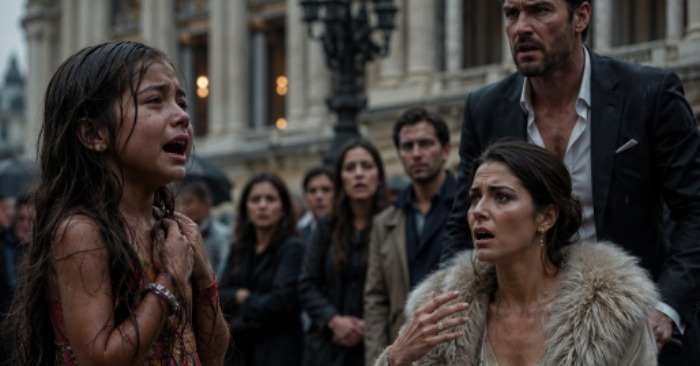
The entire square froze.
The girl’s voice still seemed to float in the air, weak, broken, almost lost beneath the distant noise of the cars.
But no one was listening to the cars.
No one was looking at the theater.
No one was paying attention to the expensive bags, the elegant coats, or the raised phones.
Everyone was looking at one thing.
The woman’s hand.
One finger had moved.
Barely.
Almost nothing.
But for a woman who had spent four years being told she would never feel anything again, that tiny movement was like thunder inside her chest.
“I felt it…” she whispered.
Her husband grabbed the handles of the wheelchair.
“Valeria, you’re nervous. We’re leaving.”
But she raised her hand.
Not much.
Not strongly.
But enough to stop him.
“No.”
The man froze.
So did the girl.
She looked frightened by what she had just caused.
Until a few seconds earlier, she had only been a girl singing for coins in front of a theater.
Now everyone was looking at her as if she were carrying a forbidden key.
Valeria struggled to breathe.
“Who taught you that song?”
The girl tightened her grip on the strap of her small bag.
“My mom.”
Valeria’s husband took a step toward her.
“Enough. Don’t answer any more questions.”
The girl stepped back.
Valeria slowly turned her head toward him.
“Why are you afraid?”
The silence grew heavier.
The question was not loud.
But it changed everything.
He tried to smile.
“I’m not afraid. I just don’t want you to get upset.”
Valeria let out a broken laugh.
“You always say that when someone talks about my past.”
The crowd murmured.
The girl looked at the ground.
“I didn’t mean to bother anyone.”
Valeria reached her hand toward her.
“Don’t go.”
The girl hesitated.
Her eyes were full of tears, but she was not crying.
As if she had learned not to waste tears in front of strangers.
“What’s your name?” Valeria asked.
“Luna.”
That name made Valeria close her eyes.
Not because she recognized it.
Because she felt the world closing in around her.
“Luna… sing it again.”
Her husband reacted harshly.
“No.”
Valeria looked at him.
“I said she should sing.”
The square fell silent.
Luna took a deep breath.
Her voice trembled at first.
Then became clearer.
The melody returned.
It was simple.
Sad.
A lullaby.
But not just any song.
Valeria knew it.
Not as a melody she had learned.
She knew it the way one knows things that live in the skin.
Before the accident.
Before the chair.
Before the doctors.
Before everyone spoke for her.
There had been a woman who sang that song in her house.
A woman who disappeared from her life exactly when Valeria needed her most.
Valeria opened her eyes.
“It can’t be…”
Her hand trembled again.
This time more clearly.
A woman in the crowd let out a choked cry.
Luna stopped singing.
“Does it hurt?”
Valeria shook her head, crying.
“No.”
Pause.
“It wakes me up.”
Her husband lost control.
“That’s enough!”
He moved toward Luna.
But a man from the crowd stepped in front of him.
Then another.
No one touched him.
They only blocked his path.
Because everyone had seen something.
And when a crowd sees a truth begin to come out, it is no longer so easy to push it back into silence.
Valeria spoke in a broken voice:
“What was your mother’s name?”
Luna swallowed.
“Marina.”
The name pierced Valeria.
Her face lost all color.
“Marina was my sister.”
The entire square froze.
Luna frowned.
“My mom said she had a sister.”
Pause.
“But that she was told her sister didn’t want to see her anymore.”
Valeria looked at her husband.
He lowered his gaze for an instant.
Only an instant.
But it was enough.
“No…” Valeria whispered.
Luna took something out of her bag.
A fabric ribbon.
Blue.
Old.
With small flowers embroidered by hand.
Valeria brought a hand to her mouth.
“I made that…”
Luna looked at her.
“My mom kept it under her pillow.”
Valeria truly began to cry.
Not soft tears.
Not elegant tears.
She cried like someone who had just been given back a part of her life far too late.
“They told me Marina left because she couldn’t bear to see me like this.”
Luna shook her head firmly.
“No.”
The word came out almost like a shout.
“My mom said she went looking for you many times. But they wouldn’t let her in.”
Valeria felt the square move beneath her.
Scattered memories began to fit together.
Visits that never came.
Letters she never answered because she never received them.
The changed phone number.
The new staff.
Her husband always saying:
“She needs distance.”
“Your sister isn’t good for you.”
“Waiting for her hurts you.”
Valeria looked at her husband.
“Did you keep her away?”
He opened his mouth.
Nothing.
The answer was silence.
Luna pressed the ribbon against her chest.
“My mom died believing you hated her.”
Valeria released a broken sound.
Her hand closed around the armrest of the chair.
“No.”
Pause.
“No, no, no…”
Her husband tried to kneel in front of her.
“Valeria, I only wanted to protect you.”
She looked at him with terrifying calm.
“Stop using that word.”
The crowd fell silent.
“Protecting me is not taking my sister away from me.”
He lowered his head.
“She made you suffer.”
“I missed her.”
Her voice broke.
“That is not the same thing.”
Luna wiped a tear with her sleeve.
“My mom told me that if I ever found you, I should sing that song.”
Valeria looked at her.
“Why?”
“Because she said that before the accident, you always moved your fingers when you heard it.”
Valeria’s heart struck hard.
Luna lowered her voice.
“She said your body may have forgotten many things, but not that song.”
A doctor who was standing in the crowd approached carefully.
“Ma’am, I’m a neurologist. I don’t want to intervene without permission, but what just happened may be a real response.”
Her husband turned toward him.
“Stay out of this.”
Valeria spoke before anyone else.
“I want to hear him.”
The doctor knelt in front of the chair.
“I can’t promise anything. But if there was a motor response to an emotional stimulus, you need an evaluation. Today.”
Valeria looked at her hand.
Her fingers were still trembling.
And for the first time in years, that tremor did not frighten her.
It gave her anger.
Hope.
Life.
Luna began singing again, more softly.
Valeria closed her eyes.
She tried to move her hand with the melody.
At first, nothing.
Then one finger.
Then another.
The crowd exhaled all at once.
The doctor looked serious.
“This is not imagination.”
Her husband went pale.
Valeria opened her eyes.
She no longer looked at her husband first.
She looked at Luna.
“Your mother found me too late.”
The girl lowered her head.
“Yes.”
Valeria extended her trembling hand.
“But you arrived.”
Luna hesitated.
Then she came closer.
When her fingers touched Valeria’s, something inside both of them broke.
A woman who had lost her sister.
A girl who had lost her mother.
Two lonely souls meeting in the middle of a square, in front of strangers who no longer knew whether they were witnessing a miracle or a debt.
Valeria looked at her husband.
“I want my reports.”
He did not answer.
“All of them.”
Valeria’s voice grew firmer.
“And I want to know who decided Marina couldn’t see me.”
The man lowered his gaze.
The truth had nowhere left to hide.
Days later, Valeria confirmed what that doctor had suspected.
There was no guarantee she would walk.
There was no perfect ending.
But there was a response.
There was possibility.
And the most painful part: there had been possibility before.
Years before.
Luna began visiting her.
Not as a stranger.
Not as a girl who sang for coins.
As Marina’s daughter.
As the last note of a song no one had managed to silence.
At first, she sang sitting by the window.
Then during therapy sessions.
Valeria moved her fingers.
Then her hand.
Then part of her arm.
Every small advance was a victory.
Not like in a movie.
Not perfect.
But real.
And every time someone told Valeria not to get her hopes up too much, she answered the same thing:
“Don’t give me back the cage and call it care.”
Because that day, a homeless girl did not just sing a song in the street.
She sang a truth.
And that truth did what no one else had dared to do:
it awakened a hand.
It opened a lie.
And it gave a woman back the part of herself that others had tried to keep asleep.