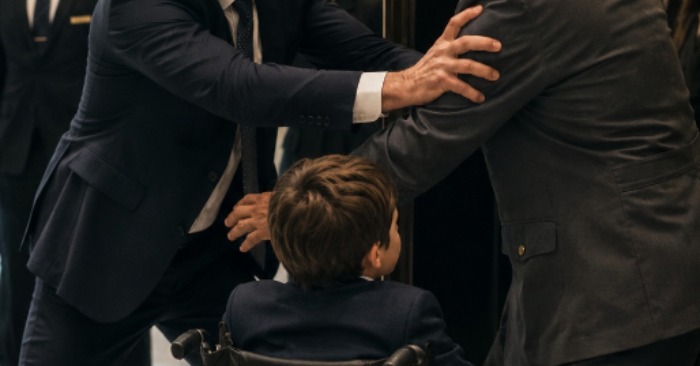
The entire lobby lost its breath.
The golden elevator doors were still open.
The boy’s father still had one hand on the wheelchair handles.
The old janitor remained standing in front of them, his chest rising and falling as if he had just run an impossible distance.
And inside the elevator, the floor was no longer level.
It had dropped just a few centimeters.
Very little.
Almost nothing.
But enough for a wheelchair to catch, tilt, and fall forward.
The father looked at the gap.
Then at his son.
Then at the janitor.
All the color drained from his face.
“No…”
The janitor swallowed hard.
“I told you to wait.”
The boy in the chair, who had stayed silent until then, looked up.
He was twelve years old.
Expensive suit.
Perfectly combed hair.
A thin blanket covering his legs.
But his eyes didn’t look like the eyes of a child raised in luxury.
They looked like the eyes of someone used to having people decide for him before asking what he wanted.
“I felt the wheel hit,” he whispered.
The father turned toward him.
“What?”
“I told you the chair was vibrating.”
The blow was invisible.
But brutal.
The father closed his eyes.
He remembered.
His son had said something at the building entrance.
“Dad, wait. The wheel sounds weird.”
And he had answered:
“Not now. We’re late.”
We’re late.
As if a meeting mattered more than listening to his own child.
The building manager came running over.
“What’s happening here?”
The janitor pointed toward the elevator.
“The leveler failed.”
The manager looked inside.
His face changed immediately.
“Shut down the elevator. Now.”
Two security guards moved quickly.
The executives stepped back.
The golden doors, which seconds earlier had looked like an elegant entrance to power, now looked like an open trap.
The father slowly released the wheelchair handles.
“How did you know?”
The janitor didn’t answer right away.
He was staring at the boy’s wheel.
Not at the father’s suit.
Not at the guards.
Not at the executives.
At the wheel.
“Because of the sound.”
The father frowned.
“The sound?”
The janitor nodded.
“When a wheelchair rolls into an uneven elevator, the front wheel changes suddenly. It makes a dry clicking sound.”
The boy looked at him carefully.
“You heard it too.”
“Yes.”
“So did I.”
The father lowered his eyes.
The janitor slowly crouched in front of the boy.
He didn’t touch the chair.
He didn’t touch the boy’s legs.
He simply brought himself to his level.
“Your name is…?”
“Daniel.”
“Daniel, may I check the wheel?”
Out of habit, the boy looked at his father first.
Then stopped himself.
That tiny pause said everything.
The janitor noticed.
“You don’t have to look at him to answer me.”
The lobby fell silent.
The father froze.
Daniel swallowed.
Then nodded.
“Yes. You can.”
The janitor inspected the front wheel.
He turned the brake.
Touched the axle.
“It’s loose.”
The father stiffened.
“They checked it this morning.”
The janitor looked up.
“Not well enough.”
The building manager stepped closer.
“We have technicians for that.”
The janitor looked at him calmly.
“And the elevator still failed.”
No one answered.
Daniel watched every movement the man made.
Not with fear.
With curiosity.
“Do you fix wheelchairs?”
The janitor went still.
For a second, his face darkened.
“I used to.”
“Before becoming a janitor?”
The man nodded.
“Before I lost my daughter.”
The silence changed shape.
It was no longer just tension.
It was pain entering the room.
Daniel’s father lowered his gaze.
“I’m sorry.”
The janitor didn’t look at him.
“She used a chair too.”
Daniel stopped breathing.
“What happened to her?”
The janitor held the wheel a little tighter.
As if he needed something solid in his hands to keep speaking.
“One day, someone was in a hurry.”
Pause.
“An elevator wasn’t level. Her chair got stuck. She fell.”
The boy closed his eyes.
The father covered his mouth with one hand.
“She didn’t die that day,” the janitor continued. “But she stopped trusting everything. Buildings. Ramps. People who said, ‘Hurry up, it’s fine.’”
Daniel opened his eyes.
“And then?”
The janitor swallowed.
“Then she got sick.”
The sentence remained unfinished.
But nothing else needed to be said.
The father struggled to breathe.
The man he had just treated like an obstacle had spent years listening to wheels, elevators, and invisible dangers because once, long ago, he hadn’t stopped one in time.
And today, he had.
Daniel looked at his father.
“He listened to me.”
No one spoke.
“I said something sounded wrong, and he listened.”
The father knelt in front of his son.
His expensive suit touched the marble floor.
This time, he didn’t care.
“Forgive me.”
Daniel didn’t answer immediately.
He looked down at his own hands resting on the armrests.
“You always push too fast.”
The father closed his eyes.
“I know.”
“You always say we’re late.”
“I know.”
“But I’m the one in front.”
The sentence cut through the lobby.
The janitor lowered his eyes.
The father opened his, full of tears.
“You’re right.”
Daniel took a deep breath.
“I don’t want you to push me without asking.”
The father nodded.
“I won’t.”
“And I want to learn how to check my chair.”
The father looked at the janitor.
The janitor lifted his gaze.
“I can teach him the basics.”
The manager interrupted:
“Sir, this is not the moment—”
The father turned toward him.
“This is exactly the moment.”
The manager fell silent.
Daniel looked at the janitor.
“Would you teach me?”
The man paused for a second.
Then nodded.
“Yes.”
Pause.
“But not so you’ll depend less on others.”
Daniel frowned.
“Then why?”
“So that when someone helps you, you’ll know whether they’re truly helping.”
The boy understood.
Maybe not with every word.
But with his heart.
The janitor showed him the brake.
The front wheel.
The sound of a loose axle.
How to feel a different vibration beneath his hand.
The executives were still standing there.
The luxury lobby had turned into an improvised lesson about dignity.
The father didn’t interrupt.
Didn’t correct.
Didn’t answer for his son.
He simply listened.
And for Daniel, that was something new.
When they finished, the janitor stood up.
“Now you can use another elevator. But slowly. And you decide when to enter.”
Daniel looked at his father.
His father stepped back.
“You decide.”
The boy inhaled deeply.
He rolled the chair forward a few inches by himself.
He listened to the wheel.
Looked at the floor.
Looked at the janitor.
“Sounds good.”
The janitor smiled faintly.
“Then keep going.”
The father walked beside him.
Not behind him pushing.
Beside him.
Like someone accompanying.
Not controlling.
Before entering the second elevator, Daniel stopped.
“What was your daughter’s name?”
The janitor closed his eyes.
“Elisa.”
Daniel nodded.
“Today Elisa helped me too.”
The janitor broke.
Not loudly.
He simply lowered his head and covered his eyes with one hand.
Daniel’s father stepped closer.
“How can I thank you?”
The janitor shook his head.
“Don’t give me money.”
“I wasn’t going to.”
The man looked up.
The father took a deep breath.
“I want you to inspect every accessible area in this building. Elevators, ramps, entrances. And I want you to lead a new safety protocol.”
The manager widened his eyes.
“Sir, that would require authorization—”
“You have it.”
The janitor didn’t answer.
Daniel smiled slightly.
“You listen to wheels.”
The man looked at him.
“Yes.”
“Then this building needs you.”
Months later, the skyscraper changed.
Not because of luxury.
Not because of design.
Because of attention.
Every elevator was inspected.
Every ramp adjusted.
Every entrance evaluated not only by architects, but by people who used wheelchairs every day.
Daniel came back many times.
At first with his father.
Later alone, learning how to check his chair, how to ask for help without feeling small, how to say “wait” without fearing he was inconveniencing anyone.
The janitor stopped being the invisible man in the lobby.
He became the building’s head of accessible safety.
And inside his small office, beside a box of tools, he placed a photo of Elisa.
Underneath it, he wrote one simple sentence:
“This time, I arrived in time.”
Because that day, in a lobby full of marble, suits, and hurry, an old janitor didn’t stop a wheelchair to humiliate a boy.
He stopped it to save him.
And he taught a father that helping isn’t pushing faster.
Helping is listening when someone says:
“Wait. Something isn’t right.”