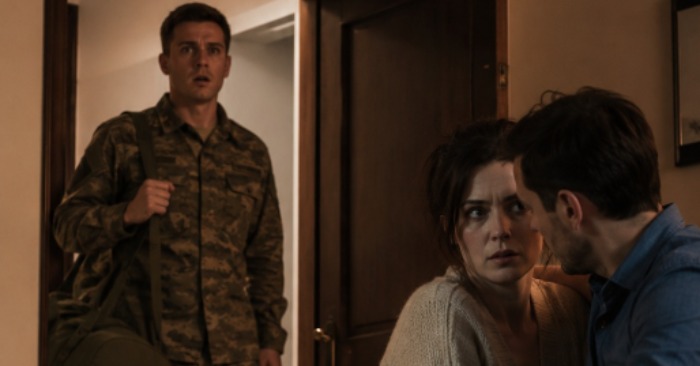
The living room became completely still.
The military bag was still on the floor.
The impact had made the glasses on the table tremble.
The music kept playing too low, too softly, as if it did not understand that something inside that house had just broken.
The soldier held the child’s drawing between his fingers.
His hands were trembling.
Not from rage.
From something worse.
From fear.
On the page, there was a house drawn with crayons.
A woman in a yellow dress.
A man in a blue shirt inside the living room.
And outside, beside the door, a green figure.
A man with boots.
A man who was supposed to be him.
But what destroyed him most was not the drawing.
It was the sentence written above it in clumsy handwriting:
“Mom said Dad must not see it.”
The soldier slowly lifted his gaze toward the stairs.
The little girl’s voice sounded again, closer now.
“Mom… is the soldier man back already?”
His wife closed her eyes as if that sentence had physically struck her.
The man in the blue shirt did not move.
And the soldier felt all the air vanish from the room.
“The soldier man?” he repeated.
His voice was low.
Broken.
Almost unrecognizable.
His wife took a step toward him.
“Daniel, please…”
He raised one hand.
Not to touch her.
To stop her.
“No.”
The word was dry.
The little girl appeared at the top of the stairs.
Emma.
His daughter.
Five years old.
Light pajamas.
Messy hair.
Big eyes, half asleep.
In one hand, she held another crayon.
In the other, a small blanket.
When she saw him, she did not run.
She did not shout “Dad.”
She did not smile the way he had imagined for months.
She only stood still.
As if she did not know whether she should come closer.
Daniel felt something inside his chest silently split apart.
“Emma,” he whispered.
The girl looked at her mother.
Seeking permission.
That gesture finished destroying him.
Before he left, Emma would run to him even when he came back from buying bread.
She would throw herself around his neck.
Touch his face.
Ask him whether soldiers got tired too.
And now she was looking at him like a dangerous visitor.
Like someone she did not know whether she was allowed to love.
Daniel lowered the drawing.
“Come here, sweetheart.”
Emma took one step.
Her mother moved.
The girl stopped.
Daniel saw it.
He saw everything.
The man in the blue shirt spoke for the first time:
“I think you should calm down.”
Daniel turned toward him.
He did not shout.
He did not need to.
“You do not get to tell me what to do in my house.”
The man lowered his gaze.
His wife was crying silently.
“Daniel, it’s not what it looks like.”
He let out the smallest laugh, without joy.
“That’s the worst part.”
Pause.
“I don’t know what it looks like anymore.”
He slowly crouched down and picked up the pink stuffed bunny.
Emma pressed the blanket against her chest.
“That belongs to Lily,” the girl said.
Daniel frowned.
“No, sweetheart. It’s yours. You used to call him Snowflake.”
Emma slowly shook her head.
“Mom said Snowflake was from when I was a baby.”
The sentence seemed small.
But Daniel felt a stab.
They had not only moved his place in the house.
They had moved his memories.
“Emma,” he said carefully. “Why did you call me the soldier man?”
The girl lowered her eyes.
His wife tried to speak.
“Daniel, don’t pressure her.”
He looked at her.
“I’m not pressuring her. I’m asking why my daughter doesn’t call me Dad.”
Emma whispered:
“Because Mom said she didn’t know if you were still really my dad.”
The silence that followed was so deep even the music seemed to disappear.
Daniel stood completely still.
His wife covered her mouth.
“Emma…”
The girl began to cry.
“I’m sorry.”
Daniel placed the drawing on the table with terrible gentleness.
“You don’t have to apologize.”
He went up one step.
Only one.
“You never have to apologize for telling the truth.”
Emma looked at him through tears.
“Are you angry?”
“Yes.”
The girl shrank back.
Daniel closed his eyes.
“But not with you.”
That made her breathe a little.
He sat down on the step, far from her, so he would not frighten her.
“I’m not going to touch you if you don’t want me to.”
Emma looked at her mother.
Then at the man in the blue shirt.
Then at Daniel.
“Are you going to leave again?”
The question took all his strength away.
“I didn’t want to leave like that.”
“But you left.”
“Yes.”
Pause.
“And you had to wait for me.”
Emma squeezed the blanket.
“Mom said waiting hurt less if I called you something else.”
Daniel slowly turned toward his wife.
He could not believe what he was hearing.
“You told her that?”
She was crying.
“She was suffering.”
“She’s a child.”
“And I was alone!”
The scream came out of her like a crack that had been opening for months.
The living room tensed again.
The man in the blue shirt tried to approach.
“Clara…”
Daniel looked at him.
“No.”
The man stopped.
Clara, his wife, wiped her face with trembling hands.
“You don’t know what it was like. Every cut-off call. Every night not knowing if you were all right. Every time Emma asked when you were coming back and I didn’t know what to say.”
Daniel took a deep breath.
“So you decided to bring him in.”
The man lowered his gaze.
Clara did not answer.
And that silence was answer enough.
Daniel looked at the glasses.
The distance between them on the sofa.
The way they had both startled when he walked in.
But there was something else.
Something that did not fit.
The drawing.
The sentence.
Emma’s fear.
The hidden bunny.
“What was I not supposed to see?” Daniel asked.
Clara lifted her gaze.
“What?”
He pointed at the drawing.
“‘Mom said Dad must not see it.’ What was I not supposed to see?”
Clara went still.
The man in the blue shirt spoke quickly:
“It’s just a child’s drawing.”
Daniel turned toward him.
“I didn’t ask you.”
Emma stepped down one stair.
“The box.”
Clara closed her eyes.
Daniel looked at his daughter.
“What box?”
Emma pointed toward the upstairs hallway.
“The one under the bed.”
Clara began crying harder.
“Daniel, please…”
He stood up.
He did not go upstairs quickly.
He did not run.
Because Emma was still watching him.
And he did not want his daughter to remember that night as an explosion.
“Emma, do you want to go down with Mom or stay upstairs?”
The girl hesitated.
“I want my bunny.”
Daniel looked at the stuffed toy in his hand.
“Can I give it to you?”
She nodded.
He went up two steps slowly and handed her the bunny.
Emma took it.
Her fingers brushed his.
It was their first contact.
Small.
Almost nothing.
But Daniel felt his heart break all over again.
The girl lowered her gaze.
“Your hands are cold.”
He tried to smile.
“I came from far away.”
Emma did not answer.
She stayed there hugging the stuffed animal.
Daniel went up to the room.
Clara followed him a few steps behind.
The man in the blue shirt also tried to follow, but Daniel stopped sharply.
“You stay downstairs.”
The man swallowed.
“I don’t think that’s a good idea.”
Daniel looked at him.
“Of course it isn’t.”
Pause.
“For you.”
The man did not go upstairs.
In Emma’s room, everything looked the same and different at once.
The small bed.
The books.
The stars stuck to the ceiling.
The drawings on the wall.
But on the desk there was a recent photograph.
Emma.
Clara.
And the man in the blue shirt.
The three of them in a park.
Daniel did not touch it.
It was worse than seeing it hidden.
It was there, in plain sight, as if someone had been rehearsing a new family in his absence.
Clara whispered:
“I didn’t want you to see it like this.”
Daniel answered without looking at her:
“But Emma saw it.”
He crouched beside the bed.
Underneath it was a cardboard box.
He pulled it out slowly.
Inside, he found several things.
Drawings.
Unsent letters.
An envelope with his name on it.
And a small notebook.
He opened it.
There were phrases written in childish handwriting, probably dictated by Emma.
“Today Mom cried in the kitchen.”
“Today Marco said he can fix the door.”
“Today Mom said Dad must not see the picture.”
“Today Marco slept on the sofa.”
Daniel closed his eyes.
Marco.
At last, a name.
Clara spoke behind him:
“It didn’t happen the way you imagine.”
He opened his eyes.
“He slept on the sofa?”
She nodded quickly.
“At first, yes.”
“At first?”
Clara did not answer.
Daniel continued searching through the box.
He found the envelope with his name on it.
It was sealed.
It was not old.
It was recent.
“What is this?”
Clara covered her mouth.
“Don’t read it now.”
Daniel looked at her.
“Why?”
“Because I wrote it when I thought you weren’t coming back.”
The sentence stopped him.
Not out of immediate compassion.
Out of exhaustion.
Out of pain.
Out of understanding that the entire house was full of things left unsaid.
He opened the envelope.
The letter began like this:
“Daniel, if one day you come back and find this house different, I want you to know that I don’t know when I started saying goodbye to you before you were even dead.”
He stopped breathing.
He continued reading.
“Everyone told me to be strong. To understand. That you served something greater. But no one came when Emma screamed at night. No one was there when she drew soldiers falling. No one told me how to keep being the wife of a man who might already be a memory.”
Daniel felt his rage mix with something else.
Not forgiveness.
Not yet.
But a painful understanding.
Clara continued speaking:
“Marco was a neighbor. He helped me with the house. With Emma. With things I couldn’t do alone.”
Daniel looked up.
“And then?”
Clara cried.
“And then I let him stay too close.”
The honesty fixed nothing.
But it opened the ground beneath them both.
Daniel looked at the letter again.
At the end, there was a line written forcefully:
“The unforgivable thing is not that you were far away. The unforgivable thing would be for you to come back and find that I had taught our daughter to live as if she were no longer yours.”
Daniel held the paper.
“So you knew what you were doing.”
Clara lowered her head.
“Yes.”
That word was harsher than any excuse.
“I knew it was wrong. But every day you didn’t come back, it seemed easier to tell her not to wait.”
“By calling me the soldier man?”
“It didn’t start that way.”
“But it ended that way.”
Clara nodded.
“Yes.”
From downstairs, Emma’s voice was heard:
“Dad?”
Daniel closed his eyes.
Clara did too.
That word.
Dad.
Not “soldier man.”
Dad.
Daniel went down slowly.
Emma was at the foot of the stairs with the bunny in her arms.
Marco was still beside the sofa, stiff, uncomfortable, guilty.
Emma looked at Daniel.
“Can I ask you something?”
Daniel crouched in front of her, at a safe distance.
“Anything you want.”
“Did you know I was still waiting?”
He could not hold his breath.
“Yes.”
“Then why did you take so long?”
The question was unfair and fair at the same time.
A child’s question.
A question that does not understand orders, maps, missions, or borders.
It only understands absence.
Daniel answered with the simplest truth:
“Because I couldn’t come sooner.”
Emma squeezed the stuffed animal.
“And now can you stay?”
Daniel looked at Clara.
Then at Marco.
Then at the bags he still had not unpacked.
“I want to stay close to you.”
Emma frowned.
“In this house?”
Daniel did not answer immediately.
Because he was not going to lie to her.
Not that night.
Not after everything.
“I don’t know yet.”
Emma began to cry.
Clara took a step toward her, but Emma looked at Daniel.
“Is it because of my drawing?”
Daniel quickly shook his head.
“No, my love.”
Pause.
“Your drawing helped me see what no one was saying.”
Emma wiped her face.
“Mom said I shouldn’t show it.”
Daniel looked at Clara.
Clara lowered her eyes.
“From today on, you can show me any drawing.”
“Even if it’s ugly?”
“Especially if it hurts.”
Emma thought for a moment.
Then she held the bunny out to him.
“You can hug him too.”
Daniel took the stuffed animal carefully.
He did not sob loudly.
But the tears fell anyway.
Marco spoke from the sofa:
“Daniel, I…”
Daniel lifted his gaze.
“You are leaving.”
Clara closed her eyes.
Marco slowly nodded.
“I understand.”
“Not because of me.”
Daniel looked at Emma.
“Because of her. There is already too much confusion in this house tonight.”
Marco took his jacket.
He did not try to kiss Clara.
He did not try to explain.
He did not try to seem noble.
He simply left.
The door closing sounded like the end of a lie that had lasted too long.
But not like the immediate beginning of a reconciliation.
That would have been too easy.
Too false.
Daniel sat on the living room floor.
Not on the sofa.
Not beside Clara.
On the floor, in front of Emma.
“I have an idea.”
Emma wiped her nose.
“What idea?”
“You’re going to draw another page.”
“Now?”
“Only if you want to.”
Emma looked at her mother.
Then at Daniel.
“What drawing?”
Daniel took a deep breath.
“The truth of tonight.”
Clara shuddered.
But she did not say no.
Emma went to get her crayons.
She sat at the coffee table.
She drew slowly.
A house.
A crying mom.
A man leaving through the door.
A soldier sitting on the floor.
And a girl on the stairs with a pink bunny.
Daniel looked at the drawing when she finished.
It was not pretty.
It was not happy.
But it was honest.
“What title should we give it?” he asked.
Emma thought for a long time.
Then she wrote in big letters:
“Dad came back and everyone told the truth.”
Clara covered her mouth.
Daniel closed his eyes.
That sentence did not save the marriage.
It did not erase Marco.
It did not heal the absence.
It did not return the lost months.
But it was a starting point.
A real one.
The next morning, Daniel did not unpack his bag in the bedroom.
Clara did not ask him to.
He slept in the guest room.
Emma found him early, sitting in the kitchen, still with dark circles under his eyes, making crooked toast that was far too burnt.
“You burned it,” she said.
Daniel looked at the plate.
“Yes.”
“Mom makes it better.”
“I’m sure.”
Emma sat across from him.
“But you can practice.”
He smiled for the first time.
Small.
Painful.
“I hope so.”
The following days were not easy.
Clara and Daniel talked many times.
Some conversations ended in tears.
Others in silence.
Others behind doors carefully closed so Emma would not hear shouting.
Daniel had to accept that his pain did not erase Clara’s loneliness.
Clara had to accept that her loneliness did not justify erasing Daniel in front of his daughter.
And both of them had to accept something even harder:
Emma was not a prize that belonged to whoever had suffered more.
She was a child who needed truth, stability, and adults who stopped using silence as shelter.
Weeks later, Daniel began picking Emma up from school.
At first, she came out slowly.
Then a little faster.
One day, she ran.
Not like before.
Not exactly.
But she ran.
And when she reached him, she stopped one step away.
“Can I hug you?”
Daniel crouched down.
“You can always ask. And you can always say no.”
Emma hugged him.
Tightly.
With the pink bunny pressed between them.
That hug did not fix everything.
But it gave him back something the war, the distance, and the lies had tried to take from him:
the right to become a father again without being treated like a stranger.
The house changed.
It did not go back to being the same.
Maybe it never would.
But on the living room wall, Daniel framed two drawings.
The first, the one that broke him:
“Mom said Dad must not see it.”
The second, the one that began to save them:
“Dad came back and everyone told the truth.”
Clara cried when she saw them.
“Why are you keeping the first one?”
Daniel answered:
“Because if we hide it, we do the same thing all over again.”
Emma, from the rug, looked up.
“And the second one?”
Daniel smiled softly.
“To remember that we can still make a better one.”
Because that night, the soldier did not come home to a perfect house.
He came home to a house full of wrong music, glasses on the table, a man who should not have been there, and a little girl who no longer knew what to call him.
But he also came home in time to find a drawing.
And sometimes a child’s drawing says what adults have been hiding for months.
Sometimes a sentence written in crayon can open up an entire truth.
And sometimes the hardest return is not crossing a doorway.
It is earning back, with patience and without lies, the smallest and most sacred word of all:
Dad.