“Where did you learn that rhythm?!” the judge repeated.
Bence stopped. The first two drumbeats still seemed to vibrate in the air above the drums.
“I learned it from my grandmother,” he replied quietly. “She told me I must never forget this melody.”
The judge, András, slowly sat back down in his chair.
“Please, continue.”
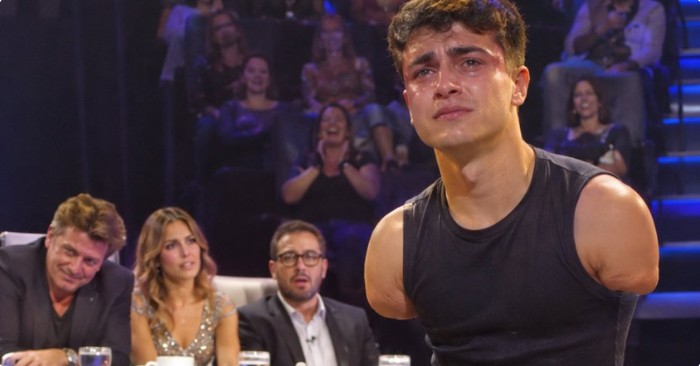
Bence took a deep breath. He positioned the two drums so that he could reach their surfaces using his upper arms and movements of his shoulders and upper body.
At first, there were slow, deep drumbeats. Then came a faster rhythm, with delicately alternating beats.
The audience fell silent.
Nobody was laughing anymore.
Bence’s entire body moved in harmony with the music. Behind every beat, you could sense years of practice, pain, and stubborn determination.
But at the end of the third minute, something unexpected happened.
András, the oldest judge on the panel, lowered his head and began to cry.
The host approached him.
“Is everything all right?”
András didn’t answer. He simply watched the young man, who was now finishing the melody.
When the final drumbeat faded away, the audience rose to its feet in applause.
Bence smiled shyly.
Then András raised his hand.
“May I ask what your grandmother’s name was?”
“Erzsébet Varga.”
The man’s expression suddenly changed.
“Was she the one who taught you to play music?”
“Yes. When everyone told me I would never be able to do it, she placed two old drums in front of me. We practiced every single day.”
András slowly stood up.
“Erzsébet was my music teacher too.”
A stunned silence fell over the room.
Bence stared at him in confusion.
“But she never mentioned you.”
“Because she didn’t like telling people how much she had done for others,” András explained.
The man revealed that thirty years earlier, he had attended a music school in a small rural town. His family was poor and couldn’t afford to pay for lessons. But Erzsébet taught him anyway, often without charging anything.
“There was a special rhythm she always played,” he continued. “She used to say that even our mistakes could be turned into music.”
Tears began flowing down Bence’s cheeks again.
“That’s exactly what she used to tell me.”
Then he pulled out the worn photograph.
András raised his hand to his mouth. The picture showed Erzsébet sitting beside the two drums, with a young boy standing behind her.
That boy was András.
“I’ve been looking for this photograph for years,” he whispered.
Bence explained that his grandmother had passed away three months earlier. During the final weeks of her life, she could barely speak, but one evening, she gently squeezed her grandson’s shoulder.
“Promise me that one day you’ll perform our song on a big stage.”
At the time, Bence hadn’t even dared to apply for a competition.
But his grandmother had already filled out the talent show’s application form for him.
“She told me that if people laughed at me, I shouldn’t be angry with them. I should just keep playing until they finally heard what I was trying to say.”
At that moment, András walked over to him and wrapped his arms around him in a tight embrace.
The audience rose to its feet once again.
Bence didn’t win the competition that day. But he advanced to the next round, and after his performance, András offered to help him prepare for what came next.
A few weeks later, Bence returned to the stage.
This time, he placed an empty chair beside the drums.
He put his grandmother’s photograph on it.
Before he began playing, he said just a few words:
“Now I understand that what makes me different isn’t the fact that I don’t have hands. It’s that someone believed in me even when I could no longer believe in myself.”
And when the first drumbeat sounded, nobody in the audience laughed.
Because by then, everyone understood: music isn’t born in the hands, but in a heart that never gives up.