The entire courtyard froze.
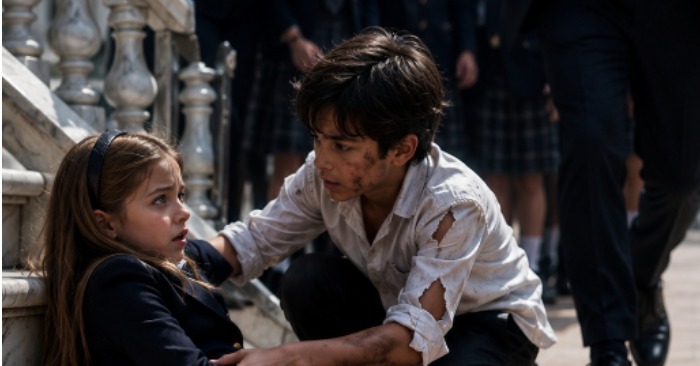
The girl was still on the ground, her knees shaking and one hand pressed tightly against her chest.
The boy was beside her.
He didn’t move.
Not because he didn’t want to.
But because everyone was looking at him as if they had already condemned him.
“He pushed her,” one student repeated from the staircase.
The words spread quickly.
Like fire.
Like poison.
Like the kind of lies people accept faster when they point at the child with the least power.
The boy’s name was Mateo.
He was twelve years old.
He studied at that school thanks to a scholarship.
His uniform was never as clean as the others’.
His shoes didn’t shine.
One corner of his backpack had been stitched together with black thread.
And from the very first day, he had learned one silent rule:
if something went wrong, everyone looked at him first.
The girl on the ground was named Valentina.
The daughter of an important businessman.
She arrived every morning in a private car.
She had private tutors, a reserved table in the cafeteria, and a father who called the principal by her first name.
So when Valentina fell and Mateo appeared beside her, nobody asked what had happened.
They just shouted.
Valentina’s father crossed the courtyard like a storm.
“Don’t touch her!”
Mateo immediately raised his hands.
They were scraped.
A thin line of blood crossed his right palm.
“I only tried to—”
“Be quiet!”
The word hit him.
Not physically.
But it hurt all the same.
The principal arrived behind them, pale-faced, phone in hand.
“Mateo, I need you to step away.”
Valentina lifted her head.
“No…”
Her voice was small.
Almost lost beneath the murmuring students.
But Mateo heard her.
So did her father.
“Sweetheart, don’t talk. I already called the doctor.”
Valentina struggled to breathe.
“He didn’t push me.”
The courtyard fell silent again.
Her father blinked.
“What?”
Valentina looked at Mateo.
Her eyes filled with tears.
“He caught me.”
Mateo lowered his gaze.
The principal frowned.
“Valentina, you were in shock. Maybe you don’t remember clearly.”
The girl pressed her lips together.
“Yes, I do.”
Pause.
“I was about to fall down the stairs.”
Her father slowly turned toward the staircase.
Then Mateo pointed at the railing.
“There.”
Everyone looked.
At first, nobody saw anything.
Just the elegant staircase.
Light marble.
Shiny metal railing.
Decorative flowers along the wall.
Everything perfect.
Too perfect.
Until a screw fell.
Small.
Dry.
Metallic.
It rolled down one step and stopped beside the principal’s shoe.
The sound was tiny.
But it changed everything.
A teacher stepped closer.
Touched the railing.
The piece moved.
Not much.
But enough.
The principal lost her breath.
“That can’t be like this…”
Mateo spoke quietly.
“It was like that since this morning.”
Valentina’s father looked at him.
“How do you know?”
Mateo swallowed hard.
“Because I reported it.”
Silence.
“To who?” the principal asked.
Mateo looked toward the group of students.
A tall boy lowered his eyes.
Another pretended to stare at the floor.
A young teacher covered her mouth with one hand.
“I told two students not to lean on it,” Mateo continued. “Then I told the maintenance man.”
The principal turned toward the school janitor.
The man went pale.
“I… thought it was just an excuse for being late to class.”
Mateo closed his eyes.
He didn’t seem surprised.
That hurt even more.
Valentina started crying.
“I leaned on it.”
Everyone looked at her.
“The railing moved. I felt myself falling backward.”
Mateo clenched his hands.
“I saw her from below.”
His voice cracked slightly.
“I ran. I couldn’t stop her from hitting the ground, but I stopped her from falling down the stairs.”
Valentina’s father looked over the edge.
Several meters below was the hard courtyard floor.
All the color drained from his face.
For the first time, he understood.
If Mateo hadn’t run…
If he hadn’t used his hands…
If he hadn’t taken the impact with her…
His daughter wouldn’t be crying on the ground.
She might be in an ambulance.
Or worse.
Valentina’s father turned toward Mateo.
But before he could speak, another student said:
“I saw him run toward her.”
Everyone turned.
It was a boy from Valentina’s class.
His voice trembled.
“He didn’t push her. He grabbed her backpack.”
A girl added:
“I saw it too.”
Another student lowered his head.
“I was the one who shouted that he pushed her.”
The courtyard became completely still.
Mateo looked at him.
Not angrily.
Just tired.
“Why?” Valentina asked from the ground.
The boy didn’t answer.
The principal repeated:
“Why did you say that?”
The student swallowed nervously.
“Because… because I saw Mateo next to her.”
Pause.
“And I thought…”
He didn’t finish.
He didn’t have to.
Everyone understood.
He thought what many were already ready to believe.
That the scholarship boy was guilty.
Because it was easier to believe that than admit the perfect school had a dangerous railing.
Valentina looked at Mateo.
“I’m sorry.”
He slowly shook his head.
“You didn’t do anything.”
“But everyone accused you because of me.”
Mateo lowered his eyes.
“It’s not the first time.”
Valentina’s father felt something hit his chest.
The sentence wasn’t dramatic.
It wasn’t exaggerated.
It was simple.
And that was why it hurt.
The school ambulance arrived in the courtyard.
A nurse checked Valentina.
No visible fractures.
Just bruises.
Fear.
Pain.
Mateo tried to step away.
The principal stopped him.
“You’re hurt too.”
“I’m fine.”
“Your hand is bleeding.”
Mateo looked at his palm as if it didn’t matter.
“It’s nothing.”
Valentina spoke firmly:
“Yes, it does matter.”
Everyone looked at her.
“He fell too.”
The nurse approached Mateo.
He hesitated.
He wasn’t used to being cared for first.
Or second.
Sometimes he wasn’t cared for at all.
But Valentina reached a hand toward him.
“Come here.”
Mateo slowly stepped closer.
The nurse cleaned his wound.
He clenched his teeth but didn’t complain.
Valentina’s father knelt in front of him.
“Mateo.”
The boy tensed up.
“I’m sorry.”
Mateo didn’t raise his eyes.
“You don’t have to be.”
“Yes, I do.”
The man took a deep breath.
“I saw you beside my daughter and assumed the worst.”
Mateo kept staring at his hand.
“Everyone assumed the worst.”
The father closed his eyes.
“I know.”
Valentina pushed herself up slightly.
“Dad, he warned them.”
Her father looked at the principal.
“Why didn’t anyone check the railing?”
The principal tried to answer calmly.
“We’ll open an internal investigation.”
“No.”
His voice changed.
He was no longer a furious father attacking a child.
He was a furious father attacking a system.
“The investigation starts now. And not to blame the boy who saved my daughter.”
The janitor lowered his head.
“I should have checked it.”
Mateo spoke softly.
“I didn’t want to get him in trouble.”
The man looked at him with shame.
“And yet I got you into trouble instead.”
That sentence silenced everyone.
The principal inhaled deeply.
“Mateo, I need you to tell me exactly who you warned.”
For the first time, he looked directly at her.
“Now you want to listen?”
The question was small.
But it took the air out of the principal’s lungs.
“Yes,” she whispered. “Now we do.”
Mateo looked at the students.
The teachers.
The stairs.
The broken railing.
“There’s no point listening to me only after someone falls.”
Nobody answered.
Because it was true.
Valentina started crying again.
“Mateo…”
He looked at her.
“Thank you for telling the truth.”
She shook her head.
“Thank you for coming back for me even though you knew they might blame you.”
Mateo tightened the bandage the nurse had just wrapped around his hand.
“My mom cleans houses.”
Pause.
“She always says there are places where people don’t see you until they need someone to blame.”
Valentina’s father lowered his gaze.
So did the principal.
Mateo continued:
“I didn’t want them to notice me today.”
He looked at Valentina.
“I just didn’t want her to fall.”
The silence that followed felt different.
Cleaner.
More ashamed.
More human.
The railing was removed that same afternoon.
But the real damage wasn’t only in the metal.
It was in how quickly everyone had chosen a culprit.
In the habit of ignoring people who didn’t seem important.
In the comfort of labeling the only child who tried to help as the problem.
Days later, the school gathered all the students together.
The principal stepped onto the stage.
Valentina sat in the front row with a bandage on her arm.
Mateo stood at the back.
Trying to go unnoticed.
But Valentina stood up.
Walked over to him.
Took his bandaged hand.
And led him to the front.
The entire auditorium watched them.
The principal spoke:
“Today we are not going to pretend that only a railing was broken.”
Pause.
“Our way of listening was broken too.”
Mateo looked at the floor.
Valentina squeezed his hand.
The principal continued:
“Mateo warned us. Nobody listened. Then he helped. And he was accused.”
The silence was absolute.
“That can never happen here again.”
The student who had shouted the accusation stood up with tears in his eyes.
“I’m sorry.”
Mateo looked at him.
He didn’t answer immediately.
Then he said:
“Next time, look first.”
Pause.
“Then speak.”
That was all.
But it was enough.
Valentina’s father funded a complete safety inspection of the school.
Ramps.
Railings.
Doors.
Stairs.
Courtyards.
Not for appearances.
But because his daughter asked him to.
As for Valentina, she started sitting with Mateo during lunch.
At first everyone stared.
Then they stopped staring.
Or maybe they simply started seeing things more clearly.
They discovered Mateo knew how to fix backpacks, bicycles, broken zippers, and problems nobody else noticed.
Not because he was “the poor boy who helped.”
But because he had spent his entire life learning how to observe.
Months later, the school created a program where any student could report dangers without being ignored or mocked.
At the entrance to the courtyard, they placed a small plaque:
“Listening in time saves lives too.”
Valentina read it beside Mateo.
“That was because of you,” she told him.
Mateo shook his head.
“It was because of the railing.”
Valentina smiled.
“No.”
Pause.
“It was because of the hand that held me when everyone else was ready to point at it.”
Mateo didn’t know what to say.
He simply looked at his palm.
The scar was already healing.
Small.
Visible.
Real.
And every time he looked at it, he remembered that helping people sometimes costs something.
It costs pain.
It costs fear.
It costs being accused before being understood.
But he also remembered something else:
a girl fell less far because he ran.
And an entire school learned too late that heroes do not always arrive wearing shining uniforms.
Sometimes they arrive with a scholarship, an old backpack, and the courage to act even when they know nobody will believe them at first.