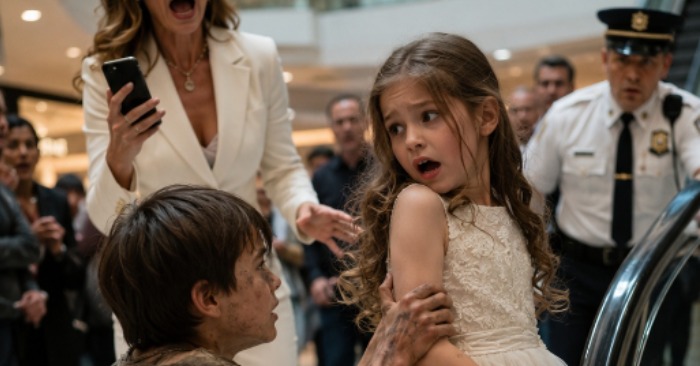
The entire mall froze.
The escalator was still moving.
The white dress, now empty, was trapped between the metal steps, twisting like a torn flag.
The girl was on the floor, trembling.
The boy was still beside her, breathing hard, one hand stretched out as if he could still save her again if he had to.
The mother looked at the trapped fabric.
Then at her daughter.
Then at the boy.
All the color had drained from her face.
Just seconds earlier, she had called him dangerous.
She had screamed for security.
She had pushed him in front of everyone.
And now she understood that if that boy had not run, her daughter would have been attached to that fabric.
“Turn off the escalator!” someone shouted.
A guard pressed the emergency button.
The mechanism stopped with a sharp jolt.
The silence afterward was worse.
The girl began to cry.
“Mom…”
The mother dropped to her knees and hugged her.
“I’m here, sweetheart. I’m here.”
But the girl was not looking at her mother.
She was looking at the boy.
“He saved me.”
The boy lowered his gaze.
“I just saw the dress.”
The mother swallowed.
“I… I didn’t see it.”
He did not answer.
He was about ten years old.
A worn T-shirt.
Old shoes.
A small backpack with a broken zipper.
He did not look like someone who belonged in that place of shining storefronts, expensive perfumes, and designer bags.
And perhaps that was why everyone had believed the worst so quickly.
A guard approached.
“Are you okay, little one?”
The boy nodded.
But his face said something else.
The mother reached a hand toward him.
“Forgive me.”
The boy took a step back.
Not out of anger.
Out of habit.
As if he expected any elegant adult to go from apology to shouting in a single second.
“I didn’t want to touch her,” he said.
His voice trembled.
“I just wanted her to move away.”
The girl wiped her tears.
“How did you see it so fast?”
The boy looked at the escalator.
The fabric was still trapped.
The edge of the dress had disappeared between the metal teeth.
“Because I had already seen how it happens.”
The mother closed her eyes.
She understood before asking.
But the girl did not.
“With who?”
The boy pressed his lips together.
“With my sister.”
The air changed.
It was no longer just fear.
It was pain.
The guard lowered his gaze.
The mother stopped hugging her daughter for a moment and looked at the boy more carefully.
“What happened?”
The boy did not want to tell it.
That was obvious.
But he also seemed as if he had been carrying that scene alone for too long.
“She had a long dress.”
Pause.
“Not as pretty as hers.”
He looked at the girl.
“But long.”
The girl stopped crying.
“And it got caught?”
He nodded.
“My mom was carrying bags. I was behind them. My sister got on first.”
His voice broke.
“The fabric got trapped. Everyone started screaming. I tried to pull her, but I was little.”
The mother covered her mouth.
“My God…”
“She didn’t die,” he said quickly, as if he needed to make that clear before the world imagined the worst.
Pause.
“But she got hurt badly. And since that day, she doesn’t like going out.”
The girl lowered her gaze.
The boy continued:
“Now, when I see long dresses near escalators, I can’t stop watching.”
The guard took a deep breath.
“That isn’t a bad thing.”
The boy looked at him.
“Sometimes people get angry when you look too much.”
The sentence fell over everyone.
The mother felt it burn.
Because that was exactly what she had done.
She had seen a poor boy touching her daughter and had decided the entire story in less than a second.
She did not ask.
She did not look.
She did not listen.
She only accused.
The girl stood up with her mother’s help.
Her dress was torn on one side, but she was unharmed.
She walked toward the boy.
“What’s your name?”
“Tomás.”
“I’m Emilia.”
He nodded, not knowing what to do.
Emilia looked at her arm.
“You grabbed me hard.”
Tomás lowered his head.
“I’m sorry.”
“No.”
She surprised him.
“If you hadn’t, something would have happened to me.”
The mother knelt again, this time in front of Tomás.
“Tomás, I owe you a real apology.”
He said nothing.
“I saw you as a threat because you didn’t look like someone from our world.”
The sentence was harsh.
But honest.
“And my daughter is okay because you saw what I didn’t.”
Tomás breathed with difficulty.
“You don’t have to give me anything.”
“I’m not trying to pay you.”
The mother stopped.
She searched for the words.
“I’m trying to learn not to fail again.”
The guard called the maintenance team.
The escalator was closed.
A technician carefully removed the dress.
When the fabric came out, everyone saw how forcefully it had been trapped.
A murmur passed through the place.
The mother took Emilia’s hand.
“I don’t want to imagine it.”
Tomás spoke quietly:
“That’s why I ran.”
The girl looked at him.
“Is your sister here?”
Tomás shook his head.
“She’s at home.”
“What’s her name?”
“Lucía.”
Emilia smiled faintly.
“I’d like to meet her.”
Tomás looked at her, surprised.
“What for?”
“To tell her that her brother saved me because he remembers her.”
The boy’s eyes widened.
The sentence hit him in a way no one expected.
For a long time, he had felt that what happened to Lucía was a shadow.
A fear.
A scene that made him check edges, fabrics, doors, wheels, steps.
But Emilia had just given it another name.
Memory.
Help.
Love.
The mother took a breath.
“Where is your mom?”
Tomás pointed toward a café in the mall.
“She works cleaning tables.”
The woman looked that way.
Then at her daughter.
Then at Tomás.
“I want to speak with her.”
The boy tensed.
“Not so she gets in trouble.”
“No.”
The mother quickly shook her head.
“To thank her.”
Tomás hesitated.
“My mom always thinks that if they call her, it’s because something bad happened.”
The mother lowered her gaze.
“Then we’ll go slowly.”
They walked together to the café.
Tomás’s mother was clearing glasses from a table when she saw her son with an elegant woman, two guards, and a girl with a torn dress.
Her face changed immediately.
“Tomás, what happened?”
He opened his mouth, but he couldn’t speak.
Emilia stepped forward.
“Your son saved me.”
The woman froze.
“What?”
Emilia’s mother told her everything.
Without embellishment.
Without softening her own mistake.
She said she had shouted.
That she had accused him.
That she had not looked.
And that Tomás had seen the danger before everyone else.
Tomás’s mother brought a hand to her chest.
“My boy…”
She hugged him tightly.
Tomás tried to stay strong, but when he felt his mother’s arms, he broke.
“It was like Lucía, Mom.”
She closed her eyes.
“I know.”
“I didn’t want it to happen again.”
“I know, my love.”
Emilia’s mother listened in silence.
She no longer saw only the boy who had saved her daughter.
She saw a family that had learned to live with a wound no one around them knew about.
Emilia walked toward Tomás.
“Thank you for running.”
Tomás wiped his face with his sleeve.
“Thank you for believing me afterward.”
The sentence was small.
But Emilia’s mother felt it like a lesson.
Afterward.
Always afterward.
After shouting.
After accusing.
After almost losing something.
That afternoon, the mall changed its protocols.
Not because of a lawsuit.
Not because of a campaign.
Because a mother insisted.
They placed visual warnings near the escalators.
They trained the staff to stop them faster.
They reviewed risk areas for long clothing, loose shoelaces, and baby strollers.
But Emilia asked for something more.
She asked for Tomás and Lucía to be invited on the day they presented the new measures.
Lucía arrived holding her mother’s hand.
She was a thin girl, with a shy gaze and a simple dress that reached only to her knees.
She did not want to go near the escalator.
Tomás stood beside her.
“You don’t have to get on.”
Lucía squeezed his hand.
“What if I want to look?”
“Then we’ll look.”
Emilia approached slowly.
“Your brother helped me because he loves you very much.”
Lucía looked at Tomás.
He lowered his head, embarrassed.
“He always checks everything for me,” she said.
Emilia smiled through tears.
“Today he checked for me too.”
Emilia’s mother, listening behind them, then understood the deepest part of help.
Tomás had not acted to be a hero.
He had not acted to receive applause.
He had acted because pain had trained him to look.
And that gaze had saved her daughter.
Months later, Tomás began collaborating with the mall’s child safety program.
Not as an official employee.
As an invited voice.
As someone who knew how to explain in simple words what adults sometimes make too complicated:
“If something gets caught, don’t pull the person. Turn it off first.”
“If a child shouts, look before judging.”
“If someone runs toward danger, maybe they aren’t causing the problem. Maybe they saw it before you did.”
Little by little, Lucía began walking through malls again without holding her mother’s hand so tightly.
Emilia and Tomás became friends.
Not the perfect kind of friends from a storybook.
Real friends.
With different worlds.
With different lives.
But joined by one second in which he ran and she survived.
And every time Emilia saw an escalator, she remembered the pull on her arm.
Her mother’s scream.
The trapped fabric.
And Tomás’s voice saying:
“I didn’t want to touch her. I wanted it not to happen again.”
Because sometimes help arrives in a way that frightens you at first.
It arrives fast.
It arrives roughly.
It arrives without asking permission.
But if you look closely, you discover it was not coming to do harm.
It was running from an old wound…
to prevent another family from learning the same pain too late.