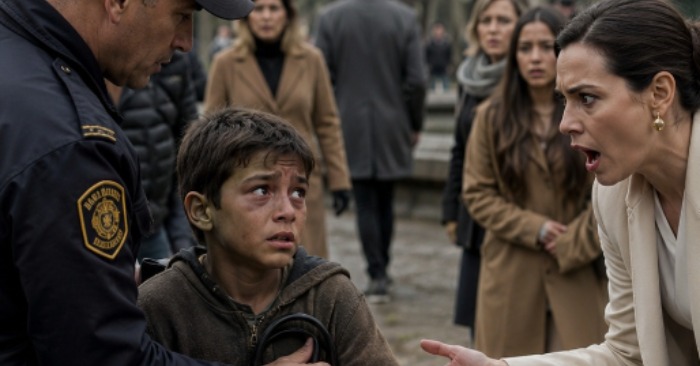
The guard was still holding the boy by the arm.
The elegant woman was breathing heavily in front of him.
Her expensive purse was open.
Everything inside was a mess.
The wallet.
A handkerchief.
A phone.
A pair of glasses.
And in the boy’s trembling palm was a small key.
Silver.
Taped beneath the inner lining.
The woman stared at it without blinking.
—That key isn’t mine —she whispered.
The boy looked up.
—That’s why I ran.
The guard loosened his grip slightly.
—What are you saying?
The boy didn’t answer right away.
He looked toward the trees.
Toward the side path of the park.
Toward the man in the gray coat who was walking too quickly, without looking back… but glancing sideways.
—He put it there —the boy said.
The woman spun around.
—Who is he?
—I don’t know.
—Do you know him?
The boy shook his head.
—I saw him earlier.
The woman clutched the purse to her chest.
—Where?
The boy swallowed.
—On the street outside your building.
Silence fell over everyone.
The guard looked at the boy with suspicion.
—And what were you doing on the street outside her building?
The boy lowered his gaze.
—I collect cardboard with my brother.
A woman watching nearby lowered her head, ashamed that she had shouted “thief” only seconds earlier.
The boy continued:
—I saw the man waiting by the entrance. When you came out, he walked behind you. Then, here in the park, he sat on the bench beside you.
The woman felt cold.
She remembered the man.
Not his full face.
Only a gray coat.
A folded newspaper.
A quick glance when she left her purse beside the bench.
—I was there —the boy said—. Near the fountain.
The guard looked around.
—And why didn’t you say anything?
The boy lifted his eyes.
—Would you have believed me?
No one answered.
Because everyone knew the answer.
No.
They would not have believed him.
A boy with worn clothes, a torn backpack, and wet shoes, in a park full of people who had learned to look at appearance first and truth afterward.
The woman swallowed.
—How did they put the key in my purse?
The boy pointed to the side of the purse.
—When you were talking on the phone. He dropped some coins near your foot. You looked down. He touched the purse.
The woman remembered the metallic sound.
The coins on the ground.
Herself barely leaning down.
The man apologizing with a smile.
Everything had seemed normal.
Too normal.
The guard took the key.
—I’m calling the police.
The boy reacted quickly.
—Wait.
The guard frowned.
—Why?
—Because it wasn’t just a key.
The woman felt her stomach tighten.
—What else did you see?
The boy carefully slipped his fingers into the open lining of the purse.
He took out a small folded card.
It wasn’t a bank card.
It wasn’t an ordinary note.
It was a paper tag with an address written on it.
The woman’s address.
Floor.
Number.
Entry code.
She covered her mouth with her hand.
—No…
The guard became serious immediately.
—Ma’am, is that your address?
She couldn’t speak.
She only nodded.
The boy pointed toward the trees again.
—He was going to get back to your house before you.
The sentence left the park motionless.
The woman looked at the boy.
She no longer saw him as a thief.
She no longer saw only his wet clothes, his old backpack, or his dirty hands.
She saw someone who had understood in seconds what all the adults around him had failed to see.
—How did you know that? —she asked.
The boy pressed his lips together.
His face changed.
As if that question opened a door he didn’t want to touch.
—Because it happened to my mom once.
The guard lowered his gaze.
The woman moved a little closer.
—What happened?
The boy took a deep breath.
—A man followed her from the market. She thought he was just going down the same street. Then her keys disappeared.
Pause.
—That night they got into our room.
The woman closed her eyes.
The guard murmured:
—I’m sorry.
The boy didn’t answer the guard.
He was looking at the woman.
—Since then, I watch people’s hands.
Pause.
—And purses.
The woman began to cry.
Not dramatically.
Her eyes simply filled with tears.
Because seconds earlier that same gaze had made her shout at him.
Accuse him.
Demand that he be caught.
And now she understood that he had run not toward her purse…
but toward a danger she didn’t know she was carrying.
The guard spoke into his radio.
—I need support at the central fountain. Possible stalking and tampering with belongings.
The man in the gray coat quickened his pace.
The boy saw him.
—He’s leaving.
The guard ran after him.
Two park employees blocked a side exit.
The man tried to blend into the crowd.
But this time everyone was watching.
A street vendor pointed to the right.
A woman with a baby stroller indicated the path.
A runner stopped and blocked the way.
The same crowd that had accused the boy began, late, to help.
The man was stopped near the fence.
There was no fight.
No long shouting.
Only his pale face when they found another card in his pocket.
Another address.
Another code.
The woman felt her legs weaken.
She sat on the bench.
The boy remained standing in front of her, not knowing if he could leave.
She looked up.
—What’s your name?
—Samuel.
—Samuel…
Her voice broke.
—Forgive me.
He lowered his eyes.
—You thought I was stealing.
—Yes.
—Everyone thought that.
The woman looked at the people around them.
Many lowered their gaze.
The guard returned, more serious and more human.
—Samuel, I owe you an apology too.
The boy said nothing.
The guard swallowed.
—I grabbed you before listening to you.
Samuel looked at his arm.
There was a red mark from the guard’s fingers.
The woman saw it.
And it destroyed her.
—You got hurt for helping me.
Samuel shrugged.
—I’m used to it.
That sentence was worse than any crying.
The woman slowly stood up.
—You shouldn’t be.
He didn’t answer.
He seemed not to know what to do with an adult who, suddenly, spoke without shouting.
—Where is your brother? —she asked.
Samuel looked toward the fountain.
A smaller boy was hiding behind a column, hugging a bag of cardboard.
—There.
The little boy didn’t come closer.
He was afraid.
The woman understood why.
Because they had just watched his brother be treated like a criminal for doing the right thing.
—Can I talk to him? —she asked.
Samuel hesitated.
—He doesn’t like elegant people.
The woman let out a broken, sad laugh.
—Today I understand why.
She didn’t approach suddenly.
She didn’t invade their space.
She only crouched down at a distance.
—Thank you for waiting for your brother.
The little boy didn’t answer.
Samuel went to him.
He whispered in his ear.
The little boy looked at the woman.
Then at the purse.
Then at the guard.
—They’re not going to take you away anymore?
Samuel shook his head.
—No.
The little boy slowly came closer.
—Were you right?
Samuel nodded.
The younger boy hugged him.
—You always look too much.
Samuel closed his eyes.
—Someone has to look.
The woman covered her mouth.
That sentence stayed lodged inside her.
Someone has to look.
She lived in a building with a doorman, cameras, and expensive locks.
She carried a designer purse.
She had contacts.
Security.
Comfort.
And still, she had not looked.
Samuel, on the other hand, had almost nothing.
But he had attention.
Attention born from fear.
From memory.
From a night when no one looked in time.
The police arrived minutes later.
They took statements.
Reviewed park cameras.
Confirmed that the man had been following the woman from several streets back.
They also confirmed that Samuel had seen everything.
The park guard asked that it be included in the report.
—The minor prevented the lady from leaving with the hidden key in her purse.
Samuel heard that sentence as if it weren’t about him.
The woman, whose name was Laura, asked him:
—Do you have anyone to call?
Samuel nodded.
—My mom works at a laundromat.
—Does she know you’re here?
—Yes. She waits for us when we finish collecting.
Laura looked at the bag of cardboard.
—Can I walk with you?
Samuel tensed.
—Why?
—To tell her what happened.
—She’ll get scared.
—Then I’ll tell her slowly.
Samuel watched her.
No longer with fear.
With caution.
Like someone who has learned that good intentions also have to be proven.
—We don’t want trouble.
Laura nodded.
—Neither do I.
Pause.
—But today you saved me from very big trouble.
The laundromat was four streets away.
Laura walked with them.
Not ahead.
Not behind.
Beside them.
The guard walked with them to the corner and then returned to the park, still ashamed.
Samuel’s mother was folding sheets when she saw them come in with an elegant woman.
Her face changed.
—Samuel, what happened?
Samuel opened his mouth, but Laura spoke first.
—Your son saved me from something serious.
The woman dropped a sheet.
—What did he do?
Laura told her everything.
Without turning it into false heroism.
Without hiding her own mistake.
She said she had shouted.
That she had accused him.
That she had called for help against him before understanding that he was helping her.
Samuel’s mother listened with a hardened face.
Not from lack of gratitude.
From exhaustion.
—People always believe my son too late.
Laura lowered her gaze.
—Today I did too.
—At least you say it.
Samuel looked at his mother.
—Mom, he had her address.
The woman closed her eyes.
She knew that fear.
Too well.
She hugged her sons.
—You did the right thing.
Samuel took a deep breath.
As if he had been waiting for those three words all day.
Laura opened her purse.
Then stopped.
She didn’t take out money.
She understood that it wasn’t the moment.
—I want to help, but I don’t want to offend you.
Samuel’s mother looked at her.
—Then don’t start with money.
Laura nodded.
—What should I start with?
The woman pointed at Samuel.
—By believing him when he speaks.
Laura raised her eyes to the boy.
—I can do that.
Days later, the police discovered that the man in the gray coat was part of a group that marked the addresses of distracted people in parks, cafés, and shopping centers.
They didn’t always steal in the moment.
Sometimes they prepared everything for later.
Hidden keys.
Codes.
Routines.
Purses.
Small details no one checks.
Laura didn’t want the story told as “poor boy tries to steal and saves rich woman.”
She asked that it be told properly:
a boy saw something strange.
He tried to warn her.
He knew no one would listen.
And he acted.
With fear.
With risk.
With the weight of being misunderstood.
In the park, the guard pushed for a new protocol: before accusing a minor, separate, ask questions, and review the whole situation.
Laura began working with the laundromat where Samuel’s mother worked, not as a photo-op benefactor, but as a real customer. She also arranged for the building where she lived to hire services from the neighborhood under fair conditions.
Samuel didn’t suddenly become a famous child.
He didn’t want that.
He kept going to the park.
Kept taking care of his brother.
Kept watching hands, purses, doors, and keys.
But something changed.
When the guard saw him, he no longer followed him with suspicion.
He greeted him by name.
And one afternoon, Laura returned to the park with a small bag.
It wasn’t money.
It was a notebook.
On the first page, she had written:
“For Samuel, who looks when others don’t.”
He opened it.
It was empty.
—What is it for?
Laura smiled.
—So you can write down everything you see.
Samuel looked at her seriously.
—I see a lot of things.
—I know.
Pause.
—That’s why maybe one day you’ll be able to help more people.
Samuel touched the cover.
His little brother leaned in to look.
—Are you a detective now?
Samuel almost smiled.
—No.
He looked toward the fountain.
Toward the bench.
Toward the place where everyone had called him a thief before knowing the truth.
—I just don’t want anyone to say again that they didn’t see something coming… when someone did see it.
Because that day, in an ordinary park, a boy didn’t steal a purse.
He pulled it away from a trap.
And forced everyone to understand something uncomfortable:
sometimes help comes running so fast that it looks like guilt.
But if you stop and look closely…
it may be exactly what just saved you.