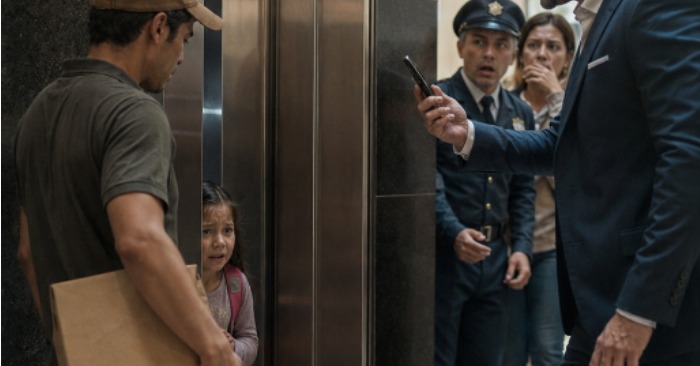
The lobby fell silent.
The elevator doors were still half open.
The delivery man’s foot was trapped between the metal and the frame, but he did not pull it back.
The guard was holding him by the arm.
The elegant man still had his phone in his hand.
And the girl inside the elevator had eyes full of tears.
—What’s going on? —the man asked, no longer shouting.
The delivery man pointed at the floor.
—Her backpack.
Everyone looked.
At first, no one understood.
Then they saw it.
A thin cord, almost invisible, was coming out of the girl’s backpack and was trapped between the elevator doors.
The other end was still fastened to her shoulder.
If the elevator had gone up, the cord would have pulled her hard.
The father dropped his phone.
—No…
The girl began to cry.
—Dad, I told you something was pulling me.
The impact was immediate.
The man looked at her.
—What?
—I told you.
Pause.
—Three times.
The entire lobby seemed to run out of air.
The guard let go of the delivery man.
—I’m sorry.
The delivery man carefully pulled his foot back.
His shoe was marked from the pressure of the door, but he didn’t complain.
He crouched in front of the elevator.
—Don’t move, little one.
The girl nodded.
The father took a step toward her, but the delivery man raised one hand.
—Wait.
The man tensed.
—She’s my daughter.
—And right now she’s scared.
Pause.
—Ask her before touching the backpack.
The sentence landed hard.
It wasn’t an insult.
It wasn’t humiliation.
It was a lesson.
The father looked at his daughter.
For the first time in the whole scene, he didn’t look at the clock.
He didn’t look at his phone.
He didn’t look at the guard.
He looked at her.
—Sofía… can I help you?
The girl cried harder.
But she nodded.
The delivery man carefully loosened the trapped cord.
The guard kept the doors open.
A neighbor put a hand to her chest.
Another person murmured:
—It could have been terrible.
The father knelt in front of his daughter once the cord was free.
—Forgive me.
Sofía didn’t answer right away.
She hugged her backpack to her chest.
—You’re always in a hurry.
The man closed his eyes.
The phrase was small.
But it destroyed him.
—I know.
—You always say “one second.”
—I know.
—But it’s never one second for me.
The delivery man lowered his gaze.
He didn’t want to hear an intimate conversation.
But he was already there.
And, somehow, everyone in the lobby was too.
The girl looked at the delivery man.
—Thank you.
He smiled faintly.
—I’m glad I heard you.
The father turned toward him.
—How did you hear her from there?
The delivery man pointed to the building entrance.
—I was leaving a package at reception. I heard her say, “Dad, wait.”
Pause.
—Then she said it again.
The man swallowed.
—I was on a call.
The delivery man didn’t answer.
He didn’t need to.
The girl wiped her face.
—He listened to me.
The father lowered his head.
The guard tried to soften the moment.
—It was an accident. These things happen.
The delivery man looked at him.
—No.
The guard froze.
—Accidents happen. But ignoring a child shouldn’t happen.
The sentence stayed floating in the lobby.
The father looked up.
For a moment, he seemed to want to defend himself.
To say he was a busy man.
That he worked hard.
That he did everything for his daughter.
That the meeting was important.
That it had only been a mistake.
But he looked at Sofía.
And said nothing.
Because no excuse sounded right in front of her tears.
—What’s your name? —Sofía asked the delivery man.
—Mateo.
—I’m Sofía.
—I know.
The girl frowned.
—How?
Mateo pointed to a small label on her backpack.
—It’s written there.
Sofía looked at the label.
Then she smiled faintly.
—You really look at everything.
Mateo lowered his gaze.
—Sometimes you have to look.
The father noticed the tone.
—Why do you say it like that?
Mateo took a deep breath.
He didn’t want to tell it.
But Sofía was looking at him with that clean attention children have when they feel someone has truly done something for them.
—My little brother once got trapped in an automatic door.
The lobby fell silent again.
—It wasn’t serious —he said quickly—. But everyone was looking at their phones. I was the only one who saw it.
Sofía grew very serious.
—Was he scared?
Mateo nodded.
—Very.
Pause.
—Since then, I listen when a child says “wait.”
The father closed his eyes.
That sentence left him defenseless.
Mateo wasn’t a hero looking for recognition.
He was someone trained by an earlier scare.
Someone who knew that the word “wait” can sound small to an adult, but enormous to a child who doesn’t control the situation.
The building manager appeared beside the elevator.
—Is there a problem?
The guard began to explain.
The father interrupted him.
—I was the problem.
Everyone looked at him.
He took a deep breath.
—My daughter asked me to wait, and I didn’t listen to her. This young man stopped the elevator from starting with the cord trapped.
The manager looked at Mateo.
—Thank you.
Mateo nodded, uncomfortable.
—I only did what had to be done.
The father looked at his shoe.
—The door hurt your foot.
—I’m fine.
—You’re not.
—I can work.
The father understood something in that answer.
Mateo wasn’t saying “I’m fine” because it was true.
He was saying it because maybe he couldn’t afford not to be fine.
—Are you delivering packages in this building?
Mateo nodded.
—Yes.
—Will they deduct money because of the delay?
Mateo didn’t answer.
That was answer enough.
The father picked up the phone from the floor.
But he didn’t make a business call.
He called the delivery company.
—One of your delivery workers just prevented an accident in my building. His name is Mateo. The delay on this route is my responsibility.
Mateo looked up, surprised.
—You didn’t have to.
The man hung up.
—Yes, I did.
Sofía took her father’s hand.
—Dad.
He crouched down.
—Yes.
—The meeting can wait.
The man looked at her.
For years he had thought “it can wait” was a dangerous phrase.
Contracts don’t wait.
Clients don’t wait.
Emails don’t wait.
Bosses don’t wait.
But his daughter had waited.
Too many times.
At the elevator door.
At the table.
In the car.
At school pickup.
With her hand raised, with a sentence half spoken, with a small fear that he left for later.
—Yes —he finally said.
Pause.
—It can wait.
Sofía breathed as if she had just received something enormous.
Not an expensive gift.
Not a trip.
Not a toy.
Attention.
The father turned to Mateo.
—I want to truly thank you.
Mateo took a step back.
—I don’t need anything.
—I’m not talking about money.
Mateo looked at him.
—Almost everyone talks about money.
The father lowered his gaze.
—Then I’m starting badly.
Sofía smiled a little.
—You can start by saying thank you without taking out your wallet.
The man looked at her.
—You’re right.
He turned to Mateo.
—Thank you for listening to my daughter when I didn’t.
Mateo nodded.
—Take care of her.
The sentence was simple.
But it sounded stronger than any sermon.
—I will —the father said.
Mateo picked up his delivery box and got ready to leave.
Sofía stopped him.
—Are you coming back?
—To deliver packages, yes.
—Then when you come, I’m going to say hello to you.
Mateo smiled.
—That sounds good to me.
That afternoon, the father didn’t go to the meeting.
He went upstairs with Sofía using the stairs.
Not because the elevator was still dangerous.
But because she said she didn’t want to get in yet.
And for the first time, he didn’t try to convince her.
They walked slowly.
Floor by floor.
Sofía talked more than she had in weeks.
She told him small things.
That she didn’t like when he talked on the phone while they were walking.
That sometimes the elevator scared her if it was too full.
That her backpack had had a broken cord for days.
That she had told the nanny, but no one fixed it.
The father listened to everything.
Without interrupting.
Without saying “later.”
Without looking at his phone.
When they got home, he put his phone in a drawer.
Sofía looked at him as if he had just performed magic.
—Don’t you need it?
He took a deep breath.
—I need you more.
The girl didn’t answer.
She only hugged him.
Downstairs, in the lobby, the manager ordered all the elevators to be inspected.
Not because they were broken.
Because he understood that safety does not end with the machine.
It is also in attention.
A small sign was placed near the doors:
“Before closing, look down. Listen first.”
But the real change was not the sign.
It was the father.
He started doing something new every morning.
Before leaving, he crouched in front of Sofía and asked:
—Is there anything I need to hear before I go?
At first she shrugged.
Then she began to answer.
Sometimes it was something big.
Sometimes it was only:
—Today I don’t want you to walk fast.
And he walked slower.
Mateo continued delivering packages in the building.
The first time he returned, the guard greeted him by name.
Sofía ran down to the lobby.
—Mateo!
He raised his hand.
She was wearing the backpack.
No loose cord.
—I fixed it with Dad —she said proudly.
Mateo smiled.
—Good job.
The father appeared behind her.
—And we checked the shoelaces too.
Mateo nodded.
—Better.
There was no speech.
No photo.
No applause.
Only a girl who had been heard.
A father who was learning late, but learning.
And a delivery man who continued his route, leaving packages at doors that opened and closed all day.
Because that day, Mateo did not block an elevator to bother anyone.
He blocked it because a girl said “wait,” and he knew that word could save more than it seems.
Sometimes the greatest help is not pushing someone forward.
It is stopping a door.
Stopping the rush.
And forcing the world to listen to the small voice everyone was about to ignore.