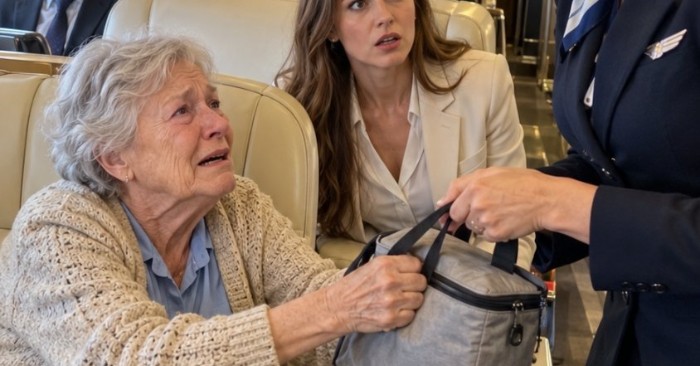
“She’s the woman who helped write the passenger-care standards your airline adopted last month.”
The attendant stared at Grace.
Eleanor looked equally confused.
“Sweetheart… what is he talking about?”
Grace gently took her grandmother’s hand.
For two years, she’d worked as an accessibility consultant, helping airlines improve their treatment of elderly passengers and travelers with medical needs.
And that morning, she was traveling on the very airline that had recently hired her team to evaluate its service.
The man introduced himself as the airline’s regional customer-experience director.
Grace hadn’t called to demand special treatment. She’d called because the attendant had ignored a passenger’s explanation, taken her belongings without permission, and discarded necessary food.
The director opened his folder.
Inside were the airline’s own passenger-care procedures.
“Did you ask whether her food was medically necessary?” he asked.
The attendant looked down.
“Did you offer to speak with the cabin supervisor?”
No answer.
“Then why did you throw away her property?”
The attendant finally whispered, “I thought she was breaking the rules.”
Grace stepped forward.
“You didn’t ask enough questions to find out.”
The cabin was completely quiet.
Then something unexpected happened.
A businessman across the aisle stood up.
“I saw everything,” he said. “That woman was polite. She begged the attendant not to take her bag.”
Another passenger nodded.
The director instructed the attendant to step into the galley while the cabin supervisor took over.
Because the food had been thrown into a trash compartment, nobody suggested serving it again.
Instead, the crew checked Eleanor’s dietary requirements and arranged a suitable replacement before departure.
The flight was briefly delayed.
Eleanor kept apologizing.
“I’m sorry everyone had to wait because of me.”
Grace knelt beside her seat.
“Grandma, you didn’t cause this.”
For the first time that morning, Eleanor began crying openly.
She wasn’t crying about the food anymore.
She was crying because someone had finally listened.
The airline opened a formal investigation. The attendant was removed from that flight while the incident was reviewed.
Grace submitted her account, and several passengers provided witness statements.
Before boarding resumed, the regional director approached Eleanor.
“I’m sorry we failed you today.”
Eleanor looked at him.
“Please make sure the next old woman doesn’t have to beg.”
He nodded.
Weeks later, Grace helped deliver additional staff training using an anonymized version of the incident.
And Eleanor received a handwritten apology from the airline.
But her favorite part of the story was much simpler.
That evening, in their hotel room, she hugged her granddaughter and whispered:
“I thought getting old meant people stopped seeing me.”
Grace held her tighter.
“Not while I’m here.”
Respect should never depend on how much money someone has, how old they are, or who happens to be sitting beside them.