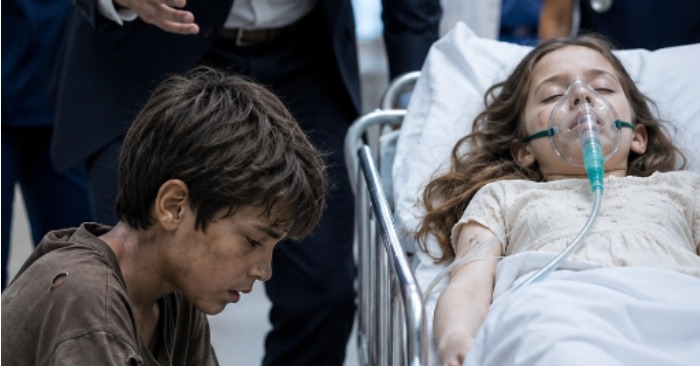
The hallway froze.
The girl was breathing.
Not well.
Not calmly.
But she was breathing.
The sound of air entering through the mask was small, almost invisible beneath the alarms and hurried footsteps.
But to everyone standing there, it sounded like a miracle.
Her father still had his hand raised, caught halfway between pushing the boy away and embracing his daughter.
He did not know what to do.
He did not know what to say.
The boy was still crouched beside the stretcher, his hand under the sheet, holding the oxygen tube so it would not bend again.
His fingers were trembling.
His eyes were wet.
His face was pale.
But he did not let go.
“Don’t move it like that,” he said quietly. “It closes again.”
A nurse hurried over.
She checked the tube.
Then she looked at the boy.
Her expression changed.
“He was right.”
The father froze.
“What?”
The nurse carefully lifted the sheet.
“The line was bent. The flow wasn’t getting through properly.”
The head doctor came running from the end of the hallway.
“What happened?”
The nurse pointed at the boy.
“He saw it.”
The doctor looked at the boy in disbelief.
“You?”
The boy did not answer.
He kept looking at the girl.
She barely opened her eyes.
There were tears on her eyelashes.
She lifted a weak hand.
The boy saw her and moved a little closer.
“It’s okay,” he whispered. “Breathe slowly.”
The girl tried to speak beneath the mask.
She could not.
But her fingers touched the boy’s torn sleeve.
As if she wanted to make sure he was still there.
The father swallowed.
“Who are you?”
The boy lowered his gaze.
“Mateo.”
“What were you doing on this floor?”
Mateo hesitated.
“Waiting for my mom.”
“Does your mother work here?”
“She cleans the rooms.”
The silence became more uncomfortable.
Several employees lowered their eyes.
The father looked at the boy’s clothes as if seeing them for the first time: a worn T-shirt, pants too short, old sneakers.
A few minutes earlier, if he had seen him near his daughter, he would have called security.
Now the boy was holding his daughter’s air with his own hands.
“How did you know about the tube?” the doctor asked.
Mateo clenched his jaw.
The answer cost him.
“Because it happened before.”
The father went still.
“To whom?”
Mateo looked at the floor.
“My sister.”
The whole hallway seemed to lose sound.
Even the monitors seemed farther away.
“She needed oxygen too,” Mateo said. “In another hospital. There were a lot of people. Everyone was running. Everyone was talking.”
Pause.
“But no one looked under the blanket.”
The nurse covered her mouth.
The doctor lowered his eyes.
Mateo continued, not crying yet:
“I was smaller. I didn’t know what to do. I just watched her try to breathe.”
His voice cracked.
“Afterward, they said they had done everything they could.”
Silence.
“But I saw the bent tube too late.”
The father closed his eyes.
The blow hit him directly in the chest.
His daughter was still on the stretcher.
Alive.
Breathing because a boy who had lost someone looked where no one else had looked.
“I’m sorry,” the doctor said softly.
Mateo shook his head.
“I don’t want you to be sorry.”
Pause.
“I want you to look.”
The sentence cut through the hallway.
Simple.
Brutal.
Necessary.
The father stepped closer.
“Mateo…”
The boy tensed, as if waiting for an order, an accusation, an expulsion.
But the man did not shout.
He knelt in front of him.
There, on the shining hospital floor.
With his expensive suit touching the ground.
“Thank you.”
Mateo did not raise his eyes.
“I didn’t do it for you.”
“I know.”
The man looked at his daughter.
“You did it for her.”
Mateo nodded faintly.
The girl moved her fingers again, still holding his sleeve.
The doctor spoke urgently:
“We have to take her to observation.”
Mateo let go of the tube only when the nurse had secured it properly.
Before pulling his hand away, he checked it again.
Once.
Twice.
Three times.
The nurse noticed.
“It’s positioned correctly.”
Mateo nodded, but he did not look convinced.
“Don’t cover it with the blanket.”
The nurse looked at him with respect.
“We won’t.”
The stretcher began to move.
The girl turned her head toward Mateo.
With effort, she lifted her hand.
She did not want him to leave.
Her father saw it.
And for the first time in his life, he did not think about protocol, permission, or appearances.
“Come with us.”
Mateo blinked.
“I can’t.”
“Why not?”
“I’m not family.”
The girl closed her eyes in pain.
The father took a deep breath.
“Today you are.”
No one contradicted that.
Mateo walked beside the stretcher.
Not in front.
Not behind.
Beside it.
Every few steps, he looked at the tube.
Every few steps, he looked at the girl’s face.
The doctor watched him in silence.
He had seen trained assistants with less attention than that boy.
In the observation room, the girl was finally able to speak a little when they changed her mask.
“Thank you,” she whispered.
Mateo lowered his head.
“I only saw the tube.”
She shook her head.
“Everyone was here.”
Pause.
“But you were the only one who saw me.”
The boy pressed his lips together.
That sentence broke him.
Because his sister had said something similar once.
Not with those words.
But with the same look.
Mateo’s mother arrived running minutes later, frightened, still wearing her cleaning uniform.
“Mateo, what happened?”
She hugged him tightly.
Then she saw the father.
The doctors.
The girl.
And fear filled her face.
“I’m sorry if he caused trouble. He wasn’t supposed to—”
The father stood up.
“Your son saved my daughter.”
The woman froze.
“What?”
Mateo looked at his mother.
Finally, he cried.
Not loudly.
Not as a spectacle.
He cried like a boy who had held a scene for too long without anyone helping him carry it.
His mother hugged him tighter.
“My love…”
The father watched them.
For the first time, he understood something that left him defenseless.
He had money for doctors, private hospitals, specialists, bright rooms, and ambulances ready to go.
But his daughter’s life had depended on the eyes of a boy whom probably no one ever invited to sit in that same hospital.
The doctor approached Mateo.
“You have an incredible instinct.”
Mateo wiped his face.
“It’s not instinct.”
Pause.
“It’s fear.”
No one spoke.
“Since my sister, I look at everything.”
The girl in the bed listened.
“That is helping too,” she said.
Mateo looked at her.
“What?”
“Looking even when it hurts.”
The silence that followed was gentle.
Not comfortable.
But human.
The father took a deep breath.
“What was your sister’s name?”
Mateo took a moment to answer.
“Lucía.”
The girl smiled weakly.
“Then Lucía helped me too.”
Mateo closed his eyes.
That sentence was too much.
His mother cried silently.
The father stepped closer to her.
“I want to help you.”
The woman tensed.
“We don’t need charity.”
“It isn’t charity.”
He looked at Mateo.
“It’s a debt.”
Mateo shook his head.
“I don’t want money.”
“Then tell me what you want.”
Mateo looked at the girl.
Then at the doctor.
Then at his mother.
“I want hospitals to teach people to look.”
The doctor lowered his gaze.
The father did not answer immediately.
Because that request was bigger than a check.
More uncomfortable.
More real.
“We’ll do it,” he finally said.
Mateo looked at him with distrust.
“Really?”
“Really.”
Weeks later, the hospital began a new internal protocol.
Nothing spectacular.
Nothing for cameras at first.
Just one rule written in every emergency room:
“Before moving a patient, check what cannot be seen.”
Tubes.
Straps.
Blankets.
Wheels.
Lines.
Breathing.
Small details.
Details that can separate a life from a loss.
Mateo was invited to a training session.
Not as a doctor.
Not as an expert.
As a witness.
He stood in front of nurses, stretcher attendants, and doctors with a sheet of paper in his hand.
At first, he could not speak.
Then he breathed.
And said:
“My sister didn’t die because no one wanted to help her.”
Pause.
“She died because everyone was helping too fast.”
The room went silent.
“Please, look slowly.”
He did not need to say more.
The girl, whose name was Amelia, recovered.
Not immediately.
Not without fear.
But she began breathing properly again.
Every time she saw Mateo, she raised two fingers and pointed to the oxygen tube like a small secret greeting.
He smiled.
Sometimes.
Not always.
Because some wounds do not close quickly.
But they begin to hurt differently when they help save someone else.
Months later, Amelia’s father funded a pediatric patient safety program in Lucía’s name.
Mateo’s mother cried when she saw the plaque.
Mateo said nothing for a long time.
Then he touched the letters with his fingers.
And whispered:
“Now they saw you.”
Because that day in the hospital, a poor boy did not perform a miracle.
He had no technology.
No title.
No power.
He only had a painful memory and the courage to use it.
And sometimes the greatest help is born exactly there:
from a wound that decides not to repeat itself in another body.