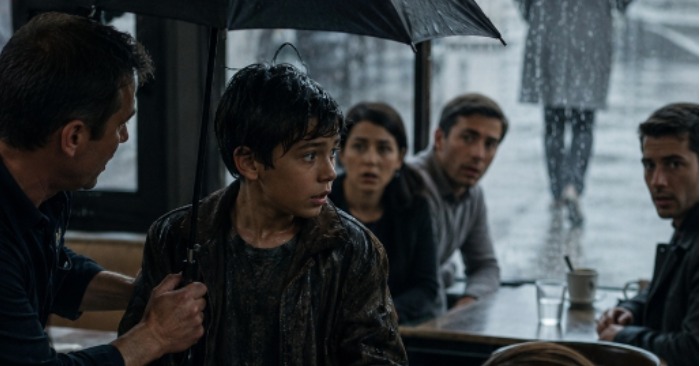
The café went completely still.
The black umbrella was still open in the middle of the place, dripping onto the floor.
The boy stood by the door, soaked, his arm still held by the manager.
The elegant woman held the photo with trembling fingers.
In the image was a young girl of about seventeen, sitting at a bus stop, looking to one side as if she didn’t know someone was photographing her.
On her wrist, she wore a red ribbon.
The same ribbon the woman had tied to her daughter’s bag the week before.
—That’s my daughter —she whispered.
The manager slowly let go of the boy.
—What is going on?
The boy didn’t answer.
He was looking toward the window.
Outside, between the rain and the people crossing in a hurry, a man in a gray coat was walking away from the café.
He wasn’t running.
That was the worst part.
He was walking with the calm of someone who had already done what he came to do.
—He switched the umbrellas —the boy said.
The woman looked up.
—Who is he?
—I don’t know his name.
—Then how do you know he did that?
The boy swallowed.
—Because I saw him yesterday too.
The woman felt her blood run cold.
—Where yesterday?
The boy gripped the umbrella handle.
—At the bus station.
The café remained silent.
All that could be heard was the rain hitting the windows and the coffee machine breathing in the background.
The woman looked at the photo again.
Her daughter.
Her Clara.
The day before, she had said she was going to study with a friend.
She came home late.
Too quiet.
When her mother asked what was wrong, she answered:
“Nothing.”
But her eyes didn’t say nothing.
They said fear.
—My daughter came home with a different umbrella —the woman murmured.
The boy nodded.
—A black one.
—Like this one.
—No.
The boy shook his head.
—Like yours.
The woman didn’t understand.
The boy lowered the umbrella and pointed to the handle.
There was a small mark, almost invisible: two lines carved with some thin object.
—This wasn’t hers.
The woman looked at her own bag.
The umbrella she had brought to the café was black, expensive, elegant, identical to many others.
But now she remembered something.
That morning, as she was leaving home, her daughter had seen the umbrella in the hallway and frozen.
—Where did you find that? —she asked.
The woman answered without thinking:
—It was by the door.
Clara said nothing more.
She only hurried upstairs to her room.
At that moment, her mother had thought it was a teenage reaction, tiredness, a bad mood.
Now everything changed.
—Tell me exactly what you saw —the woman asked.
The boy looked at the manager.
Then at the customers.
He didn’t seem comfortable with so many eyes on him.
The woman lowered her voice.
—Please.
That made him speak.
—Yesterday I was selling tissues near the station. Your daughter was sitting alone, with a black umbrella. That man sat nearby. They weren’t talking. But he was looking at her backpack.
The woman closed her eyes.
—My God…
—Then she stood up to get on the bus. He dropped his umbrella next to hers. When she looked at her phone, he switched the handles.
The manager frowned.
—Why would he switch umbrellas?
The boy opened the umbrella again and carefully slipped his fingers into the inner edge.
He took out a small black piece, the size of a coin.
The woman stepped back.
—What is that?
A man sitting nearby, who had not spoken until then, stood up.
—It looks like a tracker.
The boy nodded.
—My brother taught me to look for those things.
—Your brother? —the woman asked.
The boy’s face changed.
—He used to fix used phones.
Pause.
—Before he left.
No one asked more.
The wound was visible.
The woman carefully took the umbrella, as if it were no longer an ordinary object, but a trap.
—So that man knew where my daughter was.
The boy pointed to the photo.
—And he wanted you to carry the umbrella today too.
The sentence left everyone frozen.
The woman looked at the door.
—Why?
The boy lowered his gaze.
—I don’t know.
Pause.
—But when you came in, he was sitting at the corner table.
Everyone turned toward that table.
It was empty.
Only a half-finished cup of coffee and a folded napkin remained.
The manager went over.
He lifted the napkin.
Underneath was a second photo.
This time, the woman appeared entering her building.
The photo had been taken from the street.
She covered her mouth with her hand.
The boy spoke almost in a whisper:
—That’s why I took the umbrella from you.
Pause.
—I didn’t want you to leave with it.
The woman looked at the boy.
A minute earlier, she had called him a thief.
Now she understood that he had stopped something she couldn’t even name.
—What’s your name?
—Nico.
—Nico… forgive me.
He lowered his gaze.
—Everyone says that afterward.
The sentence hurt.
Because it was true.
After accusing.
After grabbing.
After understanding.
After.
The man who seemed to know about trackers called the police.
The manager locked the front door.
Someone checked the café cameras.
On the screen, they saw everything.
The man in the gray coat entering before the woman.
Sitting in the corner.
Looking toward the door.
Watching the umbrella.
Waiting.
When the woman entered, she left the umbrella near the umbrella stand.
The man stood up.
Took another identical umbrella.
Switched something with a quick movement.
Sat back down.
Then, when Nico entered soaked and saw the umbrella in the woman’s hand, his face changed.
He ran.
Everyone had already seen the rest.
The woman asked to call her daughter.
She dialed once.
Nothing.
She dialed again.
Still nothing.
Her breathing quickened.
—She isn’t answering.
Nico looked at the photo.
—Does she have a friend she’s usually with?
—Yes.
The woman called the friend.
The answer came on the third ring.
—Is Clara with you?
There was a pause.
Too long.
The woman closed her eyes.
—Answer me.
The friend’s voice trembled on the other end.
—She left twenty minutes ago. She said she was going to meet you.
The woman almost dropped the phone.
—Me?
—Yes. She got a message from your number.
The woman looked at Nico.
Nico looked at the umbrella.
The tracker.
The key.
The photo.
Everything was beginning to form a horrible shape.
—I didn’t text her —the woman said.
The manager closed his hand around the back of a chair.
—We have to find her.
The police were already on the way, but the woman couldn’t wait sitting down.
Nico moved closer to the photo.
He studied it carefully.
—That stop is near the tunnel.
The woman turned toward him.
—What tunnel?
—The underpass by the station. There aren’t many cameras there.
The man checking the tracker looked up.
—If they’re luring her with a fake message, they may want to take her somewhere without surveillance.
The woman felt her legs failing her.
—My daughter…
Nico picked up his old backpack.
—I know how to get there.
The woman looked at him.
—No. It’s dangerous.
He answered without hesitation:
—For her too.
The sentence silenced her.
The manager spoke:
—I’m going with you.
Two customers offered as well.
But Nico shook his head.
—If too many of us go, he may see her and move.
The woman looked at him desperately.
—Then what do you suggest?
Nico pointed to the umbrella.
—You leave without it. I leave through the back. If he’s watching, he’ll keep thinking you don’t know anything.
—And Clara?
—We look for her near the stop.
The woman didn’t know whether to take advice from a child.
But that child had seen more in ten minutes than all the adults together.
The police said a patrol was five minutes away.
Five minutes could be little.
Or too much.
The woman took a breath.
—You’re not going alone.
Nico nodded.
—Then quickly.
They left through the café’s back door.
The rain was still falling.
The city seemed normal.
People crossing.
Cars passing.
Umbrellas opening.
No one knew that a terrible story could be hidden inside such an ordinary object.
They reached the station in a few minutes.
Nico went ahead, watching corners, glass, reflections.
The woman followed him, her heart pounding in her chest.
—How do you know how to look like that? —she asked.
Nico didn’t stop.
—When you don’t have money, you learn to notice who looks at you too much.
The sentence pierced her.
They went down toward the underpass below the station.
The light there was colder.
The sound of the rain faded a little.
There were old posters, damp walls, and footsteps echoing from far away.
Nico stopped.
He raised a hand.
—Listen.
The woman held her breath.
In the distance, behind a column, a young voice could be heard.
—Mom?
The woman almost shouted, but Nico gently covered her mouth with one hand.
He pointed toward a reflection in a broken piece of glass.
Clara was there.
Standing.
With her phone in her hand.
In front of her, the man in the gray coat was speaking calmly.
Too close.
The woman felt the world stop.
Nico picked up a small stone from the ground and threw it toward the opposite side of the tunnel.
The sound bounced.
The man turned his head.
In that second, Clara saw her mother.
Her eyes opened wide.
The mother raised one finger to her lips.
She did not move.
Nico pointed toward a side exit.
Clara understood.
She began walking slowly to the side, pretending to look at her phone.
The man turned back.
—Where are you going?
Clara froze.
Then the siren sounded.
The patrol had arrived above.
The man in the gray coat reacted.
He tried to grab Clara by the arm.
The mother shouted:
—Clara, run!
Clara ran.
Nico came out from behind the column and pushed an abandoned cart into the man’s path.
He didn’t hit him.
He only blocked him.
The man stumbled just enough for two officers to run down the stairs and stop him.
Clara reached her mother’s arms.
The hug was desperate.
Broken.
Alive.
—I thought it was you —Clara cried—. He wrote to me from your number.
The woman held her tightly to her chest.
—It wasn’t me. It wasn’t me.
Nico stood a few steps away, soaked again.
He didn’t come closer.
He didn’t want to interrupt.
But Clara saw him.
—Who is he?
Her mother looked at Nico through tears.
—The boy who didn’t let me leave with your umbrella.
Clara looked at the black umbrella in an officer’s hands.
Her face changed.
—That umbrella…
Nico nodded.
—It wasn’t yours.
Clara began to cry harder.
—I knew it. I felt something was wrong, but I thought I was exaggerating.
Her mother took her face between her hands.
—I will never again tell you you’re exaggerating when you’re afraid.
That promise came out of her like a confession.
Because she remembered all the times Clara had said:
“I feel like someone is following me.”
And she had answered:
“It’s probably tiredness.”
“It’s probably nothing.”
“You’re probably nervous.”
Now she understood that sometimes a daughter’s fear does not need a perfect explanation to deserve attention.
The police later confirmed that the man had used the umbrella to track routines, buildings, and movements. He had also copied contacts from Clara’s phone on an earlier occasion, when she left it on a table at the station.
The key belonged to a nearby locker.
Inside, they found other objects.
Other umbrellas.
Other photos.
Other people being watched.
The story was bigger than it seemed.
But for the woman, everything came down to one instant:
a boy everyone called a thief opened an umbrella in a café and saved her daughter from walking further into a trap.
That night, Clara and her mother returned to the café.
Nico was sitting at a back table with a cup of hot chocolate the manager had given him.
When Clara came closer, he quickly stood up.
—You don’t have to—
She hugged him.
Nico stayed stiff at first.
Then his shoulders lowered.
—Thank you —Clara whispered.
He looked at the floor.
—I only saw the umbrella.
—No.
Her mother came closer too.
—You saw what we couldn’t see.
Nico swallowed.
—My brother used to say objects tell stories.
Clara looked at the black umbrella, now inside a police evidence bag.
—That one told a very ugly story.
Nico nodded.
—But it ended before it got worse.
The mother asked him:
—Where is your brother?
Nico lowered his gaze.
—He didn’t come back one night.
Silence arrived suddenly.
Clara then understood why Nico looked the way he did.
Why he noticed small things.
Why he couldn’t ignore a swapped umbrella, a hidden photo, a man walking too calmly in the rain.
Nico wasn’t curious.
He was someone who had learned to search after losing.
The mother didn’t try to fill him with promises.
She only said:
—Then today your eyes brought someone back.
Nico closed his eyes.
That phrase hurt him.
But it also gave him something almost like peace.
Days later, the café placed a small rule near the umbrella stand:
“Check your umbrella before leaving. If something doesn’t seem yours, report it.”
The police used the case to warn neighbors about swapped objects, trackers, and small signs.
Clara returned to school.
Her mother started listening differently.
And Nico kept coming by the café on rainy days.
Sometimes the manager gave him chocolate.
Sometimes Clara sat with him.
Sometimes they didn’t talk about the man in the gray coat.
Or the umbrella.
Or the tunnel.
They simply watched the rain fall.
But every time someone picked up the wrong umbrella while leaving, Nico looked up.
Because he had learned that mysteries don’t always begin with a locked door or a dark night.
Sometimes they begin with something as simple as a black umbrella in an ordinary café.
And a question almost no one asks:
what if what you’re carrying in your hand didn’t get there by accident?