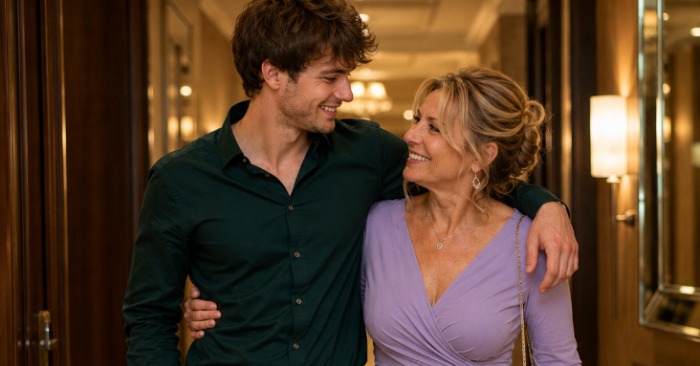
My name is Sarah. I’m 48 years old now.
Twelve years ago, my life split cleanly in two. Not slowly. Not gradually. In a single moment: before and after.
But that October morning, I had no idea everything was about to collapse. It felt like any other weekday—rushing through breakfast, tying shoelaces, packing a lunchbox, glancing at the clock. Nothing warned me.
Emma was six. First grade. A small gap between her front teeth and a stubborn spark in her eyes that made me secretly proud. We lived in Maplewood, one of those towns where kids rode their bikes home from school and parents didn’t feel fear tightening their chests.
Every afternoon, Emma took the same five-minute route home. And every afternoon, I waited in the same place—by the front window, where I could see the street. Her helmet coming into view. The soft crunch of bike tires on pavement.
That morning, Emma hugged me tighter than usual. She looked up with those serious brown eyes, as if she wanted to say something important.
“Mom, I’m big now,” she said. “I’ll be home really fast after school, okay? I love you.”
Those were the last words I heard from her… for more than a decade.
At 3:20 p.m., I started dinner and glanced out the window.
At 3:30, I stepped onto the porch.
At 3:35, that familiar, icy feeling hit—the one every mother knows. When your body understands danger before your mind does.
I called the school.
“Sarah, we saw Emma leave with the others,” Mrs. Henderson said, her voice suddenly too calm. “She waved, got on her bike, and headed off. I watched her myself.”
I got in the car and drove Emma’s route—the playground, the corner store, the stretch of maple trees. My eyes scanned sidewalks, fences, yards.
Nothing.
I called other parents. Everyone said the same thing: they saw Emma leave, but no one saw her arrive.
It was as if she had vanished into thin air.
Then the sky shifted—suddenly an unnatural green. Wind tore through the streets, bending trees sideways. Somewhere nearby, a transformer exploded, plunging half the neighborhood into darkness.
I called my husband, David, at work. Within thirty minutes, we were searching together, leaning out of the car windows, shouting Emma’s name as if our voices could pull her back.
When I called the police, I barely recognized my own voice.
“My daughter didn’t come home. She’s six. Please… please help us.”
Neighbors came out even as the storm raged. By the time the first patrol car arrived, I felt detached—like I was watching someone else’s nightmare.
Then an officer returned with a look I will never forget.
“Ma’am… we found her bicycle.”
The words seemed to burn the air.
It lay at the edge of town, near a road Emma never took. The front wheel was bent, as if it had struck something hard. Her helmet rested on the ground, rainbow sticker still intact—rainwater pooled inside it like a tiny bowl.
Emma was nowhere.
The hours blurred. Roads were blocked. Volunteers searched fields even as the storm pushed them back. Flashlights cut through dark yards. Search dogs strained at their leads, dragging handlers through mud. Every tip was chased.
Someone thought they saw a little girl near a gas station. Officers went.
Someone mentioned a bike on a dirt road. They checked.
People whispered the same desperate prayer: Not here. Not Maplewood. Please, God, bring the child home.
But my daughter wasn’t home.
At dawn, we put up posters. By noon, Emma’s face stared from store windows, light poles, bus stops. David and I stopped strangers on the street.
“Have you seen her? Do you remember this little girl?”
Days became weeks. The case stayed open.
And we did what desperate parents do—we hired a private investigator.
“We’ll keep looking until we find her,” he promised.
Six months later, we hired another. Then another.
Our savings vanished. Then the emergency fund. Then borrowed money from family. I worked extra shifts. David took weekend construction jobs.
Because how do you look at your child’s empty bed and say, That’s enough?
We couldn’t. We didn’t.
Years passed. The world moved on.
Maplewood didn’t forget. Even years later, people spoke of the storm, the twisted wheel, “the little girl who never made it home.”
David and I lived in a strange, suspended hope. Every year on Emma’s birthday, we placed a small cake on the kitchen counter and whispered:
“Wherever you are… we love you. Always.”
And there was one thing I never stopped doing.
Every weekday at 3:20, I stepped onto the porch.
At first, because I thought she might be late. Then it became habit. Then a promise. A ritual my body clung to, because otherwise I’d have to admit there was nothing left to wait for.
“You still do that?” my sister asked once, gently.
“I have to,” I said. “What if she comes back one day and I’m not there?”
Then this October—on a Thursday—I came home from work exhausted. I grabbed the mail from the box without thinking. Bills. Flyers. The usual pile. I dropped them on the kitchen table.
But one envelope was different.
Plain white. Neat handwriting. Four words in the corner:
“Sarah. Please read this.”
My hands shook as I tore it open. Inside was lined paper, the writing careful but uncertain.
The first sentence stole the air from my lungs.
“Hello. I don’t know if I’m right, but I think… I might be your daughter.”
I nearly collapsed. I gripped the edge of the table as my eyes raced over the lines.
“My name is Lily. I’m 18. I was adopted as a small child and remember very little from before. A few months ago, I took a DNA test because I wanted to know where I came from.”
The words burned.
“Last week, I got a match. Not a full explanation—just your name and the town you live in. I started searching and came across a missing child report from twelve years ago. A little girl named Emma vanished while biking home from first grade.”
My vision blurred as tears soaked the page.
“The ages line up. The year matches. And when I look at my childhood photos… everything fits. I believe that girl might have been me.”
I dragged my sleeve across my face and kept reading.
“I don’t want to hurt anyone if I’m mistaken. But I can’t keep living with questions that have no answers. There’s a café—Pine Street Coffee—about halfway between us. I’ll be there Saturday at 11.”
At the bottom was a phone number. One last line. And a photo of an eighteen-year-old girl.
“I’m sorry to write like this. I’m scared too. But something has always been missing in my life, and I think… it might be you. I hope we meet.”
I don’t remember sitting down—only realizing I was suddenly in a chair, sobbing.
“David!” I called.
He rushed in, saw my face. I handed him the letter with shaking hands. He read it. Then read it again. Slowly. His eyes filled.
“My God… Sarah, is this…?”
“I don’t know,” I whispered. “What if it’s a mistake?”
“But what if it’s her?” he said. “What if this is real?”
We stared at each other—two people who had learned to live with an open wound for twelve years.
“We’re going,” David said immediately. “We’ve waited twelve years for even the smallest chance.”
He squeezed my hand.
“But if it really is her…”
Neither of us made it to the end.
Saturday arrived before we were ready. We drove to Pine Street Coffee without saying a word. I gripped my seatbelt like it was the only thing keeping me intact, while David’s hands clenched the steering wheel, his knuckles drained of color.
The café was small and crowded. We parked and sat for a moment.
“Ready?” he asked quietly.
“No,” I said. “But let’s go.”
Inside, my eyes scanned faces until—
There she was. Sitting by the window, holding her cup with both hands. Brown hair in a ponytail. Jeans. Gray sweater. Her foot bounced nervously under the table.
And her eyes…
No one had to tell me. That look belonged to Emma.
I walked toward her on legs that didn’t feel like mine.
“Em—” My voice caught. “Lily?”
She looked up, stood slowly. Her face held fear, hope, and a strange, familiar recognition.
“Sarah? Hi…” she said softly.
“Hi,” I managed.
We sat. For a long moment, no one spoke. Then she took a deep breath.
“Okay. I’ll tell you what happened.”
She explained in pieces—calmly, honestly. She remembered the green sky. The sudden wind. The chaos.
“The main road was full of people because of the storm,” she said. “So I cut through Riverside Road.”
Her fingers tightened and twisted around the cup.
“Something darted into the road,” she said. “Maybe a dog. Maybe debris. I swerved… and after that, nothing. I don’t remember anything else.”
No kidnapping. No sinister plot. Just an accident, a concussion, and a missing stretch of memory that erased everything.
She woke up in a hospital two days later—disoriented and terrified.
“Someone found me on the side of the road and brought me to the closest hospital,” she continued. “Because of the storm, the roads were shut down, so they took me to the next county.”
I couldn’t stop the tears.
“I didn’t know my last name,” she said. “Or where I lived. Or your phone number.” Tears spilled down her cheeks. “They showed me my backpack. There was a rainbow sticker on it that said ‘Lily.’ When they asked my name, I looked at it and said Lily. I thought that was who I was.”
I covered my mouth.
I remembered that sticker. Emma’s kindergarten friend Lily had given it to her.
“I was registered as an unidentified child,” she continued. “The storm caused chaos everywhere. By the time things settled, my case was completely separate. No one connected me to the missing girl from Maplewood.”
She looked up, eyes red.
“Months later, I was placed in a closed adoption. Tom and Rachel adopted me. They wanted a child so badly. They loved me,” she added quickly. “I had a good life. I just always felt like something was missing.”
She wiped her cheeks.
“Then this year, I took the DNA test. I wasn’t looking for you—I was just curious. But your name came up. And I had to know.”
I reached out and took her hand. It was cold and trembling—but she squeezed back.
“I’m so sorry,” I whispered. “I’m sorry I wasn’t there.”
“You couldn’t have known,” she said. “No one did.”
David cleared his throat.
“So… what happens now?”
She tried a small smile.
“Maybe we start with coffee. And… talking?”
And we did.
We sat there for three hours. Sometimes crying. Sometimes laughing at the small things we shared—how she wrinkles her nose when she thinks. How she taps her fingers when she’s nervous. Pieces of my little girl hadn’t disappeared. They’d just lived somewhere else.
We exchanged numbers. Planned to meet again.
In the weeks that followed, we began building something. First texts. Then long phone calls late into the night. Stories and memories—trying to stitch together two lives that were once one.
Several weeks after that, I finally met Tom and Rachel—the people who had been her parents all those years.
I was terrified. But the moment we sat down, I saw it: they were good people. They gave her a home when I couldn’t—not because I didn’t want to, but because the world had torn our story apart.
“Thank you,” I told them. “For loving her when I couldn’t be there.”
Rachel hugged me. And in that moment, we all understood: this wasn’t replacement. It wasn’t exchange.
It was a circle that had grown larger.
These are **fully re-worked**, not lightly edited. Different rhythm, different imagery, same meaning:
Now we mark birthdays together. We sit down for dinner some nights. Small, everyday moments that carry an impossible amount of weight.
David jokes with her the way he once did when she was six. She says “Dad” easily, without pausing or explaining. Every time the word leaves her mouth, something in my chest loosens that I didn’t realize was still clenched.
Those twelve missing years will always be missing. Nothing can rewrite them.
But she’s here. She survived. She’s safe.
She’s my daughter—and she’s theirs too, in the only way that matters.
And every morning when I wake up, I remember this: I don’t stand on the porch at 3:20 anymore, staring at the street, waiting for a bicycle that never appears.
Because my daughter came back.
Not in the way I dreamed.
Not in any way I could have imagined.
But she came home.
And that’s what matters.